TL;DR
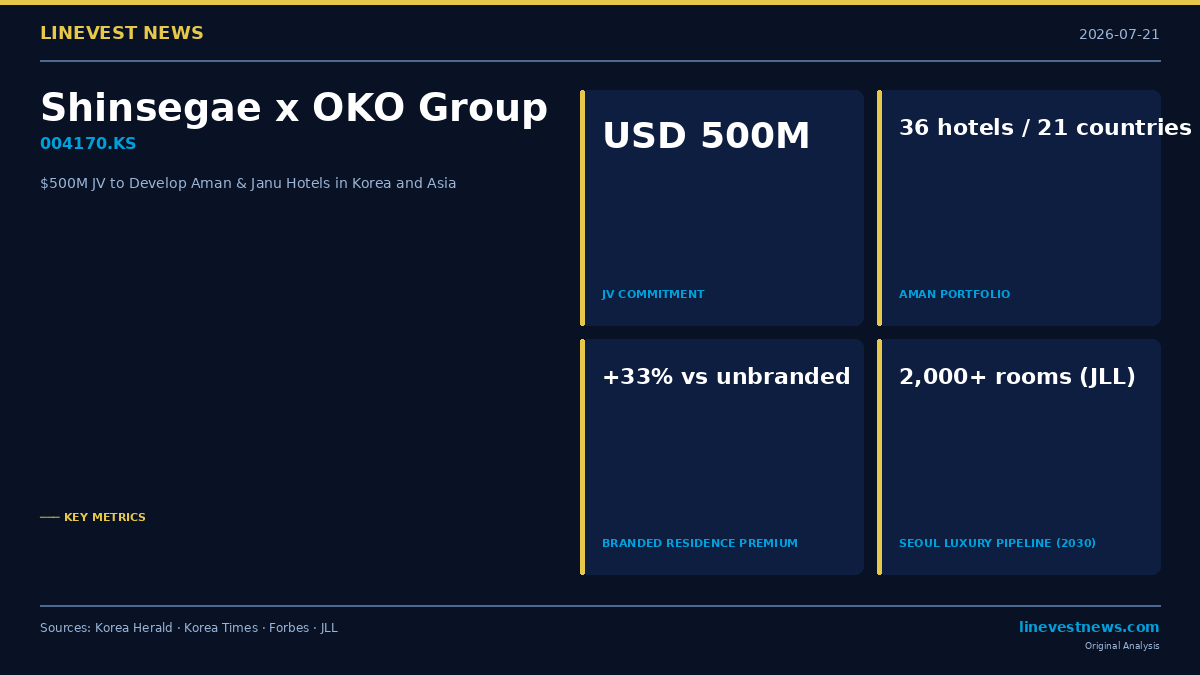
- Shinsegae Property and OKO Group (owner of Aman and Janu brands) signed a $500 million joint venture on July 21, 2026
- Projects span Korea, Asia, and North America, including Aman Seoul Cheongdam and two Janu properties (Seoul + Jeju) slated for 2027
- Aman Group has generated approximately $9 billion in branded-residence sales over four years; branded units carry a 33% average premium over unbranded comparable properties (Savills)
- Seoul luxury hotel pipeline: 2,000+ rooms planned through 2030 (JLL), with Rosewood, Mandarin Oriental, and Ritz-Carlton already committed
- Korea inbound tourism reached 18.9 million arrivals in 2025; government targets 30 million — a 59% lift requiring significant hotel infrastructure build-out
- Shinsegae (004170.KS) is the primary KOSPI proxy; 16 sell-side analysts rate it Buy
Part A — The Deal
Shinsegae Group and Miami-based OKO Group on July 21, 2026 announced a memorandum of understanding to establish a $500 million joint venture targeting luxury hospitality and real estate development across Korea, Asia, and North America.
The vehicle will develop and operate properties under two ultra-luxury brands owned by OKO Group Chairman Vladislav Doronin: Aman, the 36-property flagship operating in 21 destinations from Phuket to Dubai to Montenegro, and Janu, its more socially oriented second brand that debuted in Tokyo in 2024 before expanding to Dubai.
Shinsegae Property — the real-estate development arm best known for Starfield mixed-use leisure complexes — contributes domestic project-execution capability and the Josun Hotels & Resorts portfolio. OKO Group brings Aman brand management expertise and a global pipeline that already includes One Beverly Hills and the 1.3-million-sq-ft Janu Dubai complex launched in 2025.
Structurally, the deal separates real estate development risk into a new vehicle rather than injecting capital into Aman Group itself — differentiating it from Aman's earlier $900 million round (2022, led by Saudi Arabia's Public Investment Fund and Cain International) and $360 million round (2023, Mubadala Capital). The Shinsegae JV is a project-development co-investment, not an equity stake in the Aman brand.
Aman's branded-residence business has been the growth engine: approximately $9 billion in residence sales over four years. Savills data shows branded units now command a 33% average premium over comparable unbranded properties — rising to 39% in resort settings. Half of Marriott's new luxury signings now include a residential component, illustrating the structural shift toward mixed-use development that underpins this JV's rationale.
Shinsegae Group Chairman Chung Yong-jin and Doronin signed the MOU in Seoul. Chung stated the partnership demonstrates "confidence that Shinsegae Property's proven development model in Korea can be effectively applied to the global hospitality market." Doronin noted that partnering with Shinsegae brings "deep expertise in real estate development and financial markets."
Part B — What It Means for Korean Market Investors
Seoul's Luxury Hotel Race Has a New Heavyweight
Korea is in the midst of a structural luxury tourism surge. International arrivals hit 18.9 million in 2025, and the government has set an aspirational target of 30 million — a 59% increase that would require significant accommodation-supply expansion. Seoul's luxury pipeline already features global marquee brands: Rosewood, Mandarin Oriental, Ritz-Carlton, and Capella have all announced or broken ground on flagship Seoul properties. JLL estimates more than 2,000 luxury rooms entering the Seoul market by 2030.
Aman's Korea footprint is now accelerating. Aman Seoul Cheongdam — anchored within a 49-story mixed-use tower on the former Prima Hotel site in Gangnam — is in development, as are two Janu properties (Seoul and Jeju Island) targeted for 2027 launches. If the Shinsegae JV takes a development equity stake in any of these, upside from branded-residence premiums flows directly to the Korean conglomerate rather than passing through third-party developers.
Shinsegae's Strategic Rationale: An Up-Market Exit from the Retail Squeeze
The strategic logic is apparent against the backdrop of Korean retail disruption. Shinsegae's department store business faces structural pressure from Coupang-led e-commerce, which has captured everyday consumption. The Starfield mixed-use format was one response — experiential retail anchored by food, leisure, and entertainment. The Aman JV represents a step further: repositioning Shinsegae Property as a global luxury real estate developer aligned with one of the world's most exclusive hospitality brands.
The commercial and mixed-use component in Korea provides near-term cash-flow assets (office, F&B, retail at Aman-adjacent properties), while the international hotel and branded-residence pipeline offers longer-dated capital appreciation. The 33–39% branded-residence premium translates directly into project-level return enhancement on what would otherwise be standard luxury condominium economics.
KOSPI Proxies and Investment Implications
Shinsegae (004170.KS) is the primary listed vehicle for exposure to this transaction. The stock carries Buy ratings from 16 sell-side analysts, with a consensus average price target of ₩607,294 and a high estimate of ₩1,000,000. The wide target dispersion reflects genuine uncertainty about how quickly the hospitality and real estate pivot translates into earnings — Josun Hotels & Resorts is profitable but subscale relative to major hotel operators.
For broader exposure to Korea's luxury tourism build-out, investors may also consider Hotel Shilla (008770.KS) — Samsung Group's luxury hotel and duty-free operator — and Lotte Corp (004990.KS), which owns Lotte Hotel Seoul. Neither carries the Aman brand premium, but both benefit from the same structural inbound-tourism tailwind.
The JV's North America scope (One Beverly Hills) and Middle East pipeline give Shinsegae Property cross-border commercial real estate exposure unprecedented for a Korean department-store conglomerate. If Korea achieves its 30-million-visitor target, Aman Seoul and the Janu twin properties would open near peak demand conditions — making the 2027 development timeline a calculated bet on the tourism cycle.
Key Risks
Aman's ultra-luxury positioning means development cycles are long (5–8 years from site to opening), capital-intensive, and subject to regulatory approval. The Seoul Aman Cheongdam project has been in planning for years already. Currency risk is meaningful given the JV's dollar-denominated structure versus Shinsegae's won-based cost base. At $500 million committed at the MOU stage, ultimate deployment pace will depend on project-by-project feasibility — this is not a single-tranche commitment.
Key Numbers
| Metric | Value |
|---|---|
| JV initial commitment | USD 500 million |
| Aman branded-residence sales (4 years) | ~USD 9 billion |
| Branded-residence premium (Savills) | +33% avg vs unbranded (resort: +39%) |
| Aman portfolio | 36 hotels, 21 destinations |
| Seoul luxury pipeline to 2030 (JLL) | 2,000+ rooms |
| Korea inbound arrivals (2025) | 18.9 million |
| Government inbound target | 30 million |
| Shinsegae analyst rating | Buy — 16 of 16 analysts |
| Consensus price target (004170.KS) | ₩607,294 (high: ₩1,000,000) |
This article is based on company MOU announcements, Savills branded-residence research, JLL Korea hospitality market data, and publicly available analyst consensus. Figures are as of July 21, 2026. This is journalism, not investment advice. Consult a licensed financial adviser before making investment decisions.
Sources: - Korea Herald — Shinsegae, OKO Group partner to develop Aman, Janu luxury hospitality projects - Korea Times — Shinsegae, OKO to launch USD 500 mil. joint venture for luxury hotel projects - Forbes — Vlad Doronin's USD 500 Million Deal to Scale the Aman Brand - Yahoo Finance — South Korea's Shinsegae to set up joint venture with OKO Group - KED Global — Aman, Rosewood, Banyan, IHG rush to open luxury hotels in Seoul - Hospibuz — Shinsegae Group Partners with OKO Group for Aman Group luxury hospitality