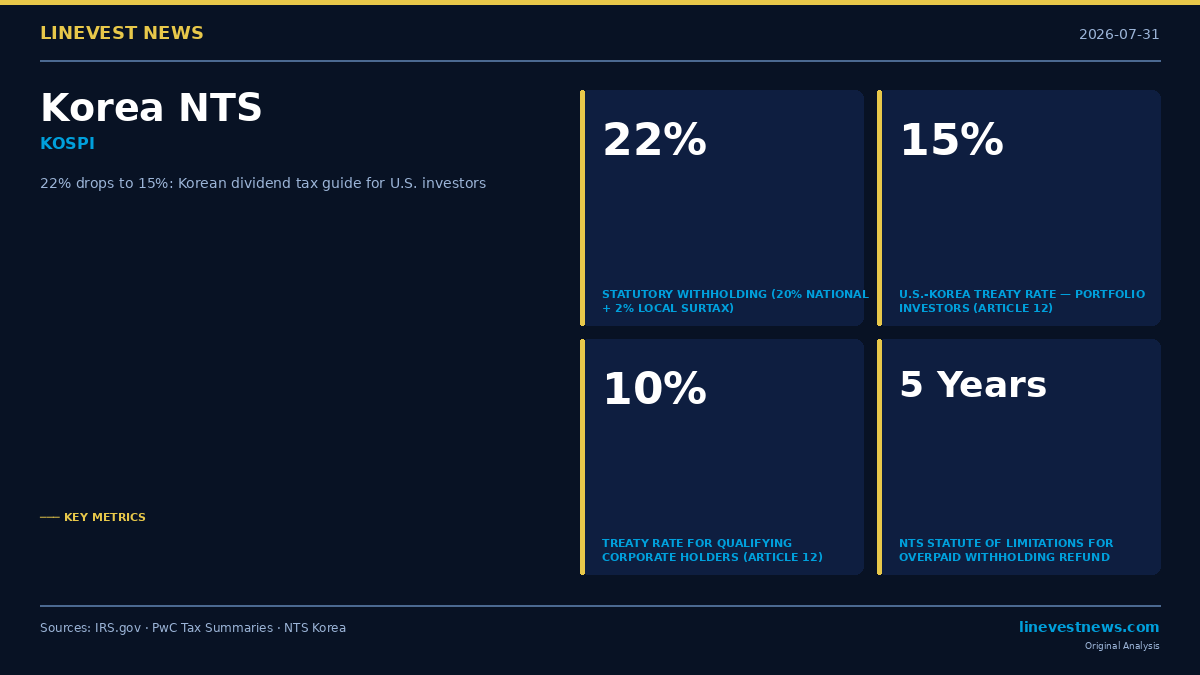
TL;DR - South Korea withholds 22% on dividends paid to foreign shareholders (20% national tax + 2% local surtax). - U.S. investors qualify for a 15% treaty rate (or 10% for qualifying corporate holders) under Article 12 of the U.S.–Korea Income Tax Convention. - Sponsored ADR holders (e.g., SKHY for SK Hynix, listed on Nasdaq in July 2026) generally receive the treaty rate automatically from the depositary bank. - Korean withholding tax up to the treaty rate (15% for most U.S. investors) can be claimed as a Foreign Tax Credit on IRS Form 1116, reducing your U.S. tax liability dollar-for-dollar.
What Is South Korea's Dividend Withholding Tax?
South Korea imposes withholding tax (원천징수) on dividends paid to non-resident individuals and foreign corporations. Individuals are governed by the Income Tax Act (소득세법, §156); corporations by the Corporate Income Tax Act (법인세법, §98). The tax is collected at source — the Korean company deducts it before sending the dividend to you.
Statutory rates (without treaty):
| Tax Component | Rate | Basis |
|---|---|---|
| National income tax (국세) | 20% | Gross dividend |
| Local income surtax (지방소득세) | 2% | Gross dividend (= 10% × the 20% national tax) |
| Effective total | 22% | Gross dividend |
Source: NTS (National Tax Service of Korea), Income Tax Act §156 / Corporate Income Tax Act §98
These rates apply unless a reduced rate is available under a bilateral tax treaty between South Korea and the investor's country of residence. South Korea maintains an active treaty network covering approximately 97 countries.
U.S.–Korea Tax Treaty: Your Reduced Rate
The United States and South Korea have maintained an income tax treaty since 1979 (signed June 4, 1976; entered into force October 20, 1979). Article 12 of the Convention sets maximum withholding rates on dividends:
| Investor Type | Rate |
|---|---|
| Individual / Portfolio investor (minority stake) | 15% |
| Corporate beneficial owner owning ≥ 10% of voting stock of the payer (subject to Article 12 conditions) | 10% |
Source: IRS — U.S.–Republic of Korea Income Tax Convention, Article 12
For most U.S. retail investors, the 15% rate applies. You save 7 percentage points compared to the non-treaty 22% rate.
Important limitation on the Foreign Tax Credit: Under IRC §901 and U.S. Treasury Regulations, tax withheld in excess of the applicable treaty rate is not a compulsory payment and is therefore not creditable on IRS Form 1116. If 22% is withheld when 15% applies, only the 15% portion is creditable; the excess 7% must be recovered through the Korean refund process described below.
Key 2026 Documentation Rule
Effective January 1, 2026, Korean withholding agents must submit applications for reduced treaty rates — along with beneficial ownership supporting documents — to the National Tax Service (NTS) district tax office by the end of February of the year following the year the dividend income is paid. This places more compliance responsibility on the Korean payer (broker or depositary bank), but the treaty rates themselves are unchanged.
Holding Korean Stocks as Sponsored ADRs: What Happens to Your Dividend?
Many U.S. investors access Korean equities through sponsored American Depositary Receipts (ADRs) in standard U.S. brokerage accounts. Here is how the dividend flow works for a sponsored ADR program:
- Korean company declares a dividend in Korean Won (KRW).
- Korean withholding agent deducts the applicable treaty rate (typically 15% for U.S. holders) and remits the balance to the depositary bank.
- Depositary bank (e.g., JPMorgan or Citibank) converts the net KRW amount to USD at the prevailing exchange rate.
- ADR pass-through fee of approximately USD 0.01–0.03 per ADR share is deducted to cover administrative costs.
- Net dividend is credited to your U.S. brokerage account in USD.
- At year-end, your broker reports the gross dividend and Korean withholding tax on your IRS Form 1099-DIV (Box 7 shows foreign taxes paid).
Illustrative example: A Korean company pays a KRW 5,000 dividend per share (ADR ratio 1:1). At KRW/USD 1,453, the gross dividend is approximately USD 3.44. After 15% Korean withholding (USD 0.52) and a USD 0.02 ADR fee, you receive roughly USD 2.90 per ADR — before U.S. income tax.
Note on unsponsored OTC quotations: Some Korean stocks trade in the U.S. via unsponsored OTC quotations (e.g., SSNLF for Samsung Electronics), which have no sponsoring depositary bank providing automatic treaty-rate administration. Tax treatment for unsponsored OTC holders may differ — consult your broker or tax professional.
Holding Korean Stocks Directly on the KRX: The Paperwork
Foreign investors who hold Korean shares directly through a Korean brokerage or global custodian must actively claim the treaty rate to avoid the full 22% statutory withholding.
Step 1 — File IRS Form 8802: Submit IRS Form 8802 (Application for U.S. Residency Certification) to the IRS with the required user fee. The IRS will issue Form 6166 (Certificate of Residency), which certifies your U.S. tax residency for treaty purposes. The Form 6166 letter must be dated within the prior 12 months.
Step 2 — Submit Treaty Claim Before Payment Date: Provide the Form 6166 letter plus a completed 제한세율 적용신청서 (Application for Entitlement to Reduced Tax Rate — NTS prescribed form, available from your Korean broker or custodian) to the withholding agent before the dividend payment date (the day the dividend is actually disbursed). The agent then applies the 15% rate.
Step 3 — Agent Reports to NTS: Under 2026 rules, your agent electronically files the application and supporting documents with the NTS district tax office by the end of February of the following year.
If documentation is missing at payment: The agent must withhold at the full 22% rate. You can then apply for a refund (see below).
Claiming U.S. Foreign Tax Credit (Form 1116)
Korean withholding tax on dividends — up to the applicable treaty rate — qualifies as a creditable foreign income tax under IRC §901. U.S. individual investors file IRS Form 1116 (Foreign Tax Credit — Passive Category Income) with their annual tax return.
| Form 1116 Field | What to Enter |
|---|---|
| Country | Republic of Korea |
| Foreign taxes paid | Box 7 of Form 1099-DIV (Korean taxes withheld, up to the treaty rate) |
| Income category | Passive income |
| Claim on Form 1040 | Schedule 3, Line 1 |
Key rules: - The credit reduces your U.S. tax dollar-for-dollar, subject to the foreign tax credit limitation (foreign income ÷ total income × U.S. tax). - Excess credit (when Korean withholding exceeds your U.S. tax on that income) can be carried back 1 year or carried forward 10 years. - As an alternative, you may deduct foreign taxes as an itemized deduction on Schedule A — but the credit is almost always more valuable. - If total creditable foreign taxes are USD 300 or less (USD 600 for joint filers), you may use a simplified election on Schedule 3 without filing the full Form 1116.
Corporate investors use IRS Form 1118 instead of Form 1116.
Treaty Rates for Key Investing Countries
Selected rates under South Korea's bilateral tax treaties, relevant for international investors:
| Investor's Country | Portfolio Rate | Corporate Rate | Threshold |
|---|---|---|---|
| United States | 15% | 10% | ≥ 10% of voting stock (conditions apply) |
| United Kingdom | 15% | 5% | ≥ 25% of voting power |
| Germany | 15% | 5% | ≥ 25% of capital |
| Japan | 15% | 5% | ≥ 25% of voting shares, held ≥ 6 months |
| Canada | 15% | 5% | ≥ 25% of capital |
| Australia | 15% | 15% | No reduced corporate rate |
| France | 15% | 10% | ≥ 10% of capital |
| Singapore | 15% | 10% | ≥ 25% of capital |
| No treaty | 22% | 22% | N/A — statutory rate |
Source: PwC Tax Summaries — Republic of Korea, Withholding Taxes
How to Refund Overpaid Korean Withholding Tax
If more than the applicable treaty rate was withheld (for example, 22% instead of 15%), you can apply for a refund directly from the NTS. The process runs in two stages.
Stage 1 — National Tax Refund - File the Application for Tax Refund (국세환급신청서) with the district tax office that has jurisdiction over the Korean company that paid the dividend. - Attach the 제한세율 적용신청서 (Application for Reduced Tax Rate), Form 6166 (Certificate of Residency), and proof of dividend payment. - Processing time: approximately 6 months (varies in practice). - Statute of limitations: 5 years from the 11th day of the month following the month in which the withholding tax was paid (i.e., the day after the statutory 10th-day remittance deadline).
Stage 2 — Local Tax Refund - After the national tax refund is approved, file a separate claim with the relevant municipal government (구청 or 시청) for the 2% local surtax portion. - The local stage generally follows national approval and uses the same documentation.
ADR holders note: Refund claims for ADR-related overpayment are typically handled by the depositary bank on behalf of investors. If you believe the full 22% was withheld on your sponsored ADR dividends when 15% should apply, contact your depositary bank or brokerage first.
Frequently Asked Questions
Q: Do I still owe U.S. taxes on Korean dividends after Korean withholding? A: Yes — Korean dividends are U.S.-taxable income for U.S. residents. However, the Korean withholding tax at the treaty rate (up to 15%) is creditable dollar-for-dollar against your U.S. tax via Form 1116, so double taxation is effectively eliminated in most cases.
Q: Can I claim a refund if I forgot to submit my residency certificate and paid 22%? A: Yes. You have 5 years (from the 11th day of the month following the month withholding was paid) to apply for a refund. File the refund application with the relevant NTS district office or appoint a Korean tax agent to handle the claim.
Q: Does the U.S.–Korea treaty cover SKHY (SK Hynix's Nasdaq-listed ADR)? A: Yes. SKHY is a sponsored ADR representing 000660.KS (SK Hynix, Inc.), listed on Nasdaq in July 2026 per SK Hynix's official announcement. The depositary bank applies the 15% U.S. treaty rate for U.S. holders, so no additional paperwork is required for most retail investors.
Q: I hold Samsung Electronics directly through a Korean broker. What do I submit? A: File IRS Form 8802 to obtain Form 6166 (Certificate of Residency). Submit the Form 6166 letter to your Korean broker before the dividend payment date, along with the NTS-prescribed 제한세율 적용신청서. Your broker will apply the 15% treaty rate.
Q: Are stock dividends (bonus shares from retained earnings) also taxable? A: Yes. Korean tax law treats stock dividends (주식배당) arising from the capitalization of retained earnings as taxable dividend income subject to withholding for non-residents, similar to cash dividends. Capitalization of most share premium (capital surplus) is generally not treated as a taxable dividend — consult a tax professional for the specific transaction.
Q: How do I find the treaty rate for my country? A: Visit the NTS International Tax Portal or PwC Tax Summaries — Republic of Korea.
Key Takeaways
- South Korea's statutory dividend withholding rate for non-residents is 22% (20% national + 2% local surtax).
- U.S. investors benefit from a 15% treaty rate under Article 12 of the 1979 U.S.–Korea Income Tax Convention.
- Sponsored ADR holders (SKHY for SK Hynix and others) generally receive the 15% rate automatically from the depositary bank.
- Unsponsored OTC holders (e.g., SSNLF for Samsung Electronics) should verify their tax treatment with their broker.
- Direct KRX holders must file IRS Form 8802 to obtain Form 6166, then submit it to their Korean broker before the dividend payment date along with the 제한세율 적용신청서.
- Claim Korean withholding tax up to the treaty rate as a Foreign Tax Credit on IRS Form 1116. Tax withheld above the treaty rate is not creditable and must be refunded via NTS.
- Overpaid tax is refundable within 5 years (from the 11th day of the month following the withholding month) via a two-stage NTS process.
Last updated: July 31, 2026. Tax laws and treaty interpretations may change. This guide is for informational purposes only and does not constitute tax or investment advice. Consult a qualified tax professional for guidance specific to your situation. LineVest News is an independent financial media publication, not a registered investment adviser.
Sources: - IRS — U.S.–Republic of Korea Income Tax Convention (PDF) - PwC Tax Summaries — Republic of Korea, Withholding Taxes - SK Hynix Newsroom — SK Hynix Lists ADRs on Nasdaq - Taxology Global — South Korea Dividend Withholding Tax Refund Guide - TaxInPangea — Korea-US Dividend Withholding Rate FAQ - Global Advisory Experts — South Korea 2026 Tax Changes - NTS International Tax Portal