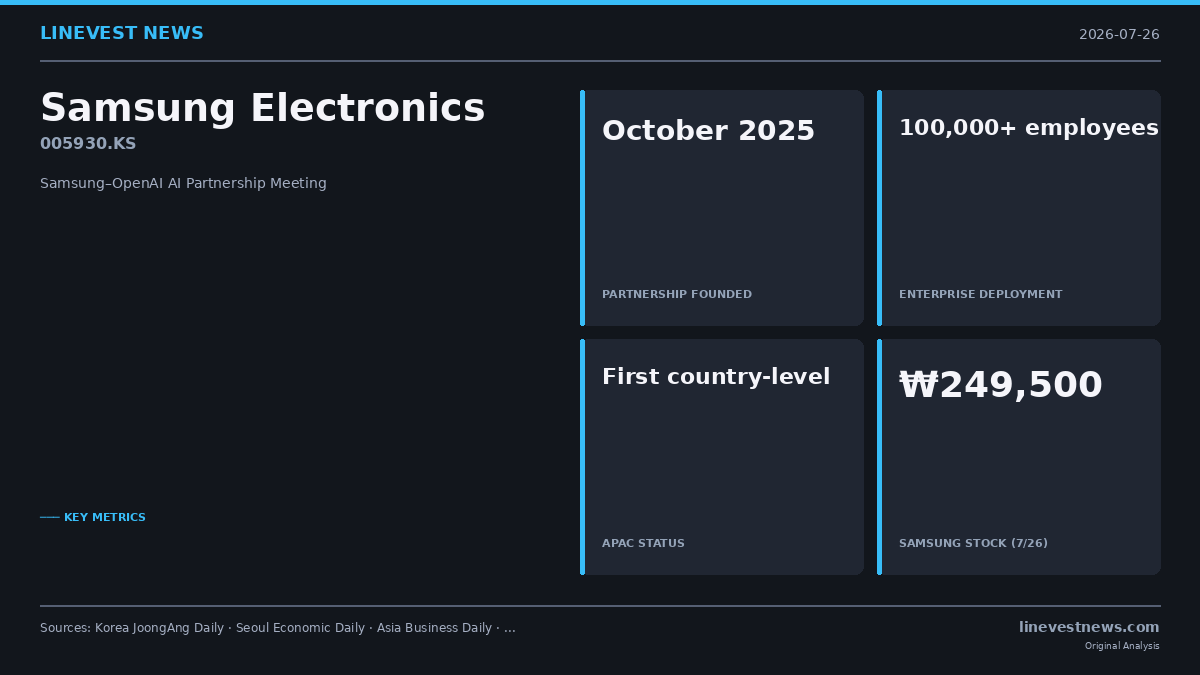
Samsung Chairman Lee Jae-yong met OpenAI CEO Sam Altman on the morning of July 25, 2026, at OpenAI's San Francisco headquarters, deepening a strategic alliance that positions Korea at the center of the global AI supply chain. The private bilateral meeting followed South Korean President Lee Jae-myung's AI summit in the city and comes as OpenAI frames its partnership with Korea's government, Samsung, and SK Hynix as "its first country-level strategic partnership in the Asia-Pacific region."
TL;DR
- July 25, 2026: Samsung Chairman Lee Jae-yong meets OpenAI CEO Sam Altman at OpenAI HQ, San Francisco — agenda covers HBM, DRAM, advanced foundry, and enterprise AI
- Existing alliance: Samsung-OpenAI strategic partnership dates to October 2025; Samsung is "one of OpenAI's largest global corporate customers"
- Enterprise scale: June 2026 deployment of ChatGPT and Codex to all Samsung Korea employees and DX Division globally — "one of the largest enterprise deployments OpenAI has signed to date"
- APAC milestone: OpenAI's framework with Korea (government + Samsung + SK Hynix) is its first country-level strategic partnership in Asia-Pacific
- No deal announced: Specific chip supply volumes, investment scale, and contract timelines were not disclosed
Part A: The Meeting and Its Background
A Private Follow-On to the AI Summit
Samsung Chairman Lee Jae-yong's visit to OpenAI's San Francisco headquarters on July 25 came a day after South Korean President Lee Jae-myung presided over a broader AI summit that gathered the heads of Nvidia, Anthropic, and Broadcom alongside Korea's top chaebol chiefs. While that summit produced a "San Francisco AI Declaration" framing Seoul's macro-level AI ambitions, the private Samsung-OpenAI session was focused on operational specifics.
OpenAI declined to disclose the meeting agenda or any outputs. Industry observers noted that the discussion would logically center on three pillars: semiconductor cooperation (high-bandwidth memory, DRAM, and advanced foundry), extending Samsung's enterprise-wide generative AI rollout, and governance of the October 2025 strategic alliance.
18 Months of Deepening Ties
The October 2025 pact marked Samsung's shift from hardware supplier to strategic AI partner. By June 2026, Samsung had begun rolling out ChatGPT and OpenAI's Codex AI coding tool to all employees in Korea and across the Device eXperience (DX) Division worldwide — described by OpenAI as "one of the largest enterprise deployments OpenAI has signed to date."
The deployment spans software development, marketing, product development, manufacturing, and non-technical functions, giving Samsung one of the largest internal generative AI footprints of any industrial corporation.
OpenAI's classification of its relationship with Korea — encompassing the national government, Samsung, and SK Hynix — as its first country-level Asia-Pacific strategic partnership is significant. It reflects OpenAI's view of Korea not simply as a chip vendor but as a systemic partner in building the infrastructure layer of the AI economy.
Part B: Market and Strategic Implications
Samsung's AI Chip Repositioning
The July 25 meeting is the latest move in Samsung's effort to close the gap with SK Hynix in AI memory. SK Hynix currently supplies Nvidia with roughly 70% of Vera Rubin-generation HBM4, while Samsung's HBM4 was commercially ramping through 2026 with Microsoft Azure's AMD Helios racks (Samsung HBM4: 13 Gbps/pin, 3.3 TB/s per stack) as a key early customer.
An explicit OpenAI partnership adds a second major AI-native hyperscaler customer to Samsung's HBM roadmap. OpenAI is both the world's most heavily used frontier AI model operator and a developer whose compute requirements are projected to scale with GPT-series and reasoning model expansion. HBM supply locked into OpenAI's infrastructure budget would diversify Samsung's revenue base beyond device memory.
| Partner Axis | Samsung | SK Hynix |
|---|---|---|
| Primary AI chip customer | OpenAI + Microsoft Azure (AMD) | Nvidia (Vera Rubin HBM4, ~70%) |
| Partnership level | Country-level APAC strategic (Oct 2025) | Long-term supply agreement |
| HBM4 status | Ramp-up (TSMC +Samsung fab logic base) | Volume production |
| Enterprise AI | ChatGPT/Codex rollout (all of DX Division) | N/A |
The Mistral Dimension
Separate from the OpenAI deepening, Samsung is reported in advanced discussions (as of July 22) to invest up to €1 billion (approximately $1.1 billion) in French AI startup Mistral AI, which would value Mistral at approximately €23.4 billion. A strategic investment of this scale would extend Samsung's AI software exposure beyond OpenAI and could open foundry and memory relationships tied to European frontier AI model development.
Both the OpenAI partnership and Mistral investment talks reflect Samsung's "multi-AI-model" strategy: instead of concentrating hardware supply through one AI champion, Samsung is anchoring itself to multiple competing frontier model companies simultaneously.
Korea's Dual-Pillar AI Supply Chain
The San Francisco AI Summit made explicit what market observers had inferred: Korea's two largest semiconductor companies are anchoring opposite ends of the AI chip supply chain for the world's two leading AI infrastructure builders.
- Nvidia + SK Hynix: Jensen Huang confirmed at the summit that Nvidia is broadening its partnership with SK Group "up to a $500 billion chip supply deal" covering AI semiconductors and infrastructure.
- OpenAI + Samsung: The country-level framework commits Samsung's HBM, DRAM, and foundry capacity alongside all of Korea's national AI strategy.
For foreign investors with KOSPI exposure, this dual-pillar structure reduces concentration risk: a correction in Nvidia's cycle would not automatically impair Samsung's AI revenue, while an OpenAI volume reduction would not directly affect SK Hynix's Nvidia-bound HBM supply.
Stock and KOSPI Context
Samsung Electronics (005930.KS) declined approximately 7.6% on July 26, trading at approximately ₩249,500, as a broader KOSPI selloff — driven primarily by the ₩944 billion divorce settlement against SK Group Chairman Chey Tae-won — weighed on large-cap Korean tech. The selloff is widely seen by analysts as unrelated to Samsung's fundamental AI trajectory.
Samsung's forward P/E remains depressed relative to global semiconductor peers despite record-setting AI chip revenue. The OpenAI partnership announcement, coming alongside ASML orders totalling €3.6 billion for EUV lithography machines (advanced node capacity expansion), reinforces the case that Samsung's capital expenditure program is demand-driven rather than speculative.
Investment Considerations
Investors should note several risks alongside the positives: Samsung has not disclosed specific chip supply volumes or contract values tied to OpenAI; the "enterprise-level" ChatGPT deployment improves productivity but does not itself generate semiconductor revenue; and Samsung's HBM4 ramp is behind SK Hynix in volume, which may limit near-term ASP gains on OpenAI-bound orders.
Nonetheless, the strategic framing — OpenAI treating Korea as its only country-level APAC partner — creates a structural demand signal that independent chip analysts will likely incorporate into longer-dated supply forecasts.
This article is journalism, not investment advice. LineVest News is an independent publication and is not affiliated with any brokerage. All readers should conduct their own due diligence before making investment decisions.
Sources: - Korea JoongAng Daily, "Samsung chairman meets with CEO of OpenAI in San Francisco," July 2026 - Seoul Economic Daily (English), "Jay Y. Lee to Meet Altman at OpenAI Headquarters on AI Infrastructure," July 25, 2026 - The Asia Business Daily (English), "Lee Jae-yong and Altman Meet at OpenAI Headquarters to Discuss AI Infrastructure Collaboration," July 26, 2026 - GuruFocus, "Samsung's Lee Jae-yong Meets OpenAI's Sam Altman to Discuss AI Collaboration," July 2026 - Kyunghyang Shinmun (English), "Lee Jae-yong·Altman meet at OpenAI headquarters," July 26, 2026 - SammyGuru, "Samsung Chairman Jay Y. Lee Visits OpenAI Headquarters, Meets Sam Altman," July 2026