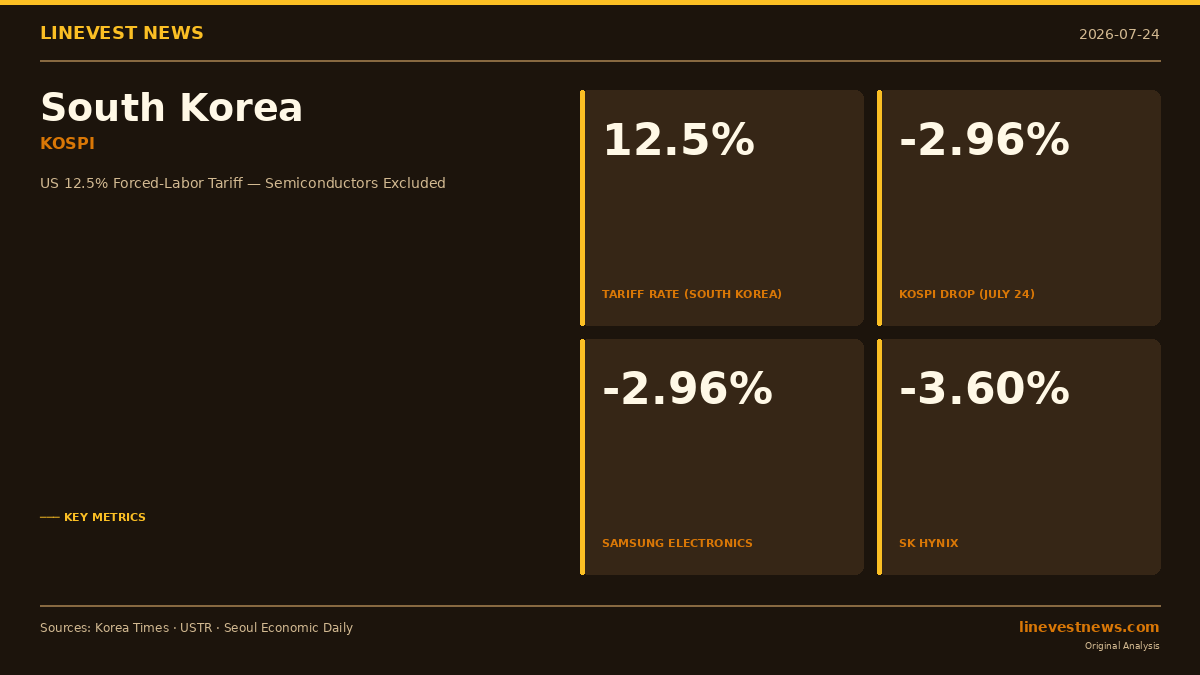
TL;DR - USTR enacted 12.5% Section 301 forced-labor tariffs on South Korea (effective July 25), among 60 economies - Semiconductors, automobiles, steel and raw materials are explicitly excluded — limited impact on Samsung and SK Hynix - KOSPI fell 2.96% to 6,886.56 on July 24, but Iran war-threat headlines — not tariffs — drove the selloff - Korea's trade ministry secured a U.S. commitment that combined forced-labor tariffs will not breach the Korea-U.S. FTA's effective 15% ceiling - Analyst: "downside rigidity centered on semiconductors" expected to limit further losses
Part A: The Policy Action
The Office of the U.S. Trade Representative (USTR) announced the results of its Section 301 forced-labor investigation on July 23, imposing tariffs effective July 25 on goods from 60 economies worldwide.
South Korea, Japan and Switzerland received the highest rate: tariffs calibrated to bring the effective U.S. duty on covered goods to 12.5% of their import value. The three countries fell into the group that "failed both to introduce and effectively enforce import bans on goods produced with forced labor," according to USTR Jamieson Greer.
Eighteen countries — including Canada, Mexico, Argentina, the United Kingdom and India — that have passed or pledged to introduce forced-labor import prohibitions received a lower 10% rate.
The tariff mechanism works as a floor, not an addition: if existing Most-Favoured-Nation (MFN) tariffs already place a product's effective duty at or above 12.5%, no new tariff applies.
What Is Excluded
The following categories are explicitly carved out of the Section 301 action:
| Category | Reason Excluded | Key Korean Products |
|---|---|---|
| Semiconductors | Separate national-security tariff framework | Samsung DRAM/NAND, SK Hynix HBM |
| Automobiles & parts | 25% Section 232 tariffs already in effect | Hyundai, Kia, Hyundai Mobis |
| Steel & aluminum | Section 232 tariffs apply | POSCO, Hyundai Steel |
| Raw materials | Sourcing alternatives unavailable | Various industrial inputs |
For Korea's three largest export pillars — memory chips, passenger vehicles and steel — the new action adds zero incremental duty.
Korea's Diplomatic Position
Officials at South Korea's Ministry of Trade, Industry and Energy (MOTIE) confirmed that the USTR reaffirmed its position that combined forced-labor and overproduction Section 301 tariffs will not exceed 15% — the ceiling embedded in the Korea-U.S. Free Trade Agreement (KORUS FTA). "The U.S. side also reaffirmed its position that the existing trade agreement must be observed," MOTIE said Thursday.
What is affected: Korean products at low MFN tariff rates — consumer goods, processed foods, textiles and certain industrial components — could see duties increase to reach the 12.5% threshold.
Part B: Korea Market Analysis
KOSPI Drops 3% — but the Cause Is Tehran, Not Tariffs
Seoul shares fell sharply on Thursday, but geopolitics, not tariff arithmetic, triggered the move.
By 9:15 a.m. KST, the KOSPI had shed 210 points (-2.96%) to 6,886.56, breaking below the psychologically significant 7,000 level. Samsung Electronics (005930.KS) declined -2.96% and SK hynix (000660.KS) shed -3.60%, while SK Square (034730.KS) — the holding company with concentrated SK hynix exposure — fell -6.06%.
The proximate trigger: a media interview in which U.S. President Donald Trump said he was "considering a large-scale attack" on Iran. Houthi rebels simultaneously declared a Red Sea blockade and claimed responsibility for missile strikes on Saudi oil tankers, threatening crude supply through the Strait of Hormuz — adding an oil-shock dimension on top of military risk.
Semiconductor Stocks: Downside Rigidity Expected
A market strategist noted that "downside rigidity centred on semiconductors" is expected to form during the trading session — translating to institutional buy-on-dip support around Korean chipmakers. That view is backed by structural demand: AI hyperscalers have not walked back capex commitments, and SK hynix has confirmed that its entire 2026 HBM output is already sold.
A secondary concern weighed on sentiment: questions over whether the AI infrastructure boom can sustain current capex levels. SK hynix surged 9% on July 22 after Alphabet's USD 205 billion 2026 investment disclosure; Thursday's pullback partly unwinds that move.
Tariff Stack — Where Korea Actually Stands
Investors face a three-track tariff landscape:
| Tariff Track | Rate | Status | Korea Semiconductor Exposure |
|---|---|---|---|
| IEEPA baseline (negotiation tariff) | 15% | Ongoing — August 1 deadline | Applies, negotiations active |
| Section 301 forced-labor | 12.5% | Effective July 25 | Semiconductors EXCLUDED |
| Section 232 autos/steel | 25% | In effect since April 2025 | Autos/steel, not semis |
The Section 301 forced-labor measure's bark is louder than its bite for listed Korean large-caps. The practical question is whether the August 1 IEEPA negotiation deadline yields a comprehensive deal that supersedes these overlapping measures — and whether that deal respects the KORUS FTA's 15% cap that MOTIE has now extracted a verbal recommitment to.
For portfolio managers who reduced exposure on the tariff headline: the exclusion list suggests the correction may represent a re-entry opportunity in semiconductor names, contingent on Middle East developments.
This article is for informational purposes only and does not constitute investment advice or a recommendation to buy or sell any securities.
Sources - Korea Times — "US announces 12.5% tariffs on Korea, Japan over forced labor concerns" (July 24, 2026) - USTR — "USTR Takes Action in Forced Labor Section 301 Investigations" (July 23, 2026) - Seoul Economic Daily — "Korea Says US Reaffirms Tariff Should Not Exceed 15%" (July 24, 2026) - Seoul Economic Daily — "Samsung, SK hynix Fall 3% as KOSPI Drops Below 7,000 on Mideast Tensions" (July 24, 2026)