JB Financial Group (KS: 175330) reported its highest-ever second-quarter net profit on Thursday, underscoring the group's emergence as South Korea's most efficient regional holding company while injecting new leverage into ongoing merger negotiations with BNK Financial Group.
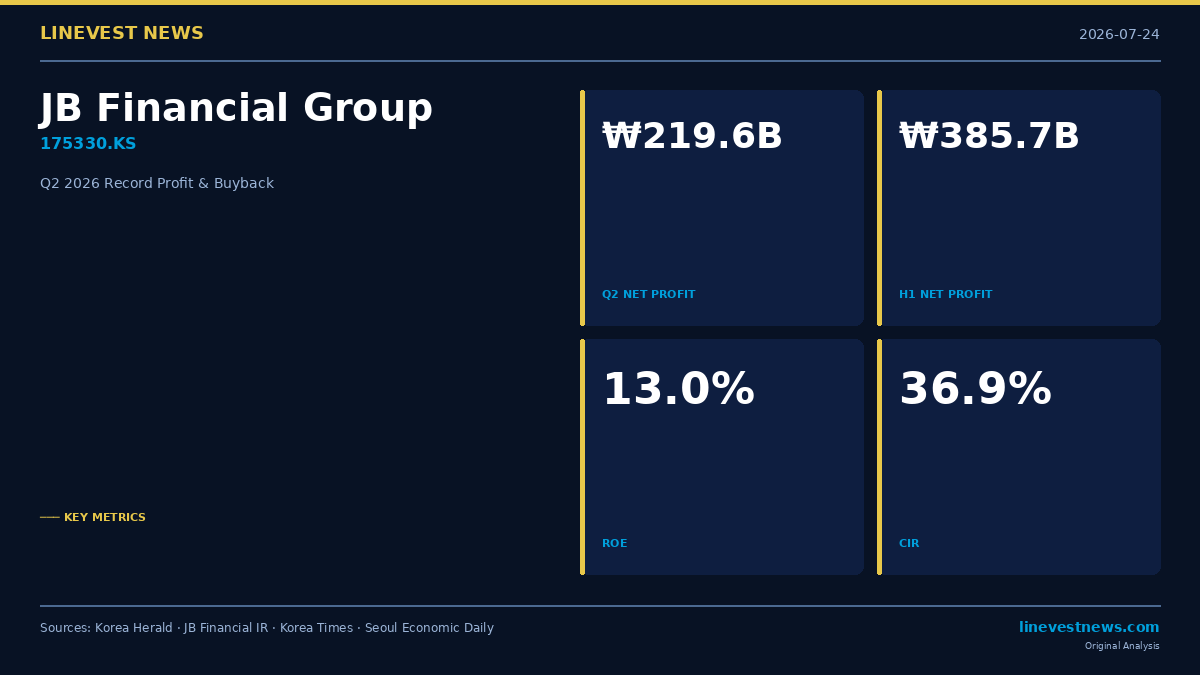
TL;DR - Q2 2026 net profit ₩219.6B (+5.7% YoY) — record for any second quarter in group history - H1 2026 cumulative profit ₩385.7B — record first-half result, driven by non-banking - Quarterly dividend ₩314 per share — highest in company history - USD 68M treasury share buyback + cancellation authorized by the board - Industry-best cost-to-income ratio (CIR) of 36.9%; ROE steady at 13.0% - JB Woori Capital (auto/consumer lending) contributed ₩104.1B — 40% of pre-elimination group profit
Part A — The Numbers
Q2 2026 Headline Results
| Metric | Q2 2026 | Q2 2025 | Change |
|---|---|---|---|
| Net profit (controlling shareholders) | ₩219.6B | ~₩207.8B | +5.7% YoY |
| H1 cumulative net profit | ₩385.7B | — | Record H1 |
| Return on Equity (ROE) | 13.0% | — | On-target |
| Return on Assets (ROA) | 1.07% | — | Best-in-class |
| Cost-to-Income Ratio (CIR) | 36.9% | — | Improving |
| CET1 (preliminary) | 12.52% | — | Stable |
Subsidiary Earnings Breakdown (Q2 2026)
| Subsidiary | Net Profit | Primary Business |
|---|---|---|
| JB Woori Capital | ₩104.1B | Auto & consumer lending |
| Kwangju Bank | ₩85.6B | Honam (Gwangju) regional banking |
| Jeonbuk Bank | ₩54.6B | Jeonbuk / Chungcheong banking |
| PPCBank (Cambodia) | ₩14.0B | Southeast Asia retail banking |
| JB Investment | ₩2.3B | Venture & private equity |
| JB Asset Management | ₩0.4B | Fund management |
Shareholder Returns
The board simultaneously approved: 1. Cash dividend: ₩314 per share for Q2 2026 — the highest quarterly dividend in the group's history 2. Treasury share buyback + cancellation: ₩100 billion (approximately USD 68 million) authorized for repurchase and immediate cancellation, reducing share count and boosting EPS
The combined return package materially exceeds any prior quarterly payout, a signal that management is confident in capital headroom beyond the 12.52% preliminary CET1 ratio.
Part B — What This Means for Investors
1. JB Woori Capital Is Now the Group's Profit Engine
JB Woori Capital's ₩104.1B single-quarter contribution accounts for roughly 40% of pre-elimination group profit, a structural shift that has been building since 2023. The Korea Times noted in November 2025 that regional financial groups were pivoting non-banking subsidiaries into their primary profit drivers — JB Financial is now a textbook example of that trend.
Auto lending and consumer finance in Korea are higher-margin activities than traditional deposit-loan spreads, particularly as competition from Internet-only banks (Kakao Bank, K Bank) has compressed net interest margins in the retail banking segment. JB Woori Capital, by contrast, serves an underserved niche in mid-prime consumer credit that digital lenders have not fully penetrated.
The practical implication: JB's profit quality is increasingly diversified away from NIM-sensitive banking income. Even if the Bank of Korea (BoK) reverses its rate cycle in 2027, JB's earnings architecture is more resilient than pure-banking peers.
2. Value-Up Execution: JB Is Running Ahead of Its Own Targets
JB Financial's three-year Value-Up plan (through FY2026) targets a minimum ROE of 13% and a shareholder return rate of 45%. With Q2 ROE hitting exactly 13.0%, and with the record ₩314 dividend plus ₩100B buyback, the group appears to be tracking at or above those commitments with one quarter remaining in the plan cycle.
For international investors, the Value-Up framework — backed by the Financial Services Commission's market reform push — gives JB's commitments a degree of regulatory teeth that earlier voluntary programs lacked. A group that consistently meets or beats its own Value-Up targets is more likely to attract the P/B re-rating that the framework promises.
At the current stock price of ₩30,400 and with 13 analysts issuing a consensus Buy recommendation (9 buy, 4 hold) and an average 12-month target of ₩36,755 — implying approximately 21% upside — JB Financial trades at a discount to most of the large-cap financial groups despite generating superior efficiency ratios.
3. Record Earnings Reframe the BNK Merger Negotiation
In July 2026, activist shareholder Align Partners (14.83% JB Financial stake, more than 1% BNK Financial stake) formally proposed that JB Financial and BNK Financial (138930.KS) merge to create a combined institution with ₩234 trillion in assets and a market capitalization approaching ₩10.76 trillion.
JB's record H1 earnings fundamentally change the merger's exchange ratio calculus. A group posting ₩385.7B in H1 profit — with a 13% ROE, 36.9% CIR, and ₩12.52% CET1 — commands a premium valuation in any fixed-ratio merger with a lower-performing peer. If BNK Financial's own Q2 results (expected within days) show wider gaps in efficiency or capital position, JB shareholders will have a compelling financial argument to demand a materially above-par exchange ratio, or to reject the deal altogether.
The activist's two possible moves: (a) use JB's stronger data to push for better terms while BNK's board still values the "scale" argument, or (b) let JB continue its standalone Value-Up trajectory and maximize the price at which any eventual deal is struck. Either path becomes more value-accretive following Thursday's results.
4. BoK Rate Hike Amplifies H2 NIM Upside
The Bank of Korea raised its benchmark policy rate by 25 basis points to 2.75% on July 16, 2026 — a unanimous 7-0 decision. For Kwangju Bank and Jeonbuk Bank, which rely heavily on retail time deposits, rate hikes typically flow through to loan repricing more quickly than at the Big 4 banks. Independent estimates suggest 3-5 basis points of NIM expansion per quarter following a rate hike of this magnitude — enough to add ₩5-10B in incremental quarterly operating profit per bank subsidiary.
Assuming no reversal in the BoK cycle, H2 2026 should benefit from a full quarter of higher rates across both banking subsidiaries, providing a material tailwind to any growth in Kwangju and Jeonbuk's profit contributions.
5. Cambodia: A Sleeper Catalyst at ₩14B
PPCBank (Phnom Penh Commercial Bank, JB Financial's Cambodian subsidiary) contributed ₩14B in Q2 — a modest figure but one that represents steady growth in an economy expanding at 6-7% annually. JB Financial CEO Kim Ki-heung outlined in March 2026 a strategy to expand foreign lending exposure, including additional branch openings in Southeast Asia.
As Cambodian consumer credit deepens and PPCBank scales, the subsidiary could add meaningful incremental profit in H2 without requiring significant additional capital from the parent. For investors seeking exposure to Southeast Asian growth embedded in a Korean holding company, PPCBank is a differentiated option unavailable through any of the Big 4 banking groups.
This article is journalistic analysis, not investment advice. JB Financial Group (175330.KS) is a publicly traded company on the Korea Exchange. Past performance does not guarantee future results.
Sources: - Korea Herald, "JB Financial posts record Q2 profit, boosts shareholder returns," July 24, 2026: https://www.koreaherald.com/article/10818481 - Korea Times, "Regional financial groups see nonbanking biz overtake banking as key profit drivers," November 25, 2025: https://www.koreatimes.co.kr/business/banking-finance/20251126/regional-financial-groups-see-nonbanking-biz-overtake-banking-as-key-profit-drivers - Seoul Economic Daily (English), "JB Financial to Expand Foreign Lending, Strengthen IB Capabilities," March 5, 2026: https://en.sedaily.com/news/2026/03/05/jb-financial-to-expand-foreign-and-strategic-lending - Korea Herald, "JB Financial posts record profit, beats guidance": https://www.koreaherald.com/article/10670750