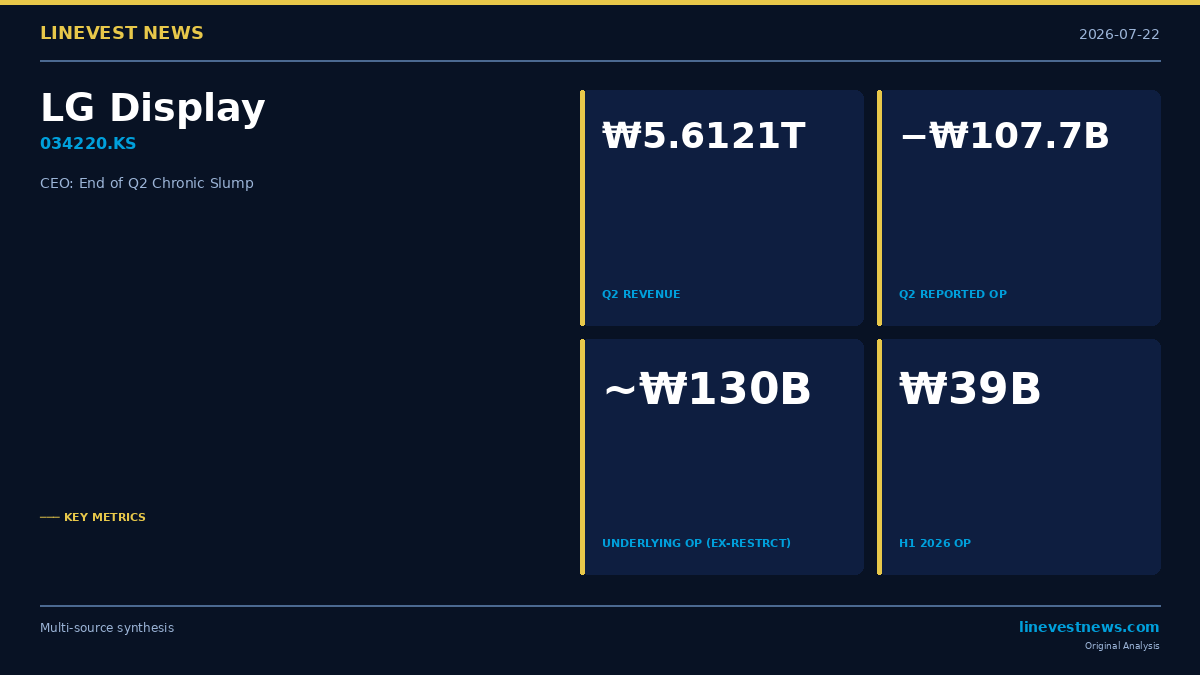
LG Display President Jung Cheol-dong declared an end to four consecutive years of chronic second-quarter losses, telling investors that restructuring charges — not structural business weakness — drove the reported Q2 2026 miss. Speaking at the 2026 Korea Display Industry Exhibition (K-Display 2026, COEX, Seoul, July 22), the same day LG Display released earnings, Jung said: "Excluding one-time costs, we have broken away from the chronic second-quarter slump that has continued for the past four years."
At the same venue, Samsung Display CEO Yi Chung announced a ₩67 trillion investment plan anchored in the Chungcheong industrial corridor and confirmed accelerated Gen 8.6 OLED IT-panel production — setting up a direct technology confrontation between Korea's two display giants.
TL;DR
- President Jung Cheol-dong: underlying Q2 profit ~₩130B after excluding a ₩240B one-off workforce restructuring charge; H1 2026 operating profit ₩39B — first profitable first half since 2021
- LG Display raises full-year 2026 capex guidance to mid-to-high ₩2 trillion, roughly double 2025 levels — bet on OLED ramp
- Samsung Display CEO Yi Chung pledges ₩67T Chungcheong mega-investment and commits to Gen 8.6 OLED mass production
- FnGuide consensus places LGD's FY2026 operating profit at ₩1.1083T (+117% YoY); achieving it requires ~₩1.07T in H2 alone
Part A — What Was Disclosed
Q2 2026 Financial Results
| Metric | Q2 2026 | Q2 2025 | Change |
|---|---|---|---|
| Revenue | ₩5.6121T | ₩5.587T | +0.4% YoY |
| Reported Operating Profit | −₩107.7B | −₩116.1B | improved |
| Underlying OP (ex-restructuring) | ~₩130B | — | — |
| One-off restructuring charge | ~₩240B | — | — |
| Net Loss | −₩418.8B | — | — |
| EBITDA Margin | 16% | — | — |
| OLED Revenue Share | 57% | ~52% | +5pp |
| Area Shipments | 3.6M m² | — | +12% QoQ |
CFO Kim Sunghyun reinforced the same message: "Excluding such one-off costs, I was determined to see that our business performance was going to be seeing profit." The voluntary early retirement programme — LG Display's third restructuring round in 18 months — generated the one-time charge. First-half 2026 consolidated operating profit was ₩39B, the company's first profitable H1 since 2021.
Capex Doubled
Full-year 2026 capital expenditure guidance was raised to the mid-to-high ₩2 trillion range, up from approximately mid-₩1 trillion in 2025. Management cited tandem OLED expansion and next-generation large-panel technologies as the primary investment targets. No product-line breakdown or specific project timelines were disclosed.
Technology Road Map
At K-Display 2026, Jung also disclosed the following:
- Tandem OLED for smartphones: Currently deployed in TV and IT panels; under evaluation for mobile integration
- Gen 8.6 OLED IT panels: Multiple technology options and business feasibility under review; no investment commitment or timeline provided
- "Flip" display technology: An internally developed next-generation format; details to be announced later
- Glass interposer: A novel substrate technology being developed for semiconductor packaging applications
Part B — Korea Market Implications
The Samsung Display Contrast
The K-Display 2026 floor made the strategic divergence between Korea's two display leaders impossible to ignore. Where Jung hedged on Gen 8.6, Samsung Display CEO Yi Chung moved in the opposite direction.
Yi acknowledged a shared headwind — "chipflation," the industry term for rising memory prices feeding through into display manufacturing costs — but then committed to a ₩67 trillion Chungcheong investment over multiple years, announced that Gen 8.6 OLED IT-panel lines have begun operating (targeting MacBook Pro supply), and unveiled plans for a second industrial complex. Samsung Display also showcased a 6.9-inch gaze-tracking OLED for humanoid robots at the exhibition.
LGD's equivalent response at K-Display: a 48-inch dashboard display and 18-inch slideable OLED for automotive, plus tandem-OLED expansion across product lines. Robust pipeline — but the CapEx commitments are asymmetric.
The gap in near-term earnings power reflects the capital allocation history. Samsung Display's FY2026 operating profit is estimated at ₩3.5–4.2 trillion; LGD's FnGuide consensus stands at ₩1.1083 trillion — a 3×–4× ratio even in a recovery year for LGD.
Gen 8.6: The Race LGD Has Not Formally Entered
Gen 8.6 OLED capacity — which produces panels for MacBooks, Windows laptops, and monitors — is the fastest-growing segment of the IT-display market. The global OLED monitor market reached approximately USD 2.8 billion in 2025 (+74% YoY) and is forecast to reach USD 3.6 billion in 2026 (+29%). Samsung Display already has first-mover advantage; Omdia data shows Samsung Display capturing 48% of medium-large OLED revenue in Q3 2026, surpassing LGD for the first time at 47%.
LGD's decision to keep Gen 8.6 in feasibility review while doubling total capex suggests the company is prioritising smaller/mobile OLED and existing tandem TV and IT lines rather than building another large greenfield facility in parallel. The risk is that by the time LGD commits, Samsung Display's Gen 8.6 yields will have matured enough to price competitively.
H2 2026 Catalysts
LGD management flagged several tailwinds that support the H2 consensus:
- Apple iPhone 18 Pro panels: LG Display is expected to supply approximately 85 million OLED units for the 2026 iPhone cycle alongside Samsung Display (BOE is excluded from the premium tier)
- Apple Watch Series 12: LGD supplies OLED panels for this cycle on a sole-source basis
- Panel pricing: Management guided for high-teens percentage ASP increases per square metre in H2, driven by seasonal demand and a tighter supply environment
- Automotive OLED: Currently 10% of LGD revenue; 48-inch and slideable displays signal the company's intent to grow this segment
H2 Risks
Despite the constructive tone, Jung disclosed significant uncertainty. He called H2 2026 macro conditions "much more than usual" in terms of risk — citing chipflation (memory costs pressuring display BOM), geopolitical trade tensions (particularly around cross-strait supply chains), and rising commodity costs for glass substrates.
What Investors Should Monitor
The FnGuide consensus of ₩1.1083T for FY2026 implies that LGD must generate approximately ₩1.07T in H2 operating profit — a 27× step-up from H1's ₩39B. That back-half loading requires near-perfect execution on three simultaneous ramps: iPhone 18 Pro OLED, OLED monitor pricing, and restructuring cost normalisation.
LGD's capex doubling to mid-to-high ₩2T signals conviction, but free cash flow will remain negative through the ramp phase, keeping net debt elevated and limiting dividend flexibility.
LGD (034220.KS) closed at ₩14,100 on July 22. The analyst community shows 11 Buy ratings against 3 Sell; the average 12-month price target is ₩15,280, representing an 8.4% upside from current levels — modest given the scale of the OP recovery embedded in consensus.
This article is for informational purposes only and does not constitute investment advice. LineVest News is an independent publication and is not affiliated with any brokerage.
Sources
- LG Display CEO Expects Stronger Second Half — The Elec
- LG Display Returns to H1 Profit After 5 Years — Seoul Economic Daily
- 'Chipflation' Signals Trouble for Display Industry — Asia Business Daily
- Korean Display Makers Push OLED into AI, Humanoid Robots — Korea JoongAng Daily
- LG Display Q2 2026 Earnings Call Highlights — Yahoo Finance