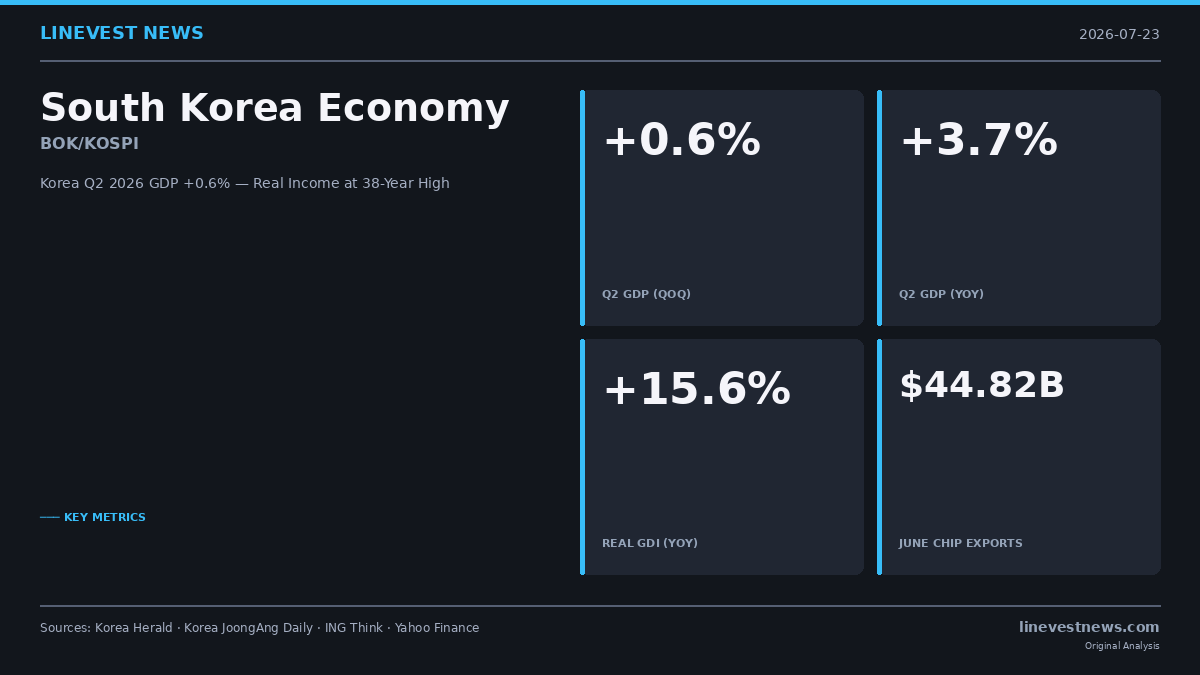
TL;DR - South Korea's Q2 2026 GDP expanded 0.6% quarter-on-quarter, three times the Bank of Korea's May estimate of 0.2%, putting the full year on a 3%-plus trajectory for the first time since 2021. - Real gross domestic income (GDI) surged 15.6% year-on-year in Q2 — the fastest pace since Q1 1988 — as AI-driven demand pushed semiconductor export prices and volumes sharply higher. - June 2026 chip exports hit a record $44.82 billion, nearly tripling from a year earlier; total June exports crossed $100 billion for the first time in history at $102.25 billion. - BOK Governor Shin Hyun-song flagged Q2 data as "key indicators for determining the direction of future monetary policy," with an updated economic outlook due August 27.
Part A: BOK Flash Estimate — What the Numbers Show
The Bank of Korea (BOK) released its preliminary second-quarter 2026 GDP estimate on Thursday, showing the economy expanded 0.6% quarter-on-quarter in April-June — sharply outperforming the central bank's own May forecast of 0.2% growth. On an annual basis, the economy grew 3.7% in Q2, building on the 1.8% quarterly expansion recorded in Q1 2026 — itself the strongest quarter since Q3 2020.
| Metric | Q2 2026 | Q1 2026 | BOK May Forecast |
|---|---|---|---|
| GDP (QoQ) | +0.6% | +1.8% | +0.2% |
| GDP (YoY) | +3.7% | — | — |
| Real GDI (YoY) | +15.6% | — | — |
Growth was balanced between the two main engines. Net exports contributed 0.3 percentage points of the 0.6% quarterly gain — exports rising 1.4% on the quarter while imports climbed 0.8%. Domestic demand provided the other 0.3 percentage points, as private consumption rose 0.5% and both government spending and facility investment each added 0.2%. Construction investment fell 0.2%, the sole major drag.
The standout figure, however, was real GDI — which adjusts nominal income for changes in terms of trade. At +15.6% year-on-year, Q2 GDI growth was the highest in 38 years, matching levels last seen in Q1 1988 (16.4%) when Korea rode the "Three Lows" boom. The difference today is that the gains are flowing almost entirely through the semiconductor channel.
The Export Engine: Chips Cross $100 Billion in a Month
June 2026 semiconductor exports reached $44.82 billion, nearly tripling on a year-on-year basis as AI-driven demand for HBM and advanced DRAM accelerated through the spring ordering cycle. Total Korean exports in June hit a record $102.25 billion — a 70.9% jump that marks the first time in history South Korea shipped more than $100 billion in goods in a single month.
The BOK noted growth "exceeded expectations" due to "stronger-than-expected semiconductor exports and higher semiconductor export prices."
Part B: What It Means for Korea Investors
Samsung and SK Hynix Are Korea's Income Engine
The GDI surge is not abstract macroeconomics — it traces almost directly to two balance sheets.
Samsung Electronics (005930.KS) Device Solutions (DS) reported preliminary Q2 operating profit of ₩89.4 trillion, a 1,810% year-on-year increase. SK Hynix (000660.KS), which reports full Q2 results on July 29, carries a sell-side consensus operating profit of approximately ₩64.8 trillion (+597% YoY). Combined, the two chipmakers generated an estimated ₩154 trillion in Q2 semiconductor operating profit alone.
Those earnings translate into record employee bonuses, expanded capex, and supplier payments that ripple through the broader Korean economy — directly explaining why private consumption added a positive 0.2 percentage points to Q2 GDP despite ongoing household debt concerns.
ING's senior economist for South Korea and Japan, Min Joo Kang, upgraded the bank's 2026 Korea GDP forecast to 4.0%, up from a prior 3.0%, citing "semiconductor momentum stronger than previously assumed" and an expected current account surplus approaching USD 250 billion for the year.
Rate Path: July Hike Now Looks Prescient
The BOK raised its benchmark rate by 25 basis points on July 16 — the first increase in more than three years — in a move that drew some criticism as premature given global uncertainties. Thursday's GDP and GDI data effectively validate that decision.
BOK Governor Shin Hyun-song explicitly identified Q2 GDP and GDI as "key indicators for determining the direction of future monetary policy," suggesting the strong print increases the probability of a follow-through hike before year-end. The bank's next formal economic outlook is scheduled for August 27.
| BOK Forecast Path | May 2026 | Post-Q2 Signal |
|---|---|---|
| Full-year 2026 GDP | 2.6% | Upward revision expected Aug 27 |
| ING External Estimate | 3.0% | 4.0% (Jul 23 upgrade) |
For investors in Korean bank stocks — KB Financial (105560.KS), Shinhan Group (055550.KS), Hana Financial (086790.KS) — the rate-hike validation is net positive for net interest margin (NIM) expansion, though longer-duration household debt refinancing risks warrant monitoring ahead of any follow-through hike.
Currency and Current Account
A current account surplus approaching USD 250 billion (ING estimate for full-year 2026) provides fundamental support for Korean won (KRW) strength. Further chip outperformance in Q3 — with both Samsung's DS division and SK Hynix guiding for continued HBM supply tightness into 2027 — suggests sustained upward pressure on the currency. For international investors holding Korean equities in USD terms, a strengthening KRW provides an additional return lever on top of equity gains.
The KOSPI reached 7,096.89 on Thursday (+4.4%), with the GDP beat arriving alongside the Alphabet-driven chip stock rally that lifted global semiconductor indices.
Risks: Construction Drag and External Uncertainty
Construction investment fell 0.2% in Q2 — a persistent soft spot in an otherwise strong report. Korea's housing market remains constrained by tight lending rules and elevated debt-service costs; a faster-than-expected rate hike path could deepen that drag in H2.
Externally, ING's Min Joo Kang flags the Middle East as a residual risk: the region "remains fragile and fluid" despite the ongoing U.S.-Iran 60-day negotiation window. Any oil-price shock would compress Korea's terms-of-trade advantage, squeezing the GDI channel that has been so supportive in H1 2026.
The Bottom Line for KOSPI Bulls
Korea's Q2 GDP beat is statistical confirmation of a semiconductor-led income supercycle that has been building since late 2025. The KOSPI's recovery to 7,000 and beyond now has fundamental backing, not just momentum. The critical question for H2 is whether the AI capex cycle — Alphabet's USD 205 billion, alongside Microsoft and Amazon commitments — remains intact. If it does, the BOK's August 27 forecast update could push full-year guidance toward 3%-plus, and the rate market may need to price in an additional 25-basis-point hike before the end of 2026.
This article is for informational purposes only and does not constitute investment advice. LineVest News is an independent publication and is not a registered investment adviser.
Sources: - Korea Herald — Chip boom lifts Korea's income growth to 38-year high - Korea JoongAng Daily — South Korea GDP grows 0.6% in Q2 2026 as exports beat forecast - ING Think — ING lifts South Korea 2026 GDP growth forecast to 4% from 3% - Yahoo Finance — South Korea's Q2 GDP beats estimates on chip export boom