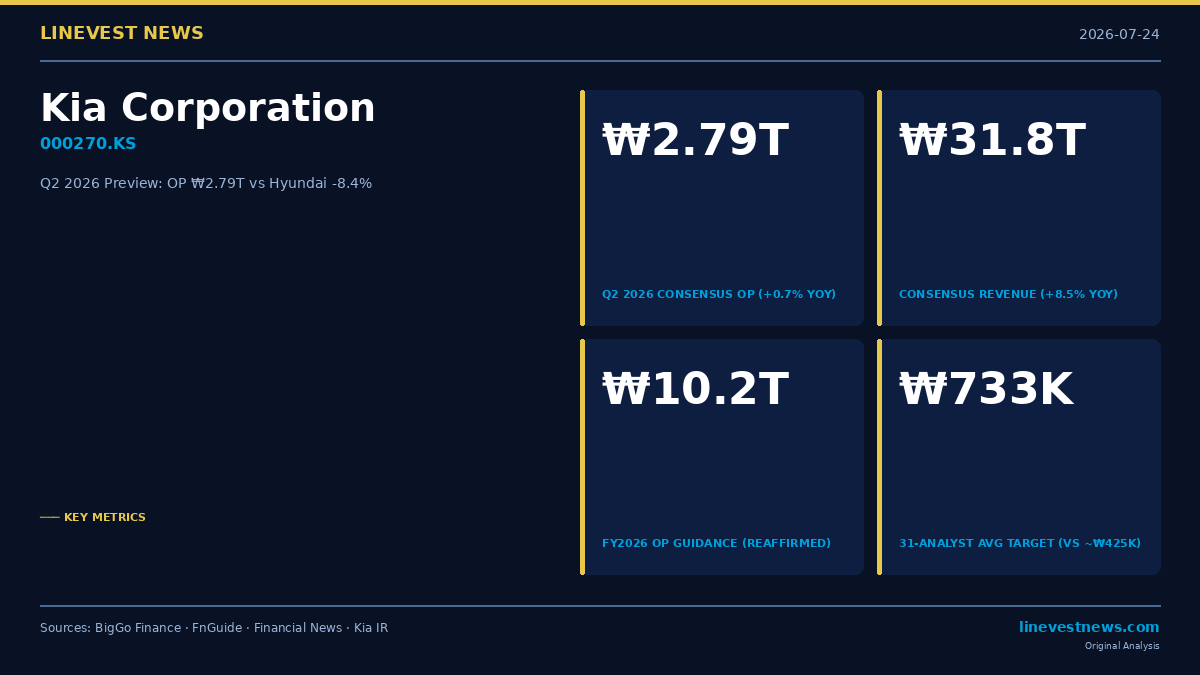
TL;DR - Kia (000270.KS) releases Q2 2026 results Thursday, July 24 KST; consensus operating profit ~₩2.79T (+0.7% YoY) - Hyundai Motor reported actual Q2 OP ₩3.3T (-8.4% YoY) today — Kia's hybrid and Georgia-made EV lineup may allow it to dodge Hyundai's worst headwinds - EV9 assembled in West Point, Georgia: not subject to the 25% import tariff — a structural cost moat Hyundai does not have at the same scale - FY2026 OP guidance ₩10.2T reaffirmed at Q1 results; 31 analysts average target ₩733,000 (+70%+ upside vs recent price ~₩425,000)
Part A: Q2 2026 Earnings Setup
What Analysts Expect
South Korean brokerage consensus compiled by FnGuide projects the following for Kia's Q2 2026 standalone report:
| Metric | Q2 2026E (Consensus) | Q2 2025 Base | YoY Change |
|---|---|---|---|
| Revenue | ~₩31.84T | ~₩29.35T | +8.5% |
| Operating Profit | ~₩2.79T | ~₩2.77T | +0.7% |
| OP Margin (implied) | ~8.76% | ~9.44% | -0.7 pp |
Sources: FnGuide/Financial News (July 6, 2026), BigGo Finance (July 2026)
Kia's combined revenue with Hyundai Motor is projected to hit a combined record ~₩81.9T for Q2 2026, according to Korea's Financial News — driven primarily by Kia's stronger volume growth (+8.5% revenue) rather than Hyundai's more modest +3.7% top-line expansion seen in today's actual results.
The Context: Hyundai Reported Today
Hyundai Motor's Q2 2026 actual results (released July 23, 2026) give investors an important comparative baseline:
- Revenue: ₩50.07T (+3.7% YoY) — first-ever quarterly ₩50T crossing
- Operating Profit: ₩3.3T (-8.4% YoY, margin 6.6%)
- Tariff drag: ~₩860B (~$581M at ₩1,480/USD)
- Key headwinds: Anjeon Industrial fire (Santa Fe parts disruption), HMGMA Georgia utilization at 38.2%
The margin compression at Hyundai — from ~7.5% in Q2 2025 to 6.6% today — frames what Kia needs to either match or avoid.
Part B: Why Kia May Diverge from Hyundai
1. The EV9 Georgia Advantage
The single most important structural difference between Kia and Hyundai's Q2 tariff exposure is where their highest-selling models are assembled.
Kia's EV9, its flagship three-row electric SUV, is manufactured at the West Point, Georgia plant — the same facility that produces the Telluride. Because EV9 is produced domestically in the United States: - It is not subject to the 25% import tariff that has been depressing margins across the sector - Kia avoids the incremental cost burden that imported models carry, allowing it to price competitively without sacrificing unit margin
This is a material advantage. While Hyundai's HMGMA (Hyundai Motor Group Metaplant America) in Georgia is producing vehicles at only 38.2% of capacity as of Q2 2026 — still ramping — Kia's West Point facility is an established operation with mature cost structures.
2. Hybrid Mix as a Margin Buffer
Kia's Q2 2026 volume story is built on hybrid models. Analysts at BigGo Finance note that Kia "aggressively expanded the sales mix of hybrids and RVs — segments where demand surged — largely offsetting the tariff burden."
Key hybrid contributors: - Sorento Hybrid: Korea's top-selling SUV in recent months, commanding a higher average selling price than the gasoline variant - Sportage Hybrid: Strong demand in both Europe and North America - Carnival: Minivan segment that benefits from domestically produced units
Global wholesale sales for Kia in Q2 2026 are tracking +4% year-on-year to approximately 850,000 units, contrasting with broader auto sector volume pressure. Higher ASP mix (hybrids carry $2,000-4,000 premiums over equivalent gasoline variants) supports both top-line growth and margins.
3. Geographic Diversification as a Buffer
Kia's revenue growth of +8.5% YoY — about 2.3 times Hyundai's Q2 rate of +3.7% — reflects stronger penetration in markets less affected by US tariff dynamics. Analysts expect meaningful contributions from: - Europe: Sportage and Niro EV/hybrid demand recovering alongside EU auto sector stabilization - India: Syros and Seltos are gaining share in a rapidly growing market; Kia targets India as a major growth lever in its 2026 plan - Emerging markets: Offsetting MEA region weakness referenced in Q1 earnings
Full-year 2026 guidance of ₩10.2T in operating profit — reaffirmed at Q1 results — implies an average quarterly OP run-rate of ₩2.55T. With Q1 2026 likely below that average (due to heavy tariff impact in the quarter), Q2 consensus of ₩2.79T aligns with a trajectory toward H2 acceleration.
Three Metrics to Watch on July 24
1. Operating Margin — Can Kia Hold 8-9%? Consensus implies 8.8% OP margin, down from ~9.4% in Q2 2025. If actual margin comes in above 9.0%, it would signal that hybrid mix and tariff-exempt US production are more than compensating for macro headwinds — a potential positive re-rating catalyst. A margin below 8.5% would put FY2026 guidance under pressure.
2. US Sales Split: Domestic vs. Import Kia management may disclose how the domestic-vs-import ratio shifted in Q2. Investors should watch for any increase in the share of US-sold Kia vehicles that were assembled in the US — a structural margin expansion story as West Point capacity utilization rises. A higher domestic ratio = lower tariff drag in H2 2026 without needing volume sacrifices.
3. FY2026 Guidance Reiteration (₩10.2T) Given that Hyundai's Q2 miss was accompanied by ongoing tariff and supply-chain uncertainty, any FY2026 guidance revision at Kia would move the stock. Reaffirmation = modest positive; a cut = immediate sector sentiment risk given Kia's elevated analyst target of ₩733K.
H2 2026 Catalysts Ahead
Beyond Q2, Korean auto analysts see several H2 drivers for Kia specifically:
- Telluride 2nd Generation: The West Point, GA-built flagship SUV is slated for a generational update, which typically drives a 15-25% volume step-up in launch quarters
- Sportage Hybrid Production Expansion: Korean production lines are reportedly increasing capacity allocation to hybrid Sportage variants to meet European demand
- EV6/EV9 European Push: Under the EU emissions framework, Kia faces incentives to shift European sales mix toward EVs; incremental EV volumes carry higher ASPs
- Union Negotiations: A potential wildcard. Korean automotive unions have a history of seasonal strikes that can disrupt H2 production. Kia management commentary on labor outlook will be closely watched.
Investor Angle
Kia Corporation shares have traded around ₩425,000 in mid-July 2026, against a 31-analyst consensus target of approximately ₩733,000 — implying +72% upside.
Broker targets range from ₩700,000 (Kiwoom Securities) to ₩840,000 (DS Securities, on Boston Dynamics humanoid upside). The bull thesis rests on: - Boston Dynamics humanoid robot collaboration (Kia is part of Hyundai Motor Group) - US tariff drag proving temporary rather than structural - EV9 West Point ramp accelerating in H2 2026
At ~₩425K, Kia trades at a significant discount to its historical average P/E of ~6-7x given current earnings trajectory. With FY2026 OP of ₩10.2T, the stock is effectively pricing in significant additional downside that may not materialize if Kia's Q2 report confirms the divergence narrative.
For international investors, ADR access is currently limited — Kia does not trade on US exchanges as a formal ADR. Direct KRX access via Interactive Brokers or through Korean equity ETFs (EWY, KORU) remains the primary route.
Kia Corporation (000270.KS) will release Q2 2026 results on July 24, 2026 (KST). This article is based on sell-side consensus estimates as of July 2026 and does not constitute investment advice. All figures are in Korean won unless stated otherwise. LineVest is not a registered investment adviser.
Sources: - BigGo Finance — Hyundai Motor Q2 Seen Falling 14%, Kia Up 1% - Financial News — 현대차·기아 2Q 매출 80조 역대 최고 - Financial News — 현대차·기아 2분기 매출 82조 전망 - Kia Newsroom — 2026 First Quarter Business Results - Kia IR — Full Year 2026 Guidance