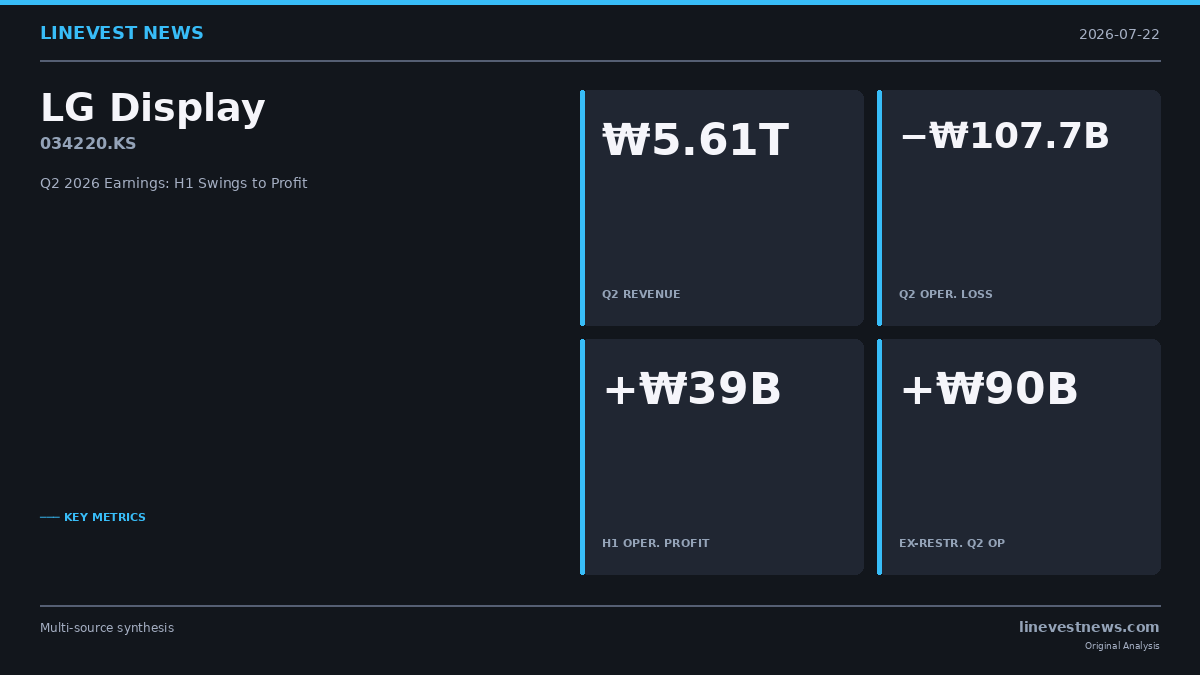
LG Display (034220.KS) swung to a first-half operating profit in 2026 despite a deeper-than-expected second-quarter loss, as heavy restructuring charges masked meaningful underlying improvement in the display maker's core OLED business. The results keep the company on track for its first ₩1 trillion annual profit in five years, powered by an accelerating shift to high-margin OLED panels for Apple's premium smartphone lineup.
TL;DR
- Q2 2026: Revenue ₩5.6121T (+0.4% YoY), Operating loss −₩107.7B (vs. consensus −₩83–95B)
- H1 2026: Revenue ₩11.15T, Operating profit +₩39B — swing from −₩82.6B in H1 2025
- Ex-restructuring: IBK estimates Q2 underlying OP at +₩90B; one-time voluntary retirement charge drove the headline miss
- iPhone 18 Pro: Mass production began June 2026; LGD splits supply with Samsung Display, BOE excluded
- FY2026 guidance: Consensus OP ₩1.1179T (+116% YoY vs. ₩517B in FY2025)
Part A — What Was Reported
Q2 2026: A Structural Win Hidden by One-Time Costs
LG Display reported Q2 2026 revenue of ₩5.6121 trillion, a marginal 0.4% gain year-over-year and 1.3% quarter-over-quarter — ahead of internal expectations despite the display industry's traditional spring trough. The second quarter is structurally the weakest season for panel makers, as consumer electronics brands draw down inventory ahead of second-half product launches.
The headline number, however, was an operating loss of −₩107.7 billion — meaningfully wider than the analyst consensus of −₩83–95 billion. The miss traced almost entirely to a voluntary early retirement program launched in April 2026, which offered severance packages of up to three years' salary plus education allowances. IBK Investment Securities estimated that, excluding restructuring charges, Q2 operating profit would have reached approximately +₩90 billion — a figure that would have comfortably beaten consensus.
Net loss for the quarter was −₩418.8 billion, the bulk of which reflected non-cash foreign exchange translation losses as the Korean won weakened against the dollar during the period.
H1 2026: First-Half Profit — A Symbolic Milestone
Stacking Q1's ₩147 billion operating profit against Q2's −₩107.7 billion loss produces an H1 2026 operating profit of approximately ₩39 billion, compared to a −₩82.6 billion loss in H1 2025. While the margin is thin at 0.35%, the swing marks a significant structural shift: LG Display has not recorded a profitable first half since 2021.
| Metric | Q1 2026 | Q2 2026 | H1 2026 | H1 2025 | YoY Δ |
|---|---|---|---|---|---|
| Revenue (₩T) | 5.534 | 5.612 | 11.15 | ~11.67 | −4.3% |
| Operating Profit (₩B) | +147 | −107.7 | +39 | −82.6 | swing |
| OP Margin | 2.7% | −2.0% | 0.35% | −0.7% | +1pp |
| Net Income (₩B) | −576 | −418.8 | −995 | — | — |
Net income figures include non-cash FX translation losses unrelated to operating performance.
Management Commentary
Management attributed Q2 weakness to "the display industry's seasonal trough" combined with intensive workforce restructuring costs. The company confirmed this is the third restructuring round in two years (two in 2025, one in H1 2026), designed to accelerate the transition to an OLED-centric business model with a leaner cost structure. Capital expenditure guidance for 2026 was set at the mid-to-high ₩2 trillion range, focused on OLED capacity.
Part B — Korea Market Analysis
The iPhone 18 Pro Catalyst: Why H2 Is a Different Story
The defining event of Q2 2026 — beyond the restructuring charge — was the start of mass production for iPhone 18 Pro OLED panels in June 2026. Apple's decision to exclude China's BOE Technology from its premium panel supply chain and split orders between LG Display and Samsung Display represents the most significant supply chain shift for LGD in years.
The implications are financial and strategic:
Revenue ramp: Mobile P-OLED shipments will surge in Q3–Q4 as Apple's seasonal production cycle peaks ahead of the iPhone 18 launch. This is the same seasonal driver that delivered LGD its profitable Q1 2026 (from early production runs).
Apple Watch exclusivity: LGD is positioned as the exclusive OLED panel supplier for Apple Watch Series 12 (launch expected September 2026), a segment that commands high margins and consistent volumes.
BOE exclusion premium: Chinese competitors face structural barriers to qualifying for Apple's premium supply chain, effectively limiting new entrants in the foreseeable future.
For reference, OLED accounted for 61% of LG Display's FY2025 revenue — a threshold that management has highlighted as the point at which the business model stabilizes. The H2 mobile OLED surge will push that proportion higher.
FY2026 Profit Target: ₩1 Trillion in Sight
Sell-side analysts covering LG Display maintain a consensus full-year 2026 operating profit estimate of ₩1.1179 trillion, which would represent a 116% increase from FY2025's ₩517 billion. To reach that target, LGD needs approximately ₩1.079 trillion in operating profit from Q3 and Q4 alone — achievable if Q3 delivers a seasonal step-up and restructuring charges do not recur.
| Period | OP (₩B) | Consensus / Actual |
|---|---|---|
| Q1 2026 | +147 | Actual |
| Q2 2026 | −107.7 | Actual (miss vs. consensus) |
| H1 2026 | +39 | Actual |
| FY2026 (full year) | +1,118 | Sell-side consensus |
| Implied H2 2026 | +1,079 | ~27× H1 level |
That implied H2 acceleration is substantial — but broadly consistent with the display industry's historical seasonal pattern. Q3 is typically LGD's strongest quarter as Apple production ramps hit full speed. IBK's "ex-restructuring Q2 = +₩90B" data point suggests the underlying cost structure can support that trajectory.
Apple Foldable: Samsung Display Wins 2026, LGD Eyes 2027
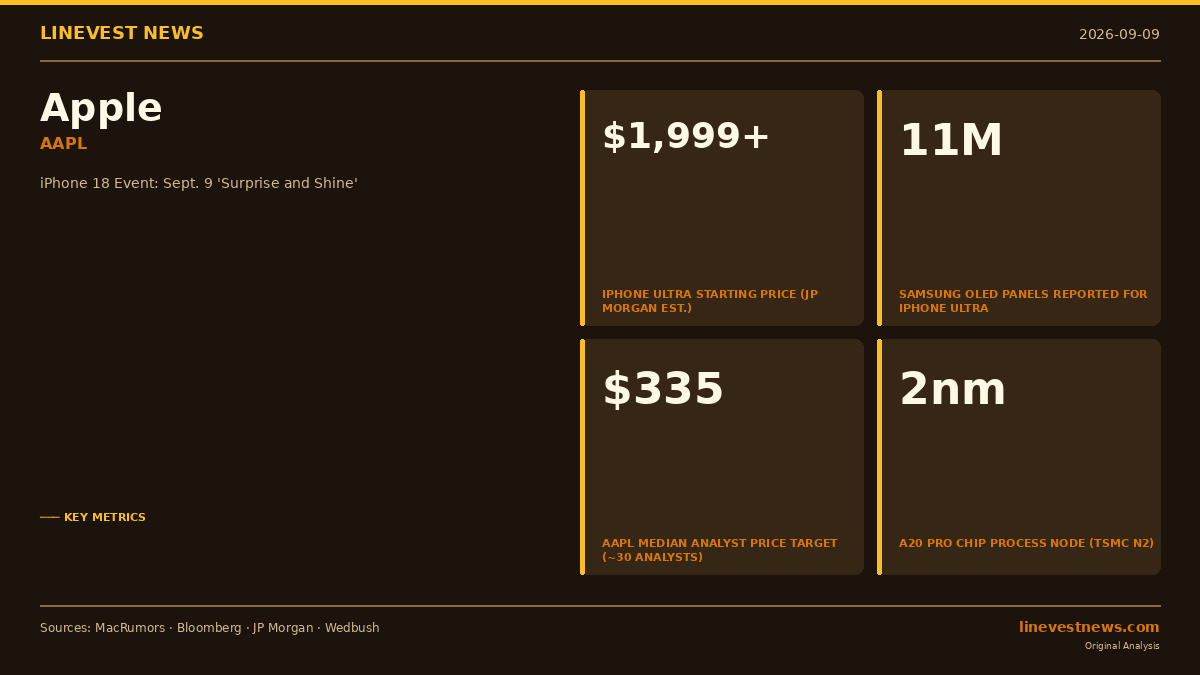
One clear near-term headwind: Samsung Display has reportedly secured exclusive OLED panel supply for Apple's debut foldable smartphone, currently expected to launch in 2026 as "iPhone Ultra." LG Display is not part of the inaugural supply chain but is in competition to enter the program for 2027. Given that foldable displays represent the highest average selling price in the panel industry, LGD's exclusion from the first generation is a material missed opportunity — though 2027 participation, if confirmed, would be a significant revenue step-up.
Competitive Context: Samsung Display Overtake Imminent
LG Display faces a structural competitive challenge in the medium and large OLED segment. Samsung Display is projected to overtake LGD in medium-to-large OLED market revenue share in Q3 2026 for the first time, reaching approximately 48% against LGD's 47%, according to data from Omdia. By Q4, the gap is expected to widen to 50% vs. 45%.
While losing display market leadership in one segment is notable, the two companies operate in different product verticals — LGD has historically dominated OLED TV panels (W-OLED) while Samsung Display leads in mobile (QD-OLED). The Q3 crossover reflects Samsung Display's aggressive push into gaming monitors and IT panels, where LGD has ceded some share.
Investor Angle
LG Display's investment case hinges on a single thesis: the worst is structurally over, and H2 2026 will prove it. The numbers investors should track:
- Q3 2026 operating profit vs. ₩540B implied run-rate needed to hit the FY consensus
- OLED mix in Q3: Crossing 65%+ would signal cost structure improvement is durable, not seasonal
- Restructuring charges: Management has not guided for further rounds; a clean Q3 would remove the biggest overhang
- Apple Watch ASP: LGD's exclusive supply position is worth tracking in the Q3 call
At a closing price of ₩14,100 ahead of the results, LGD traded at a 7.5% discount to the analyst average price target of ₩15,280 (11 Buy, 3 Sell). An earlier Seoul Economic Daily analysis noted a 57% upside case based on a 2027 profit cycle recovery.
This article is for informational and journalistic purposes only. It does not constitute investment advice or a recommendation to buy or sell any security. All figures cited are based on publicly reported data and analyst estimates as of the publication date.