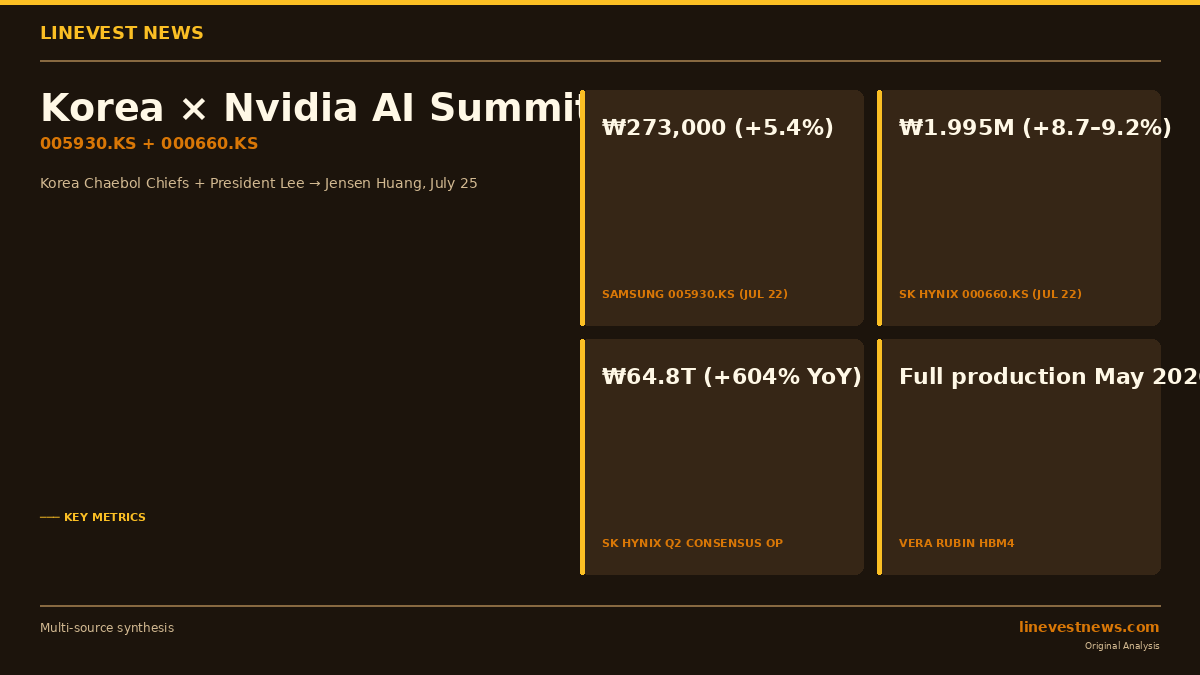
TL;DR - South Korean President Lee Jae-myung will host a July 25 dinner in San Francisco with Samsung Chair Lee Jae-yong, SK Chair Chey Tae-won, Hyundai Chair Chung Euisun and Naver Chair Lee Hae-jin alongside Nvidia CEO Jensen Huang, OpenAI CEO Sam Altman and Anthropic CEO Dario Amodei. - Samsung and SK Hynix are already shipping HBM4 memory for Nvidia's Vera Rubin AI accelerator, which reached full production in May 2026. - Topics include AI factories (SK Telecom targeting gigawatt scale by 2027), Samsung's Groq 3 LPU foundry partnership, and early-stage Anthropic 2-nanometer chip discussions. - The summit marks the second high-level Korea-Nvidia engagement in six weeks, following Huang's four-day Seoul visit in June.
Part A — The Meeting
South Korea's four largest corporate chairmen will fly to San Francisco this week for a government-hosted AI roundtable that blends state diplomacy with chip supply-chain negotiations.
President Lee Jae-myung will host a dinner on Friday, July 25 bringing together Samsung Electronics Executive Chairman Lee Jae-yong, SK Group Chairman Chey Tae-won, Hyundai Motor Group Executive Chair Chung Euisun and Naver Board Chairman Lee Hae-jin on the Korean side, and Nvidia CEO Jensen Huang, OpenAI CEO Sam Altman and Anthropic CEO Dario Amodei on the American side.
The Korean government organized the event, according to multiple media reports, with the stated aim of "emphasizing Korea's commitment to AI investment and global cooperation while securing tangible outcomes such as investment partnerships."
The summit is the second major bilateral engagement in six weeks. Huang spent four days in Seoul in early June, meeting SK Group, Naver, LG Group, Hyundai Motor and Doosan — an unusually prolonged stay for a CEO whose schedule is measured in hours. Friday's San Francisco dinner represents the return visit, elevated to head-of-state level.
Part B — What This Means for Korean Investors
HBM4 and the Vera Rubin Supply Lock-In
The most immediately relevant detail for KOSPI investors is what is already decided, not what will be discussed Friday.
Both Samsung Electronics (005930.KS) and SK Hynix (000660.KS) are currently shipping HBM4 memory for Nvidia's Vera Rubin, the company's next-generation AI accelerator, which reached full production in May 2026. Supply agreements are operational, not prospective. Friday's discussions concern the next generation of supply relationships — including AI factories, autonomous systems and foundry orders — rather than the current HBM contract.
| Company | Ticker | HBM4 / Vera Rubin Role | July 22 Move |
|---|---|---|---|
| Samsung Electronics | 005930.KS | HBM4 supplier + Groq 3 LPU foundry | +5.4% → ₩273,000 |
| SK Hynix | 000660.KS | HBM4 supplier (~56% HBM market share) | +8.7–9.2% → ₩1,995,000 |
| Naver | 035420.KS | Gak Sejong DC (55 MW→GW) + Nemotron Coalition | N/A |
| Hyundai Motor | 005380.KS | Boston Dynamics physical AI + robotics | +8.3% |
Today's KOSPI surge — up 6% to 7,150 as SK Hynix approached the psychologically critical ₩2 million level — was driven by semiconductor optimism ahead of SK Hynix's Q2 2026 results, expected after the KRX close today. Sell-side consensus puts SK Hynix Q2 operating profit at ₩64.8 trillion (+604% year-on-year), with Samsung's already-disclosed preliminary showing ₩89.4 trillion in full-group Q2 operating profit. The San Francisco summit news adds a supply-chain diplomacy premium on top of those earnings catalysts.
Company-Level Storylines
Samsung Electronics (005930.KS) arrives at the summit wearing two hats. On memory, the company is an active HBM4 supplier to Nvidia. On foundry, Samsung's 4-nanometer process is already manufacturing Groq 3 LPU (Language Processing Unit) accelerators for Groq, a U.S.-based AI inference startup — adding a real revenue line to an otherwise pressured advanced-node business. Separately, Samsung is in early-stage discussions with Anthropic regarding 2-nanometer chip manufacturing, one of the more consequential potential foundry design-wins in recent history. S&P on Tuesday lifted Samsung's credit outlook to Positive, projecting full-year EBITDA of USD 284 billion for FY2026, a 332% year-on-year increase.
SK Group (parent of SK Hynix, 000660.KS) is pursuing a broader "AI infrastructure" agenda. SK Telecom has announced plans for a gigawatt-scale AI cloud service using Nvidia's DSX platform, targeting completion of its first domestic AI factory in 2027, with subsequent expansion to Japan. This positions SK not just as a memory supplier but as an AI infrastructure operator — a business mix shift that could meaningfully re-rate SK Telecom's enterprise value if factory economics prove out.
Naver (035420.KS) is the quietest but potentially most strategically significant participant. The search-to-AI company is expanding its Gak Sejong data center from 55 megawatts toward gigawatt scale and has joined Nvidia's Nemotron Coalition as Korea's first member — a partnership program that grants early access to Nvidia's foundation model stack. Naver's own AI agent platform is scheduled for domestic launch in H2 2026.
Hyundai Motor Group (005380.KS) brings Boston Dynamics and the physical AI agenda. Huang's June Seoul visit included extensive discussions on humanoid robotics and autonomous driving; Friday's dinner is expected to deepen those conversations. Hyundai has committed to deploying 25,000 Atlas robots across its U.S. plants by 2028, making it simultaneously an end-market customer and co-developer of humanoid manufacturing systems.
The Sovereign AI Dimension
Beyond individual supply contracts, the dinner carries a sovereign AI dimension that matters for how foreign investors frame Korean equities. By convening a head-of-state-level meeting, Seoul is signaling that AI supply-chain relationships are now a matter of national industrial policy — not merely commercial arrangements between private companies.
This framing has precedent. South Korea's participation in U.S.-led AI safety commitments at the 2024 Seoul AI Summit helped legitimize Korean companies as trusted suppliers in sensitive U.S. AI infrastructure. Friday's dinner extends that narrative: Samsung and SK Hynix are not just commodity memory vendors; they are embedded partners in America's AI sovereignty project at the CEO and presidential level simultaneously.
For investors, the practical implication is switching cost elevation. The more politically integrated Korea's AI suppliers become with U.S. hyperscalers and AI labs, the harder it becomes for those hyperscalers to shift to non-Korean alternatives — even if Chinese HBM suppliers such as CXMT close the technology gap, which TrendForce estimates at two to three generations behind HBM4.
What to Watch Next
No binding agreements are expected from Friday's dinner; the format is exploratory. Concrete outcomes to monitor in the weeks ahead:
- SK Hynix Q2 results (today, post-KRX close): consensus OP ₩64.8 trillion — a miss or beat sets the tone for HBM4 pricing negotiations
- Samsung Q2 full results (July 30): foundry margin detail and HBM4 shipment volumes
- Anthropic 2nm talks: any formal MoU announcement would be a material positive for Samsung Foundry's order backlog
- SK Telecom AI factory timeline: capex commitment size will determine whether the gigawatt-cloud plan carries real revenue upside
This article is for informational purposes only and does not constitute investment advice. Meeting outcomes described herein are based on advance reporting and have not been officially confirmed by all parties.
Sources: Korea Times · Korea JoongAng Daily · Korea Herald · Digitimes · Bloomingbit · GuruFocus