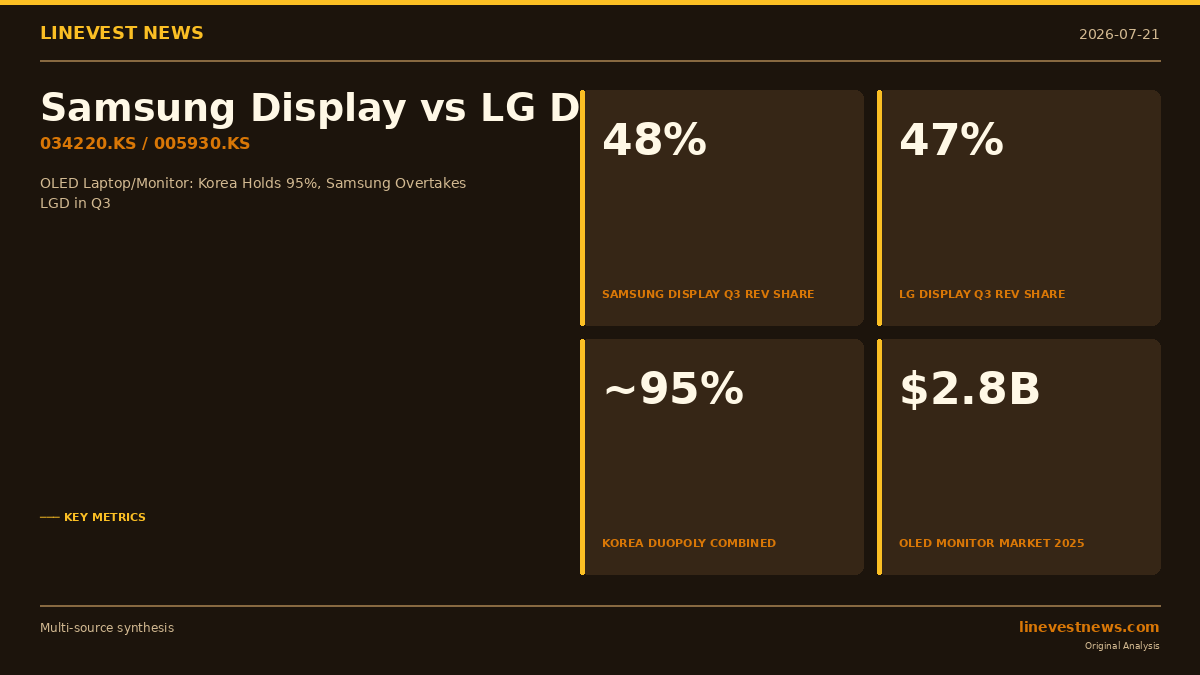
TL;DR - Samsung Display is on course to overtake LG Display in mid-to-large OLED (laptop and monitor panels) by revenue for the first time ever in Q3 2026, projecting a 48%-to-47% lead - By Q4 2026, the gap widens to 50% versus 45%, as Samsung leverages tandem OLED technology advantages - Korean manufacturers together command ~95% of the mid-to-large OLED segment; Chinese rivals EverDisplay (~4%) and BOE (~1%) "barely register," according to Omdia - LG Display (034220.KS) reports Q2 2026 results on July 22 — the stock is priced for a trough, with FY2026 consensus operating profit of ₩1.12T (+117% YoY) if H2 recovery materializes
Part A: The Historic OLED Inflection Point
Samsung Display Crosses the Revenue Threshold
For most of the past decade, LG Display held the undisputed lead in large-format OLED panels — the technology it pioneered and used to power premium OLED televisions, laptops, and monitors. But a structural shift is now underway.
According to market researcher Omdia, Samsung Display is projected to overtake LG Display in the mid-to-large OLED segment by revenue in Q3 2026 for the first time:
| Segment | Samsung Display | LG Display | Combined (Korea) | China (BOE + EverDisplay) |
|---|---|---|---|---|
| Q3 2026 revenue share | 48% | 47% | ~95% | ~5% |
| Q4 2026 revenue share | 50% | 45% | ~95% | ~5% |
The reversal is driven by Samsung Display's superior tandem OLED technology — stacking two emitter layers to achieve 1,600 nits of brightness (40% above conventional OLED), earning VESA's newly introduced True Black 1400 certification. Samsung also held commanding unit-share positions already in Q2 2026: 71% of global laptop OLED panels and 79% of monitor OLED panels shipped bore Samsung Display glass.
LG Display, meanwhile, is not standing still. Its fourth-generation RGB OLED architecture uses separate red, green, and blue emitting layers for more precise color accuracy, while Black Frame Insertion technology reduces motion blur in gaming applications. LGD has publicly committed to expanding gaming and monitor panel shipments from roughly 10% of its large-format OLED output to 20% in 2026 — a 1.5x-to-2x volume increase — signaling an aggressive push to recapture share.
The Market They Are Both Winning
The context matters: Samsung and LG are competing against each other inside a market they jointly dominate at nearly 95%. Chinese rivals lag dramatically.
EverDisplay holds only ~4% of the mid-to-large OLED segment, while BOE Technology — which has made aggressive inroads in smartphone OLED — registers only ~1% in laptop and monitor panels. The technical barrier is yield: manufacturing large-format OLED at competitive quality and cost requires process expertise that took Korea's two champions years to develop.
Lee Mi-hye, a senior researcher at the Export-Import Bank of Korea, cautions that the Chinese technology gap "has narrowed to about two years" in laptop and tablet OLED — down from a prior three-to-four-year lead. Korean companies have bought time, but the window is not permanent.
The OLED Monitor Boom
The battleground has expanded rapidly. The global OLED monitor market grew 74% in 2025, from approximately USD 1.6 billion to USD 2.8 billion, per Omdia. The 2026 outlook calls for another ~29% expansion to roughly USD 3.6 billion. Within the broader monitor market, OLED now commands 16.9% overall penetration (up from 0.8% in 2022), but in the premium tier — panels priced above USD 800 — OLED has vaulted from 2.4% to 60.6% penetration. The premium monitor buyer has effectively adopted OLED as the default.
Samsung Display currently captures 74.5% of OLED monitor revenue (Omdia), with its QD-OLED (Quantum Dot OLED) technology offering distinctive color volume advantages for HDR content. LG Display holds 25.5% but has been investing in "Penta Tandem" and RGB architecture panels designed to close the brightness and contrast gap.
Part B: What This Means for Korean Display Investors
LG Display: The Investment Case for a Trough
LG Display (034220.KS) reports Q2 2026 results on July 22 — Tuesday — at a moment when the near-term picture looks challenging but the medium-term recovery thesis is the core investment argument.
Q2 2026 consensus estimates (FnGuide): - Revenue: ₩5.6T–₩5.7T - Operating loss: ₩83B–₩119B (driven by one-time restructuring charges) - For context: Q1 2026 delivered OP of ₩147B (+2.7% margin), roughly 3× the Q1 2025 level
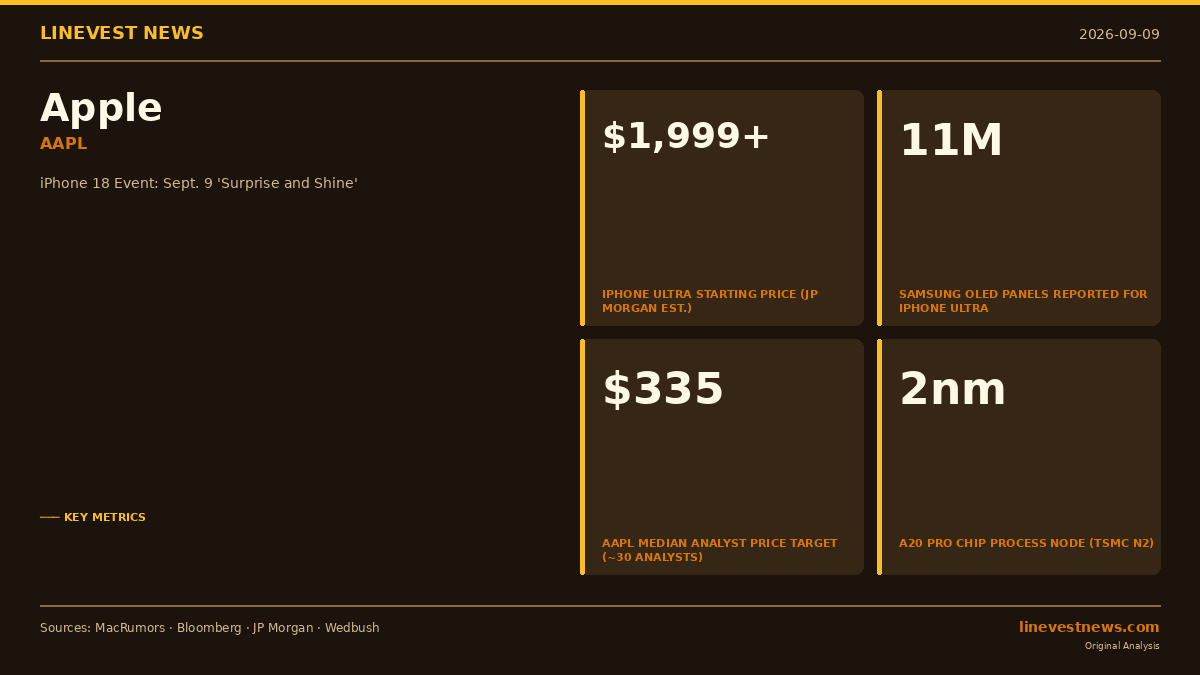
The restructuring charges are the critical variable. Analysts expect LGD is front-loading costs in Q2 to facilitate a cleaner H2 2026 recovery — particularly as Apple's iPhone 18 cycle, scheduled for launch in the fall, is expected to drive significant OLED panel demand, with LGD targeting approximately 85 million panels for Apple's 2026 device lineup (iPhone 18 + Apple Watch), with BOE excluded from premium slots.
FY2026 consensus operating profit: ₩1.12T — a 117% increase from FY2025's ₩517B. That recovery trajectory, if it materializes, reframes the Q2 loss as a temporary trough, not structural impairment.
The stock at ₩14,100 carries an average analyst target of ₩15,280, with 11 buy ratings against 3 sell recommendations — implying roughly 8.4% upside to consensus. For investors with a 12-month horizon, the trade is simple: LGD at trough valuations ahead of an Apple-driven H2 ramp.
The Competitive Risk: Samsung Takes Market Share, But the Pie Grows
The headline that Samsung Display is overtaking LGD in mid-to-large OLED revenue reads as a negative for LGD, but context matters for equity investors.
First, the absolute market is expanding. A 47% share of a $3.6B market in 2026 is worth more than a 55% share of a $2.0B market. LGD is participating in a growing pool of revenue even as its relative position softens.
Second, the shift is happening primarily in the monitor segment — an area LGD has historically under-indexed relative to Samsung Display. The core LGD strength has been large-format OLED TV panels (W-OLED technology), where it retains significant scale, and mobile panels for iPhones, where Apple's sourcing gives LGD a captive high-ASP customer.
Third, the Chinese threat timeline — Lee Mi-hye's "two-year gap" — implies that both Korean companies remain protected in the near term. BOE's 1% monitor OLED share makes the competitive dynamic between Samsung Display and LGD an internal Korean matter for now.
Samsung Display as a Hidden DS Division Asset
For holders of Samsung Electronics (005930.KS), the OLED laptop and monitor market is becoming a meaningful, if secondary, revenue story beneath the HBM memory narrative.
Samsung Display contributes to the SDC (Samsung Display Corporation) segment, which reported Q1 2026 operating profit of ₩0.4T — small relative to the DS (semiconductor) division's ₩53.7T but representing a profitable business feeding off the same AI computing megatrend. As enterprise laptops, AI workstations, and high-refresh gaming monitors all upgrade to OLED, Samsung Display's 71%+ panel share positions it as the primary beneficiary of that capex cycle.
Samsung Q2 2026 full results are due July 30, where the SDC segment performance will be disclosed in detail.
Korea vs. China: The Strategic Moat
The 95% Korean duopoly in mid-to-large OLED is not simply a market share number — it reflects a manufacturing moat built on yield engineering, materials science, and panel design that China has struggled to replicate at large formats.
For foreign investors tracking KOSPI, Korean display leadership provides a useful reference for how hardware manufacturing moats can persist in the face of well-funded Chinese competition. Unlike in commodity DRAM — where CXMT (中芯存儲) is building capacity aggressively — the OLED panel market appears structurally harder to disrupt at large formats, where defect densities, thin-film transistor precision, and encapsulation chemistry compound in complexity.
The two-year technology gap that Lee Mi-hye cites for tablets and laptops remains a floor, not a ceiling. Both Samsung Display and LGD are investing in next-generation emitter materials (thermally activated delayed fluorescence and phosphorescent blue) that could reset the gap before BOE scales.
Disclaimer: This article is published for informational purposes only and does not constitute investment advice. LineVest News is not a registered investment adviser. Past performance is not indicative of future results.
Sources: - Samsung, LG widen smartphone OLED lead over Chinese rivals — Korea Herald - Korea keeps China at bay in large OLED race — Korea Herald - Omdia: the OLED monitor market grew 74% in 2025, and will continue to grow 30% in 2026 — OLED-Info - International OLED monitor market revenue surges 74 percent as Samsung and LG lead innovation — Technetbooks - OLED Monitors Storm the Premium Segment — TrendForce