TL;DR - Kakao Bank (323410.KS) union voted for a full-day strike on July 31, after wage negotiations with management collapsed at mediation - Kakao Corp (035720.KS) headquarters talks have been deadlocked for two months, with management repeatedly cancelling negotiation sessions - Core dispute: union demands 13–14% of operating profit as performance incentives; management's offer is ~10% - Salary increase negotiation stuck in the upper-6% range - Q1 2026 saw record quarterly earnings across the Kakao group — fueling employee demands - Kakao Pay and Kakao Enterprise have completed wage negotiations; Kakao Bank and Kakao Corp remain deadlocked
Part A: What Happened
Kakao Bank's labor union — affiliated with the Korean Confederation of Trade Unions (KCTU) chemical and textile sector — formally declared a full-day walkout for July 31, 2026, after mediation by the Gyeonggi Regional Labor Commission broke down on July 20. The union and management failed to narrow differences on two core issues: performance-based incentive ratios and annual salary increases.
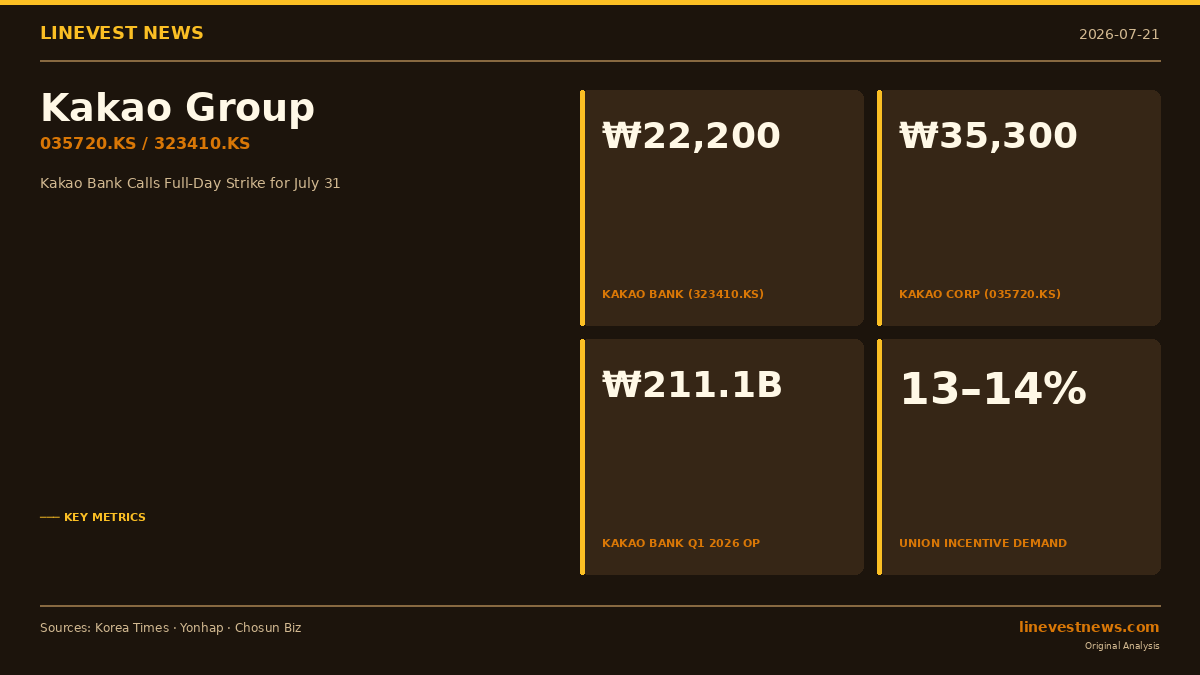
Management proposed incentives of approximately 10% of operating profit, combining cash payments and company stock. The union has demanded 13–14% of operating profit. On salary, negotiations had been proceeding in the upper-6% range but stalled without resolution.
Kakao's parent-company union, Crew Union (크루유니언), held a noon picket outside Kakao's Pangyo headquarters on Tuesday, marking the third collective action since May 2026. Formal wage talks at the parent entity have been suspended after management repeatedly cancelled scheduled sessions over two months. The union formally demanded a resumption and left open the possibility of further strikes depending on progress.
The picture across the broader group is uneven: Kakao Pay (377300.KS) and Kakao Enterprise have successfully concluded negotiations, while Kakao Bank and Kakao Corp remain at impasse.
The Crew Union's most recent precedent for full collective action was a full-day strike on June 29, preceded by a partial walkout in early June.
Part B: What It Means for Investors
Record Profits Set a High Bar for Union Demands
The timing of the dispute matters. Kakao Corp posted record Q1 2026 earnings: revenue ₩1.9421 trillion and operating profit ₩211.4 billion — both all-time quarterly bests. Kakao Bank matched this trend with Q1 2026 revenue of ₩1.94 trillion and operating profit of ₩211.1 billion (₩143 million at KRW 1,480/USD), also quarterly records. Kakao Bank net income came in at ₩187.3 billion, and Kakao Pay posted net profit of ₩32.2 billion, with both setting individual quarterly records.
With the group reporting the strongest quarter in its history, employees are anchoring demands to operating performance. The 13–14% threshold the union cites translates to approximately ₩27.5–29.6 billion in incentive payments from Kakao Corp's Q1 operating profit alone — a figure that rises substantially if annualized based on run-rate earnings.
July 31 Strike: Operational Risk, Bounded but Real
For Kakao Bank — an internet-only bank serving over 24 million registered accounts in South Korea — a single-day walkout carries manageable but non-trivial service risk. Unlike branch-based incumbents, Kakao Bank's operations are fully digital, which limits customer-facing branch disruption. However, settlement operations, back-office processing, and customer service response times could be affected.
South Korean financial sector strikes are subject to essential-service staffing provisions, requiring a minimum operational level to continue. Kakao Bank is expected to maintain core banking functions. Nonetheless, this would represent the first full-day work stoppage since the bank was founded in 2017, making it a milestone event for the company's labor relations history.
Labor Cost Trajectory: The Structural Question
The deeper concern for investors is what a settlement implies for the operating cost trajectory heading into H2 2026. A resolution above the 10% management offer would directly compress operating margins.
| Incentive Scenario | % of Q1 OP | Annual Cost (Q1 annualized) | Incremental vs. Offer |
|---|---|---|---|
| Management offer | ~10% | ~₩84.6B | — |
| Union midpoint | 13.5% | ~₩114.2B | +₩29.6B |
| Union ceiling | 14% | ~₩118.4B | +₩33.8B |
Based on Kakao Corp Q1 2026 OP of ₩211.4B annualized; excludes salary raise differential and headcount growth.
The salary raise dimension adds further complexity. A settlement at the upper end of the 6% range, applied to Kakao Corp's employee base, would represent a meaningful step-up in personnel costs. Kakao has been expanding headcount in its AI-driven services and platform businesses, amplifying the base on which any percentage increase compounds.
Market Reaction: Kakao Corp Holds, Kakao Bank Falls
As of July 21, Kakao Corp (035720.KS) was trading at ₩35,300 (+0.71%), with a market capitalization of approximately ₩15.6 trillion (~$10.5 billion). Kakao Bank (323410.KS) declined 1.55% to ₩22,200, implying a market cap of ₩10.6 trillion (~$7.2 billion). Kakao Pay (377300.KS), having already settled its wage dispute, rose 2.77% to ₩40,800.
The divergence carries a signal: the market appears to price the July 31 strike risk more directly into Kakao Bank's earnings while treating the parent's labor standoff as a longer-duration negotiating process. The settled subsidiaries — Pay and Enterprise — are effectively insulated from near-term labor cost uncertainty.
The relative calm in Kakao Corp shares also reflects the fact that the parent-level labor dispute has been a known overhang since at least early June, when the first partial strike occurred. Markets have had time to partially discount the risk.
What to Watch
- July 31: Whether Kakao Bank management returns to the table before the scheduled walkout — any resumed talks would be a positive signal
- Kakao Corp talks resumption: Management's formal response to the union's demand to reschedule sessions is the critical near-term catalyst
- Q2 2026 earnings: Kakao Corp is expected to report Q2 results later this month — whether management revises cost guidance will signal the likely settlement range
- Settlement precedent: Kakao Pay settled successfully; if Kakao Bank and Corp close near the 12–13% range, that figure is likely to become the benchmark for Korean internet-platform wage rounds in 2026
LineVest covers Korean equity markets for global investors. This article is for informational purposes only and does not constitute investment advice. All figures are derived from company filings, regulatory disclosures, and verified media reports.
Sources: - Korea Times, July 21, 2026: "Unionized workers at Kakao Bank to launch full-scale strike on July 31" - Korea Times, July 21, 2026: "Kakao's labor union to picket during lunch hours as wage dispute continues" - Yonhap News Agency, July 21, 2026 (multiple reports) - Chosun Biz, July 21, 2026 - Electronic Times (ET News), July 21, 2026 - Maeil Business Newspaper (MK), July 21, 2026 - Hankyung, July 21, 2026