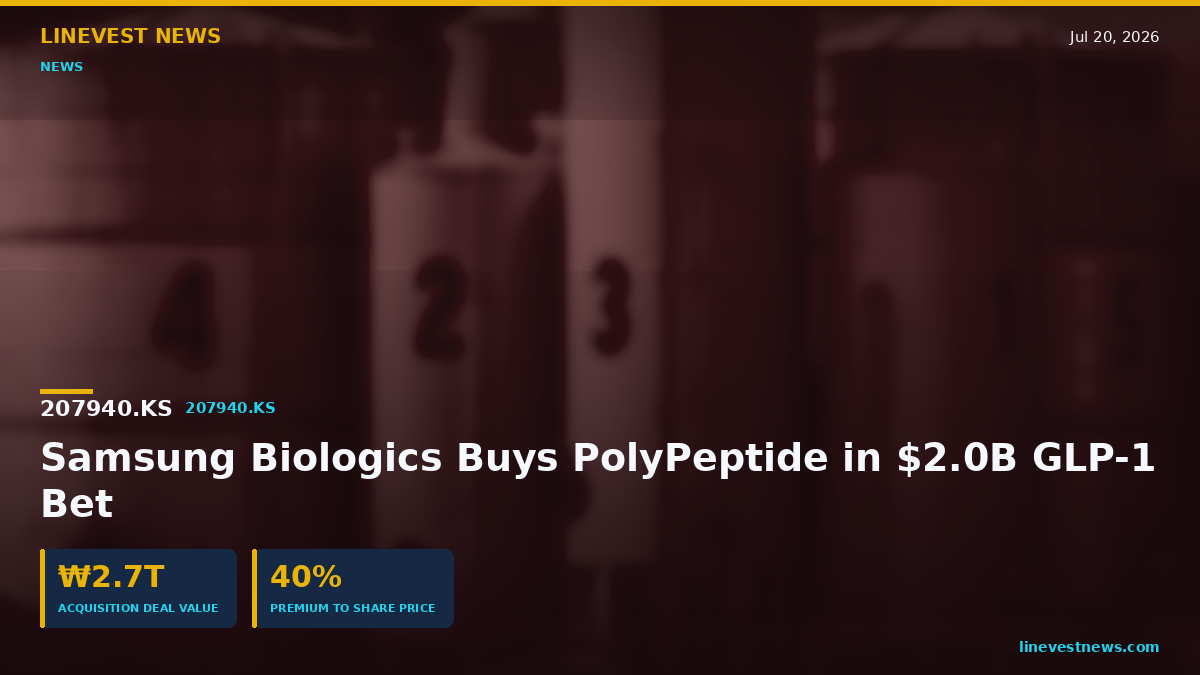
Samsung Biologics (207940.KS), the Songdo-based contract drug manufacturer within Korea's Samsung group, has agreed to acquire 100% of PolyPeptide Group AG, a Swiss-headquartered contract developer and manufacturer of therapeutic peptides, in the largest M&A ever struck by a Korean pharmaceutical or biotech company. The company disclosed the deal on July 20 (Chosun Biz; Yonhap).
The all-cash tender offer values PolyPeptide at CHF 44.31 per share, or roughly CHF 1.46 billion — about ₩2.7 trillion ($2.0 billion) — and is expected to close by the end of 2026 (Samsung Biologics press release, PR Newswire; Chosun Biz).
The one question: is the price fair, and what does Samsung actually get?
The headline premium looks rich but is more nuanced underneath. Samsung's offer is a 40% premium to PolyPeptide's CHF 31.65 close on April 10, 2026, yet only about 11.6% above the stock's 60-day volume-weighted average price, according to Samsung Biologics' own offer document (PR Newswire). Deal certainty is unusually high for a public tender: PolyPeptide's largest shareholder, holding 55.65% of outstanding shares, has given an irrevocable commitment to tender, and the independent board members unanimously recommend acceptance. The offer carries a minimum acceptance threshold of two-thirds (66⅔%) of fully diluted shares (PR Newswire).
What Samsung buys is a foothold in the fastest-growing corner of drug manufacturing. PolyPeptide — spun out of Swiss drugmaker Ferring's peptide unit in 1996 — brings more than 70 years of active-ingredient manufacturing heritage and a track record of over 1,000 therapeutic peptides produced, across six manufacturing sites in five countries (Sweden, Belgium, France, the United States and India), plus an innovation center in Strasbourg and roughly 1,500 specialist staff (Chosun Biz; PR Newswire). Crucially, peptides are the molecular backbone of GLP-1 obesity and diabetes drugs. The deal extends Samsung Biologics beyond its current antibody, antibody-drug-conjugate (ADC), fusion-protein and mRNA services into peptides. "This acquisition reinforces our long-term growth strategy by broadening our service portfolio with modality expansion into peptides including GLP-1," CEO John Rim said (PR Newswire).
Sizing the bet
At roughly ₩2.7 trillion, the transaction dwarfs any prior Korean pharma deal, and it is a direct play on obesity-drug demand. Global investment banks project the worldwide obesity-treatment market could reach as much as $150 billion (about ₩200 trillion) by 2035, with more than 170 peptide drugs currently in clinical development and over 80 already commercialized (Chosun Biz). Samsung says it will inherit PolyPeptide's existing CDMO contracts, giving it revenue from day one, and will weigh capacity expansion as demand grows.
The move mirrors the scramble by drugmakers to lock up scarce obesity-drug production. In 2024, Novo Holdings — the controlling owner of Wegovy maker Novo Nordisk — agreed to acquire contract manufacturer Catalent for about $16.5 billion, primarily to secure fill-finish capacity for its weight-loss franchise (CNBC; Fierce Pharma, 2024). Samsung is targeting the earlier drug-substance step — making the peptide itself — rather than fill-finish, positioning it as a neutral supplier to multiple GLP-1 developers rather than captive to one.
What to watch
The thesis is not confirmed until the tender clears. The specific data points that will validate or undercut it: whether the offer reaches its 66⅔% acceptance threshold, the timing of regulatory approvals across the U.S., Europe and India, and completion by year-end 2026. Beyond the mechanics, Samsung Biologics' next quarterly results and any disclosure of PolyPeptide's contract backlog will show how quickly peptides move from a strategic banner to booked revenue. Whether a 40%-premium deal at the top of the obesity cycle proves well-timed will hinge on demand holding through 2035, the horizon on which the entire investment case rests.
This article is journalism, not investment advice. LineVest is not a registered investment adviser. Figures are drawn from Samsung Biologics' disclosure and press release and Korean business media cited inline; the USD equivalent uses an approximate rate of 1 USD = 1,370 KRW and may differ from the CHF-denominated offer.