TL;DR
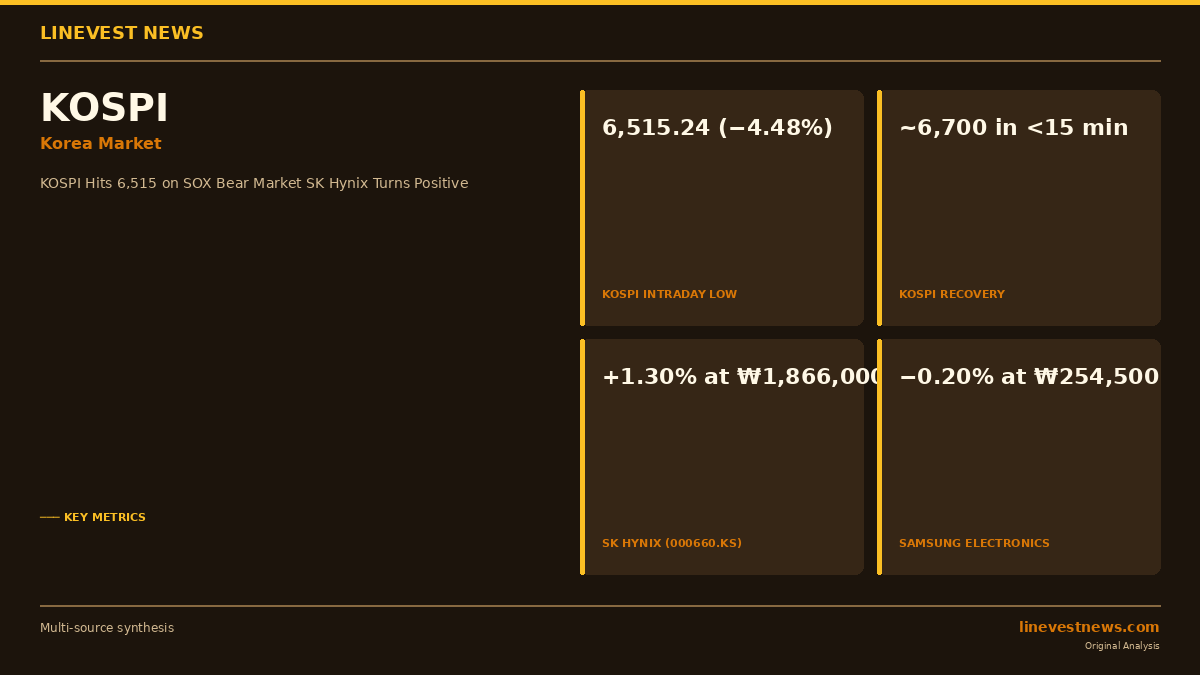
- KOSPI fell as low as 6,515.24 (−4.48%) at Monday's open before recovering to the 6,700 range within 15 minutes
- The Philadelphia Semiconductor Index (SOX) confirmed a bear market on July 17 — down 20.2% from its June 22 record high — despite TSMC's blowout Q2 2026 results
- SK Hynix (000660.KS) reversed early losses to trade +1.30% at ₩1,866,000 — traders appear to be positioning ahead of Wednesday's Q2 2026 earnings (consensus operating profit: ₩60–65 trillion)
- Samsung Electronics (005930.KS) recovered to −0.20% at ₩254,500 after a steep gap-down open
- Foreign investors net-bought ₩56.5–68 billion, absorbing retail panic selling of more than ₩134 billion
- Next key trigger: SK Hynix Q2 2026 earnings on July 22 (consensus OP ₩60–65T vs ₩9.38T a year earlier)
Part A — What Happened
South Korea's KOSPI opened on Monday, July 20, at 6,643.58 — down 177 points, or 2.60% — after Wall Street semiconductor shares continued their slide despite Taiwan Semiconductor Manufacturing Co. (TSMC) posting a blockbuster second quarter.
The index hit an intraday low of 6,515.24, a drop of 4.48% from Friday's close, within the first minutes of trading. The KOSDAQ opened at 773.21, down 2.35%.
The catalyst was the Philadelphia Semiconductor Index (SOX) entering official bear-market territory on July 17, finishing 20.2% below its June 22 record closing high. That record followed an extraordinary 105% rally from a March 2026 trough — a move powered almost entirely by expectations of AI infrastructure spending. Two forces are now reversing that re-rating: growing evidence that Chinese AI models such as Moonshot AI are achieving high efficiency at lower cost, and mounting investor doubt over whether the billions being committed to AI data centers will generate adequate returns.
The disconnect with TSMC's actual results is telling. TSMC's Q2 2026 revenue reached USD 40.20 billion (+33.7% year-over-year), gross margin expanded to 67.7%, and net income surged 77.4% YoY — results that exceeded analyst consensus on nearly every line. Yet the SOX continued to fall. That divergence suggests investors are repricing the sector's valuation multiples rather than cutting their earnings models.
Part B — Korea Market Analysis
SK Hynix's Reversal Is the Session's Key Signal
The most closely-watched development on Monday was SK Hynix (000660.KS) turning positive by mid-morning, rising +1.30% to ₩1,866,000 after opening sharply lower alongside the broader market. For investors watching the KOSPI semiconductor trade, this reversal is informative: the street appears to be accumulating SK Hynix ahead of its Q2 2026 earnings release on Wednesday, July 22.
The current sell-side consensus for SK Hynix Q2 2026 operating profit is ₩60–65 trillion — a year-over-year increase of approximately +540–593% compared to ₩9.38 trillion in Q2 2025. The driver is HBM (High Bandwidth Memory) for AI accelerators, a market where SK Hynix holds a leadership position with its HBM3E product. If the actual result meets or exceeds consensus, the "chip bear market" narrative could prove short-lived for Korea-listed semiconductor names.
Samsung Electronics (005930.KS) staged a comparable recovery — closing nearly flat at ₩254,500 (−0.20%) after opening well below Friday's price. Samsung's full Q2 2026 results are due July 30; its flash report released July 7 showed operating profit of ₩89.4 trillion (+1,810% YoY), providing a high baseline.
Foreign Investors Buy; Retail Sells
Investor flow data reinforces the institutional-accumulation thesis. Foreign investors recorded net purchases of approximately ₩56.5–68 billion during the session, while individual investors net-sold more than ₩134 billion. This pattern mirrors what occurred during the July 2 KOSPI decline, when both Samsung and SK Hynix fell more than 9% before recovering in the sessions that followed.
Broader Market Casualties
Not all sectors recovered. The auto segment bore a disproportionate share of Monday's losses, partly reflecting separate headwinds:
| Stock | Ticker | Change |
|---|---|---|
| Hyundai Motor | 005380.KS | −3.6% |
| Kia | 000270.KS | −3.8% |
| Samsung Life Insurance | 032830.KS | −4.8% |
| LG Energy Solution | 373220.KS | −2.6% |
| Samsung Electro-Mechanics | 009150.KS | +1.2% |
| SK Hynix | 000660.KS | +1.3% |
Geopolitics added an exogenous layer: US military strikes on Iran stoked energy supply concerns, dampening risk appetite and adding pressure on export-oriented Korean manufacturers already managing 25% US tariff exposure.
The Semaglutide Bright Spot
One outlier: Samchundang Pharm (삼천당제약) surged 29.8% — the daily upper limit — after the company disclosed receipt of a Pre-ANDA response from the US Food and Drug Administration, confirming it has entered formal consultation for its generic application for oral semaglutide. Semaglutide is the active ingredient in Novo Nordisk's Ozempic and Wegovy; an oral generic formulation targeting the US market represents a significant commercial opportunity in a GLP-1 market projected to exceed USD 150 billion by 2035.
What Should International KOSPI Investors Watch?
Han Ji-young, an analyst at Kiwoom Securities, described the current market as one that "reacts sensitively even to already-known negative factors," noting that the next decisive catalysts will come from domestic earnings — SK Hynix (July 22), KB Financial (July 23), Hyundai Motor (July 23) — as well as US mega-cap tech results from Alphabet and Intel.
For international investors holding Korean equities, Monday's session presents a layered risk framework:
- Earnings catalyst (July 22): A SK Hynix beat could re-anchor the KOSPI semiconductor trade. A miss, or cautious guidance, would likely extend the sell-off into the rest of the week.
- Valuation reset risk: The SOX's bear-market confirmation signals that AI-driven multiple expansion for chip stocks is under review globally. KOSPI semiconductor valuations are unlikely to fully disconnect from that repricing.
- Geopolitical overlay: US-Iran tensions introduce an exogenous risk variable that is difficult to model but historically adds volatility in the short term.
Monday's session ended with the KOSPI recovering the bulk of its opening losses — a broadly constructive sign given the severity of the early move. Whether that resilience holds depends heavily on what SK Hynix reports on Wednesday morning.
This article is for informational purposes only and does not constitute investment advice. LineVest News is not a registered investment adviser. Past price movements do not guarantee future returns.
Sources: - Seoul Economic Daily: KOSPI Plunges on US Chip Shock, Rebounds After Hitting 6,500 - Asia Business Daily: KOSPI Reduces Losses to 6,700 Level After Opening Lower - Bloomberg: Chips Stocks Sink Into Bear Market as 105% AI Rally Fizzles - Bloomingbit: Philadelphia Semiconductor Index Falls Into Bear Market After 20.2% Slide - TSMC Q2 2026 Earnings: Investor Relations