TL;DR
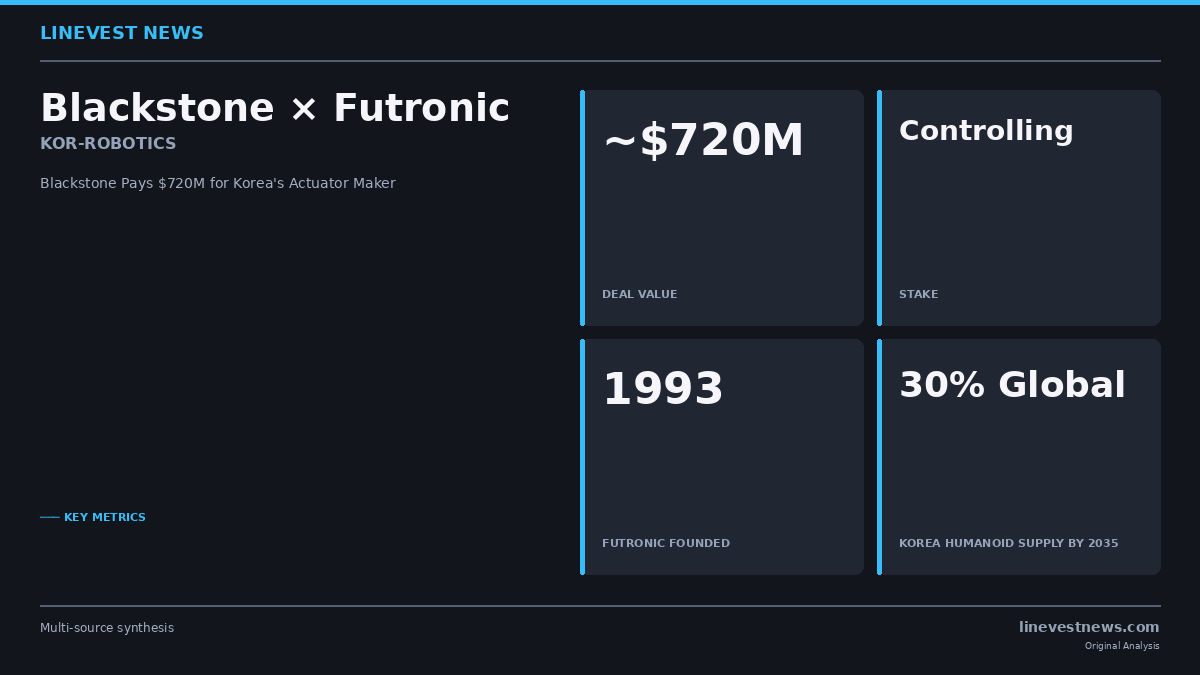
- Blackstone agreed to pay approximately $720M for a controlling stake in Futronic Co., a South Korean manufacturer of motion-control actuators founded in 1993.
- CEO Ko Jinho will stay on as chairman and chief executive; he becomes the second-largest shareholder after the transaction closes.
- Blackstone's thesis: Futronic's automotive-grade precision engineering can be redeployed to serve the fast-expanding humanoid robotics market.
- Goldman Sachs projects Korean supply chains will support 30% of global humanoid production by 2035 — the Futronic deal is the clearest signal yet that global capital agrees.
Part A — The Deal
What Futronic Does
Founded in 1993 and headquartered in South Korea with additional U.S. operations, Futronic has built its business around actuators — components that translate an electronic control signal into precise mechanical movement. Its traditional customer base has been carmakers and industrial robotics firms, where tolerances are tight and reliability requirements are unforgiving.
Over the past two years, Futronic has been systematically repositioning itself toward emerging mobility, humanoid robots, and the kind of factory automation that investors have spent the past year chasing alongside AI. The mechanical engineering principles that make an actuator work in a car's brake-by-wire system are essentially the same ones that make a humanoid robot's shoulder joint respond smoothly to a control signal.
Deal Structure and Terms
According to KED Global, Blackstone's affiliated private equity funds agreed to pay approximately $720 million for the controlling stake — a figure that Bloomberg and Seeking Alpha have alternatively characterized as reflecting a company valuation of roughly 1 trillion won ($676 million). The two figures are reconcilable: the $720M likely represents the total consideration paid for the majority position, while the $676M reflects an equity value at which the remaining minority interest is marked.
Ko Jinho, who founded Futronic three decades ago, will remain chairman and chief executive officer following the close of the transaction. The deal structure converts Ko from outright majority owner into the second-largest shareholder, retaining meaningful equity upside in the business he built.
Eugene Cook, Blackstone's head of Korea private equity, described Futronic as representing "the very best of Korea's mechatronics industry" — language that signals Blackstone views this as a platform play rather than a financial restructuring.
| Metric | Detail |
|---|---|
| Deal Size (KED Global) | ~USD 720 million |
| Implied EV (Bloomberg/Seeking Alpha) | ~₩1 trillion / ~USD 676 million |
| Stake Acquired | Controlling (majority) |
| Futronic Founded | 1993 |
| CEO Post-Deal | Ko Jinho (remains, becomes second-largest shareholder) |
| Blackstone AUM | USD 1.3 trillion+ (as of Q1 2026) |
| Blackstone Korea PE Lead | Eugene Cook |
Part B — Korea Market Impact
Blackstone's AI-Physical Convergence Thesis
Blackstone (NYSE: BX) has framed its industrial investment strategy around what it calls "AI-physical convergence" — the idea that artificial intelligence models are only as useful as the hardware that acts on their instructions. Actuators are exactly that hardware.
This is not Blackstone's first move in this direction. The firm has participated in Anthropic-related chip financing consortiums and invested in automation-adjacent businesses across Asia. The Futronic acquisition is its most direct bet yet that the physical world's infrastructure upgrade cycle will be at least as large as the software one.
Why Korea? Goldman Sachs Has an Answer
Global capital did not stumble into Korean robotics by accident. Goldman Sachs Research published an analysis of South Korea's humanoid robotics supply chain positioning in mid-2026, concluding that Korean companies are on a path to support approximately 30% of global humanoid production by 2035 — both through direct manufacturing and through critical component supply.
The quantitative projection breaks down as follows:
| Year | Korean Humanoid Unit Support (Estimate) |
|---|---|
| 2030 | ~74,000 units |
| 2035 | ~412,000 units |
The Korean government is moving in parallel. The Ministry of Trade, Industry and Energy's K-Humanoid Alliance — a consortium of more than 40 domestic robotics manufacturers, component suppliers, researchers, and government agencies — was formalized in April 2025. The government has budgeted approximately ₩700 billion ($473 million) in dedicated humanoid and robotics investment for 2026, with a production target of 1,000 humanoid units per year by 2029.
The Futronic Deal in Sector Context
The Futronic acquisition sits within a broader pattern of private equity flows into Korea's component-level robotics supply chain throughout 2026, according to DealStreetAsia. While Futronic is the largest single deal, it is part of a trend that includes smaller transactions in LIDAR, sensor fusion, and motor control companies.
For listed Korean investors, the Futronic transaction reinforces several existing investment themes:
1. Actuator demand is structural, not cyclical Humanoid robots require anywhere from 20 to 40 actuators each depending on the design. At projected 74,000 units by 2030 and rising toward 400,000+ by 2035, the addressable market for precision actuators grows in a non-linear fashion. Korea's existing automotive-grade actuator supply chain — Futronic, Hyundai Mobis, and others — is positioned to capture this demand without needing to build new manufacturing capability from scratch.
2. The auto-to-robot transition plays to Korean industrial strengths Korea's automotive supply chain — built over four decades of serving Hyundai, Kia, and their global peers — has exactly the precision engineering culture, quality systems, and mass-production capability that humanoid robot OEMs are looking for. Futronic's founding story, starting in automotive motion control and pivoting to humanoids, is likely to be repeated across several dozen Korean component suppliers over the next five years.
3. PE validation raises KOSDAQ multiples Blackstone's willingness to pay $720M for a controlling stake in a private Korean actuator maker with limited public financials establishes a meaningful valuation benchmark. Local investors and analysts who have been cautious about KOSDAQ robotics valuations — some describing them as exceeding demonstrated demand — now have a global reference point from one of the world's largest private equity firms.
Listed Korean Proxies for Foreign Investors
Since Futronic is not publicly traded and the controlling stake has been acquired by Blackstone, direct retail participation in the Futronic deal is not possible. Foreign investors seeking listed exposure to the Korean humanoid robotics supply chain may consider:
| Company | Ticker | Investment Angle |
|---|---|---|
| Rainbow Robotics | 277810.KQ (KOSDAQ) | Most direct listed humanoid pure-play in Asia; Samsung Electronics-majority owned |
| Doosan Robotics | KOSDAQ | Industrial cobot leader, IPO October 2023 |
| Hyundai Mobis | 012330.KS (KOSPI) | Most direct KOSPI proxy for the Atlas/Boston Dynamics supply chain |
| LG Innotek | 011070.KS (KOSPI) | Motors and vision sensors — components essential to robot actuation |
| LG Electronics | 066570.KS (KOSPI) | Internal robotics R&D plus supply relationship with LG Innotek |
Risk note: Multiple local Korean investors have flagged that KOSDAQ robotics valuations have moved ahead of demonstrated end-market demand. The Futronic deal validates the long-term supply chain thesis but does not accelerate near-term revenue visibility for listed names.
The Broader Signal
The Blackstone-Futronic deal is worth noting not just for its size but for what it implies about timeline compression. Three years ago, humanoid robots were a research-stage curiosity. Today, a $1.3-trillion AUM global firm is paying 1 trillion won to own the Korean actuator maker that it expects to serve them at scale.
For Korea's industrial equity complex, the question is no longer whether humanoid robotics is a real market. The question is which listed companies own the critical path in the supply chain, and how quickly that value gets priced in.
Sources: KED Global | Bloomberg | The Next Web | Seeking Alpha | DealStreetAsia | Goldman Sachs — South Korea's Growing Role in Humanoid Robot Development
LineVest is an independent financial news publication. This article is journalism, not investment advice.