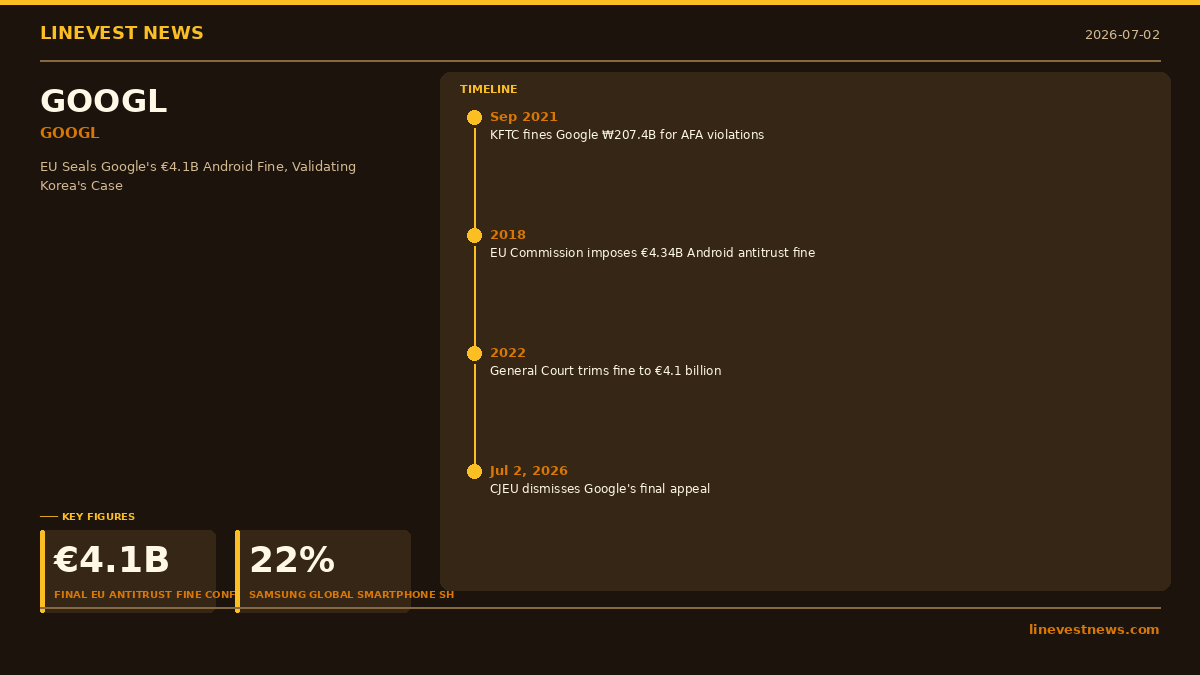
On July 2, the Court of Justice of the European Union (the EU's highest court, whose rulings cannot be appealed) dismissed the final challenge from Alphabet's Google unit to a record antitrust fine, confirming a penalty of €4.1 billion (about $4.7 billion) for using its Android mobile operating system to shut out rivals (Engadget; Investing.com).
For a portfolio manager, the fine itself is old news and financially minor for Alphabet. The sharper question is what the ruling settles as a matter of law — and here the Korea read-through is direct: Europe's top court has now put a final, un-appealable stamp on essentially the same theory of harm that Korea's own regulator used to fine Google in 2021, a case that runs through Samsung Electronics.
What the court actually confirmed
The European Commission (the EU's executive and antitrust enforcer) first imposed the penalty in 2018, originally at €4.34 billion, after finding Google forced device makers to pre-install Google Search, the Chrome browser and the Play store, and blocked them from shipping modified versions of Android known as 'forks.' The General Court trimmed the figure to €4.1 billion in 2022, and Thursday's judgment leaves that amount standing with no further right of appeal (Investing.com).
Google said it had 'adapted our agreements to comply with the initial decision back in 2018' and argued the judgment 'failed to take into account its investment to ensure Android remains open, interoperable and free' (Investing.com).
The Korea link runs through Samsung
In September 2021, the KFTC (Korea Fair Trade Commission, Korea's antitrust regulator) fined Google ₩207.4 billion ($176.9 million) for requiring smartphone makers to sign 'anti-fragmentation agreements' (AFAs) as a condition of app-store licenses and early Android access — contracts that stopped device makers from installing Android forks. The regulator pointed directly at Samsung Electronics (005930.KS), citing a 2013 episode in which Samsung launched a smartwatch on a customized operating system and then switched away after Google treated the move as an AFA breach (CNBC; Reuters via Investing.com).
The conduct Korea sanctioned — locking OEMs into Google's Android configuration and foreclosing rival builds — is a close cousin of what Brussels penalized. Thursday's ruling means the two largest developed-market competition authorities to have tested Google's Android contracts have both now landed on the same side, one of them with no route left to overturn.
That matters because of who sits on the other end of those contracts. Samsung was the world's largest smartphone vendor in the first quarter of 2026 with a roughly 22% global share (ahead of Apple's 20%), according to Omdia data cited by Android Authority — making it the single most important Android hardware partner globally. Any tightening of how Google may bind Android licensees flows first to the OEM shipping the most Android devices.
What to watch
The near-term financial impact on Samsung is not the story — its Galaxy franchise runs on Google's Android regardless. The forward question is regulatory: whether a now-final EU precedent emboldens further scrutiny of Google's OEM contract terms in Korea and elsewhere, and whether that reshapes the commercial arrangements — default search placement, app bundling, fork restrictions — that govern the relationship between Google and its largest hardware partner. Samsung's next quarterly results and any fresh KFTC commentary on Google's licensing practices are the concrete data points that would confirm or dispel a shift; until then, the ruling is best read as a hardening of the legal ground under those contracts rather than an immediate earnings event.
Sources: Engadget · Investing.com · CNBC · Android Authority
This article is for informational purposes only and does not constitute investment advice. Figures are drawn from the cited sources; currency conversions are approximate.