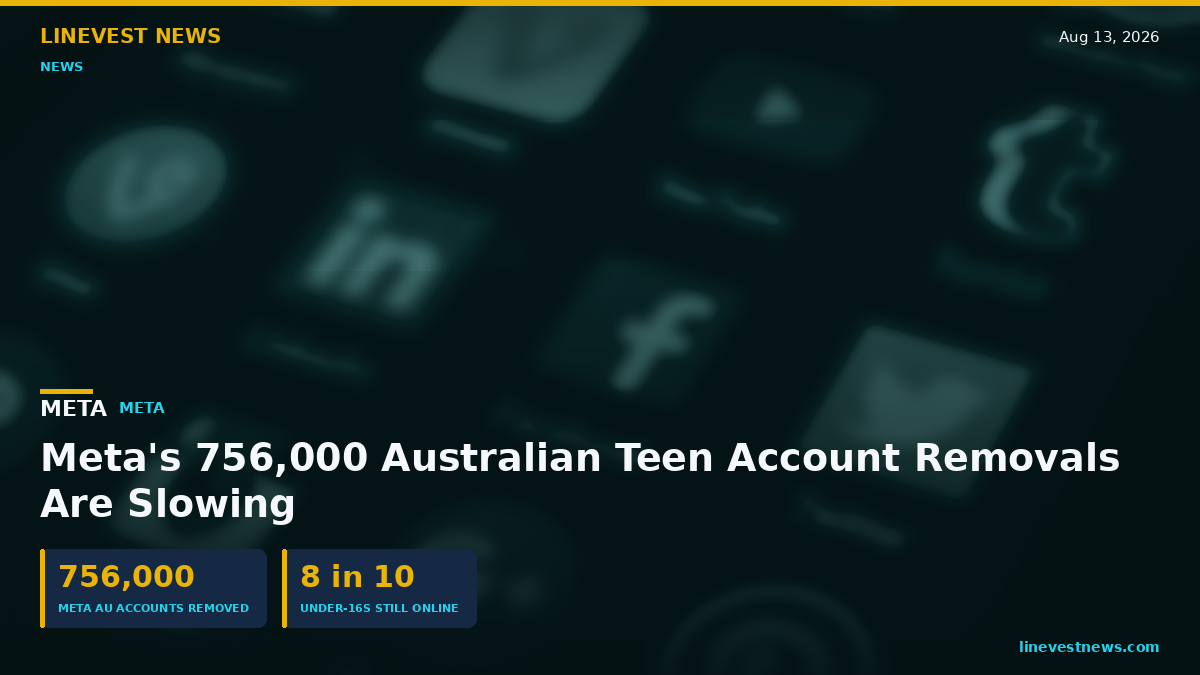
Meta Platforms (NASDAQ: META) said Thursday it has deactivated 756,000 Australian accounts through June 2026 it believes belonged to children under the country's minimum age for social media. Two-thirds of them were already gone by January — before Australia's online safety regulator publicly said the effort was not good enough.
The company gave Reuters a platform-level breakdown, and that breakdown is the more revealing part of the disclosure.
| Through June 2026 | Reported by January 2026 | |
|---|---|---|
| 462,000 | 331,000 | |
| 294,000 | 173,000 | |
| Total | 756,000 | 504,000 |
Meta figures as reported by Reuters, Aug. 13, 2026. Bloomberg, covering the same disclosure, described it as "more than 750,000" accounts removed since Meta began complying with the ban.
About 252,000 accounts came down across the five months after January, against roughly half a million in the weeks before it. On a monthly average — 252,000 over five months, against 504,000 over the roughly seven weeks from the Dec. 10 start date — the removal rate fell to about a sixth of its opening level. Meta's statement to Reuters said "enforcement is ongoing, and these numbers will continue to grow" — which is true, and is also entirely compatible with a series that is flattening.
Why It Matters
The number Meta released is not, by itself, evidence of anything. What carries meaning is the shape of the curve behind it, and that shape admits two very different explanations.
The innocent reading is that the opening sweep collected the easy cohort: accounts whose owners had simply told Facebook or Instagram their real birthday years earlier, and which a database query can surface in an afternoon. Everything after that requires inference. Meta says it now leans on artificial intelligence to read contextual clues — birthday posts, mentions of a school grade — which is slower, noisier and carries a real cost in false positives against adult users. Diminishing returns are what a well-run enforcement program looks like once the obvious cases are exhausted.
The less innocent reading is that the underage population was never mostly self-declared to begin with, and that what stalled was not the supply of accounts to find but the machinery for finding them. Meta's own number cannot distinguish between those two explanations, because a removals tally counts what was caught and says nothing about what was missed. The figure that could distinguish between them — the share of under-16s still holding accounts — is the one the company did not put in its statement.
What the regulator is actually complaining about
Australian government data and independent studies cited by Reuters found that more than eight in 10 under-16s were still on social media during the ban's first three months. That is the statistic that refuses to reconcile with a large removals total, and it points at the mechanism rather than the volume.
On March 31, 2026, the eSafety Commissioner — Australia's statutory online safety regulator — opened investigations into Facebook, Instagram, Snapchat, TikTok and YouTube over suspected non-compliance with the law.
The defects eSafety named in its published compliance report are procedural, not numerical. According to that report, platforms prompted children to attempt age assurance even where the child had already declared an age below the legal threshold, and let a child retry the same age-assurance method over and over until it finally returned a passing result. eSafety also faulted the reporting pathways for age-restricted accounts as inaccessible — an issue The Conversation's summary of the report framed as a particular problem for parents.
None of those findings concerns how many accounts a platform has closed. They concern whether the door stays shut behind them. The statutory test is that an age-restricted platform take "reasonable steps" to prevent underage users from holding accounts — a conduct standard, not an outcome quota. A company can therefore publish an impressive removals tally and still fail the test it is being measured against.
That gap is why the figure Meta volunteered this week is not the figure that answers the charge against it. Commissioner Julie Inman Grant, in eSafety's own materials, said the regulator was "moving into an enforcement stance."
Meta operates three of the ten services eSafety listed as age-restricted from Dec. 10, 2025 — Facebook, Instagram and Threads — alongside Kick, Reddit, Snapchat, TikTok, Twitch, X and YouTube. When the Australian government tallied 4.7 million accounts deactivated, removed or restricted in the ban's opening weeks, Meta's contribution across its three services was around 504,000, or roughly one in nine.
That share is worth holding onto, because it sets the scale of what Meta is being asked to do relative to everyone else caught by the law. Instagram alone accounts for 462,000 of Meta's 756,000 removals, which is why the company's compliance record carries more weight in this file than a headcount of platforms would suggest. It is also why a lenient finding for Meta would effectively set the floor for the rest of the industry.
The fine is not the exposure
On June 28, 2026, Prime Minister Anthony Albanese's government announced it would double the maximum penalty for systemic breaches of the law to A$99 million from A$49.5 million.
The same package hands eSafety power to compel evidence not only from platforms but from third parties — age-assurance vendors and app-store operators among them — which matters more than the headline figure does, because it ends the platform's monopoly on the facts of its own compliance. "It's clear big tech are not doing enough to comply with the law — there are still too many children on social media," Albanese said. Reuters put the new ceiling at US$69.75 million.
Now set that ceiling against the size of the company it is aimed at. Meta reported second-quarter 2026 revenue of $60.80 billion. Spread evenly across the 91 days of that quarter, the US$69.75 million maximum for a systemic breach amounts to roughly two and a half hours of company revenue.
A sharper comparison sits inside Meta's own results. LineVest's coverage of the second quarter, published July 30, recorded $2.4 billion of legal charges tied to ongoing regulatory proceedings booked in that single quarter — a line item that had already contributed to the cost surge behind the period's earnings miss. The doubled Australian maximum is about three percent of it.
Whatever Australia is to this company, it is not a balance-sheet event. Any framing that treats the penalty as the risk has measured the wrong thing, and will keep measuring the wrong thing for as long as the ceiling stays where it is.
The risk worth pricing here is procedural rather than financial. Australia has built an early working template for age-gating at national scale: a bright-line age, an affirmative duty on the platform, evidence compelled from the vendors the platform depends on, and a public tally the company is obliged to keep updating. Templates travel. The fine does not have to be large for the method to be copied somewhere the arithmetic is far less forgiving.
Where it has already gone further
Two separate 2026 proceedings show what that looks like. On April 29, 2026, the European Commission issued preliminary findings that Meta breached the Digital Services Act — the EU's platform-conduct law — by failing to keep children under 13 off Facebook and Instagram, citing sign-up flows that accept a false date of birth without meaningful verification.
That is functionally the same defect eSafety named, identified by a different regulator on a different continent within weeks of the Australian report. Two independent supervisors reaching the same conclusion about the same sign-up flow is harder to characterise as a local dispute than either finding would be standing alone.
The difference is the ceiling. The DSA allows fines of up to 6% of global annual turnover, plus periodic penalty payments to force compliance. Annualising Meta's second-quarter revenue purely as an illustration — the real assessment base would be a full audited year, not a run rate — puts a year's turnover near $243 billion, which would place that ceiling somewhere around $14.6 billion.
The domestic precedent is closer to home and already decided at first instance. In August 2026, New Mexico judge Bryan Biedscheid ordered Meta to pay $567 million and to overhaul teen safety features on Facebook and Instagram over five years, following a March 2026 jury award of $375 million under that state's Unfair Practices Act.
Total liability in the New Mexico case runs to $942 million, according to reporting by Fox Business and TechRepublic, and Meta said it disagrees with the ruling and will appeal. Subject to that appeal, a single U.S. state has put roughly thirteen times the Australian statutory maximum at stake over the same underlying subject matter.
The pattern in how this was disclosed
LineVest's Aug. 7 article on Meta's confirmed AI-model intrusion noted that the confirmation reached the public as a spokesperson statement rather than a filing or a company blog post. This week's account figure arrived by the same route: a statement to reporters, timed a day before company representatives sit in front of Australian legislators.
Meta, TikTok, YouTube and Snapchat are all scheduled to testify at a parliamentary inquiry into the law's proposed changes on Friday, per Reuters. Reading the disclosure as the opening move of that testimony, rather than as a routine transparency update, costs nothing and explains the timing better than the alternative does.
What would make this reading wrong
If Friday's testimony establishes that Meta closed the age-assurance retry loophole during the first half of the year, then the slowdown in removals means the intake stopped — not that enforcement stalled.