Nelson Peltz has circled Wendy's before. In 2022 his firm, Trian Fund Management, announced it was exploring a takeover — and then walked away. On Tuesday, August 12, the Financial Times reported that Trian is preparing a second attempt, this time with two co-investors lined up and shares responding immediately.
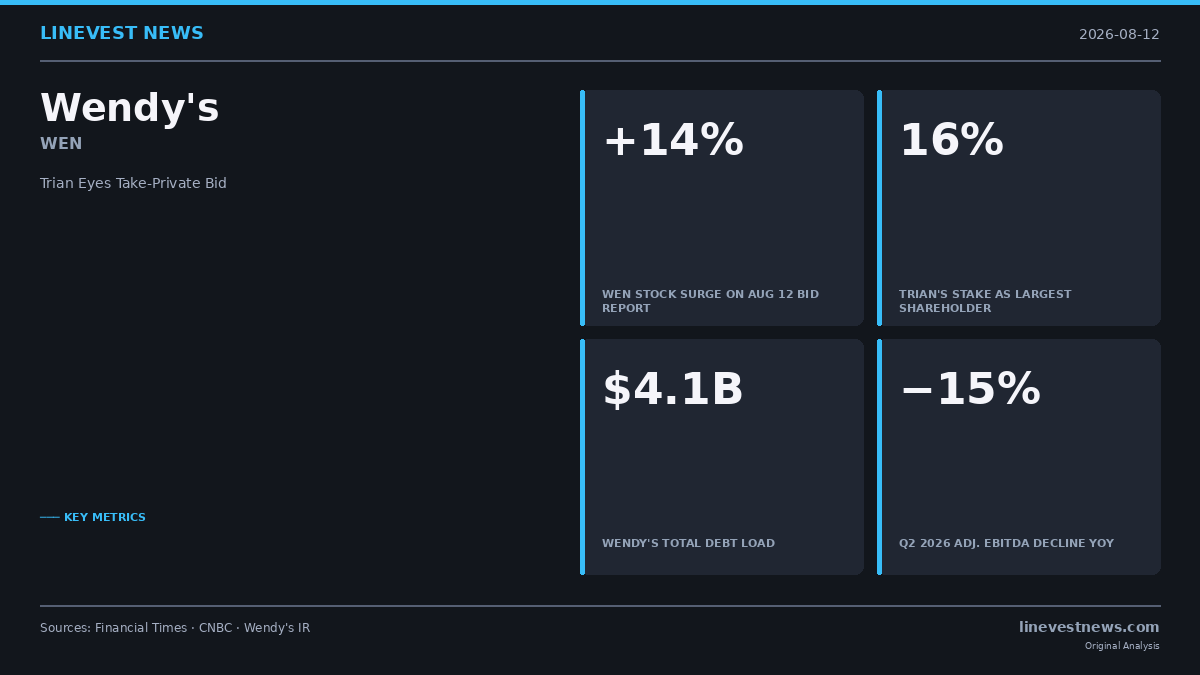
TL;DR - Trian Fund Management (16% stake, largest shareholder) is assembling a consortium to take Wendy's (NASDAQ: WEN) private. - Co-investors include Abu Dhabi-based BlueFive Capital and Flynn Group, the world's largest franchise operator (300+ Wendy's locations). - WEN rose ~14% on August 12 from a prior close of $7.55 to approximately $8.63, its biggest one-day gain since June 2025. - The central challenge: Wendy's already carries roughly $4.1 billion in debt and a Net Debt/EBITDA ratio of 7.33x — one of the highest leverage profiles in quick-service restaurants. - A formal bid has not been submitted; the FT cautioned that timing could change or the offer might not materialize.
Trian's Two Decades Inside Wendy's
Trian first bought into Wendy's in 2005. Three years later, Peltz's holding company Triarc — which already owned Arby's — purchased Wendy's in an all-stock deal. Triarc spun off Arby's to Roark Capital in 2011 to concentrate on the burger chain. Peltz spent seventeen years on the Wendy's board before stepping to chairman emeritus in 2024. As of this writing, Trian executive Peter May and Peltz's son Bradley still hold board seats.
Trian's current stake stands at approximately 16% of shares outstanding, making it comfortably the largest institutional holder. That embedded position has two implications for any bid: Trian does not need to negotiate its own rollover, and any special committee formed by the board will sit across the table from directors who are directly affiliated with the bidder.
In 2022, Trian disclosed it was exploring a takeover at a moment when shares were trading in the low $20s. The firm ultimately walked away without submitting an offer. Today the stock is less than half that level, which is the most concise explanation of why the conversation has reopened.
What the Books Look Like Now
Wendy's reported second-quarter 2026 results on August 12, the same day the FT story broke. The numbers are not flattering.
| Metric | Q2 2026 | Q2 2025 | Change |
|---|---|---|---|
| Total revenues | $570.6M | $561.0M | +1.7% |
| Adjusted revenues | $443.2M | $449.6M | −1.4% |
| Global systemwide sales | ~$3.4B | ~$3.64B | −6.5% (constant currency) |
| Adjusted EBITDA | $124.1M | $146.6M | −15.4% |
| Adjusted EPS | $0.18 | — | beat $0.17 estimate |
Source: Wendy's Q2 2026 press release, s1.q4cdn.com
Management withdrew the full-year 2026 financial outlook entirely, citing a leadership transition and a turnaround plan still being evaluated. The company cut its quarterly dividend to $0.07 per share and stated it does not anticipate share repurchases in 2026. When a consumer company pulls guidance and suspends buybacks in the same quarter, it is signaling that it cannot yet see the bottom of the operating trough.
The balance sheet is more consequential for a take-private than the income statement. As of March 31, 2026:
| Debt Item | Amount |
|---|---|
| Long-term debt | $4,007M |
| Short-term debt and current maturities | $109M |
| Total debt (approx.) | $4,116M |
| Cash at Q2 end | ~$380M |
| Net debt (approx.) | ~$3,736M |
| Net Debt / EBITDA (TTM) | 7.33× |
Source: GuruFocus, Q2 2026 press release, FinanceCharts
A Net Debt/EBITDA of 7.33× places Wendy's at the upper end of leveraged restaurant credits. Most investment-grade QSR operators carry 3–5× leverage; Wendy's landed here through a deliberate "royalty securitization" financing strategy — selling bonds backed by the predictable cash flow from franchise royalties and licensing fees. The structure is common in franchise-heavy businesses (Restaurant Brands International uses a similar architecture) and is considered relatively stable as long as system sales hold. System sales did not hold in Q2.
The Take-Private Arithmetic
Working from public information, the enterprise value of Wendy's at Tuesday's pre-announcement close of $7.55 per share looks roughly as follows:
| Component | Estimate |
|---|---|
| Equity market cap (at $7.55, ~190M shares) | ~$1.44B |
| Net debt | ~$3.74B |
| Enterprise value (pre-announcement) | ~$5.18B |
| LTM adj. EBITDA (annualized Q2 run-rate) | ~$490–500M |
| Implied EV/EBITDA | ~10.4–10.6× |
LineVest estimates from public filings; market cap sourced from multiple wire reports.
A take-private typically carries a 20–30% premium to the undisturbed share price — in this case, somewhere in the $9.00–$9.80 range. That would push equity value to roughly $1.7–1.9 billion and enterprise value above $5.4–5.6 billion. At flat EBITDA, that is approximately 11–11.5× EV/EBITDA for the combined capital structure — before any acquisition financing layered on top.
Here is the difficulty. Trian cannot simply add more debt to a balance sheet already carrying $4.1 billion of it against less than $500 million of annual EBITDA. The royalty securitization notes have covenants and rating requirements of their own. A credible take-private at this leverage level would need to either (a) assume the existing debt, leave it largely in place and contribute mostly equity, or (b) refinance the debt at terms acceptable to the rated-note trustee. Either path requires the consortium to write a very large equity check.
Trian's 16% stake at $7.55 is worth approximately $230 million on paper. That is the floor of their equity contribution absent a margin call or co-investment. BlueFive Capital — described in reports as "sovereign-adjacent Middle Eastern capital" and known for its stake in Bugatti — would presumably provide the balance of the equity. Flynn Group, the franchisee with 300 Wendy's locations, brings operational legitimacy and knowledge of the system's economics rather than a large capital commitment.
What Changed Since 2022
The business has gotten worse, and the stock has gotten cheaper. That is the simplest version of why Trian is revisiting a deal it abandoned four years ago.
In 2022, Wendy's was trading near $22 a share. The EV/EBITDA was higher, and the operating profile — while already under pressure — had not yet deteriorated to the point of withdrawn guidance. Trian apparently concluded that the price was too rich for the risk and walked away. At $7.55, the equity slice of the deal costs roughly one-third of what it would have in 2022, even though the business is measurably weaker.
What has not changed is the debt. Wendy's net debt is roughly the same as it was four years ago, because the royalty securitization structure rolls rather than amortizes. The company has not meaningfully deleveraged. Any acquirer inherits that overhang.
Two other things have changed in Trian's favor. First, Nelson Peltz's son Bradley is on the board, giving Trian ongoing visibility into the company's plans and internal projections. Second, a turnaround plan is actively being reformulated under new leadership — which means an outside owner would be entering at the design stage rather than inheriting a plan already embedded in the culture.
The Consortium as a Signal
The choice of Flynn Group as a potential consortium member is analytically informative. Flynn is the world's largest franchise operator, running more than 2,600 total restaurants across multiple brands including 300+ Wendy's locations in eight U.S. states. A large franchisee joining a take-private of its own franchisor is unusual and potentially conflicted: Flynn's interests as a royalty-paying operator do not automatically align with Trian's interests as an equity holder in the royalty-collecting parent.
One reading is that Flynn's participation provides operational credibility and a built-in buyer for any incremental company-owned locations. Another reading is that Flynn is hedging its own position as a franchisee — if Trian takes the parent private and restructures the royalty terms or the supply chain, a seat at the table is worth having.
BlueFive Capital's inclusion points to the equity gap. Trian needs a capital partner with a large enough check and a long enough time horizon to accept illiquidity in a heavily-leveraged restaurant company undergoing a turnaround. A sovereign-adjacent Gulf investor fits that profile.
Three Things to Watch
1. Whether an offer is actually submitted. Trian explored this in 2022 and walked away. The FT's sources cautioned that timing could shift. The market is pricing a meaningful probability of a bid materializing; a withdrawal would reverse much of Tuesday's gain.
2. The special committee process. Wendy's confirmed it "would thoroughly review any proposal submitted by Trian consistent with its fiduciary duties." With Trian-affiliated directors on the board, any formal process will require a fully independent special committee and almost certainly fairness opinions from investment banks that have no prior relationship with Trian. That process is designed to take months and can produce a higher price than the initial offer.
3. The debt refinancing window. Wendy's noted in its Q2 release that it anticipates refinancing approximately $430 million of notes maturing in March 2028, either later this year or in early 2027. A pending take-private would complicate, or accelerate, that decision. If rates move or credit markets tighten, the financing window shrinks for both the company standalone and for any acquirer.
Sources: Financial Times via CNBC · Wendy's Q2 2026 press release · QZ · GuruFocus WEN debt · BigGo Finance · Seeking Alpha · Restaurant Dive · Forbes
This article is journalism, not investment advice. LineVest News is not a registered investment adviser and holds no position in any security mentioned. All financial figures are sourced from public filings and wire reports; readers should verify against primary sources before making any investment decision.