TL;DR - Chipotle (NYSE: CMG) switched jalapeño suppliers on July 20 — more than two weeks before the FDA formally identified the ingredient as the outbreak source on Aug. 5. - The company's automated "Guac Signal" traceability system notified restaurants and ordered destruction of tainted peppers before federal agencies acted, according to Bloomberg. - The CDC has recorded 345 confirmed illnesses across 27 states, 36 hospitalizations, and zero deaths as of Aug. 11, 2026. - Taylor Farms issued a downstream recall on Aug. 9, pulling jalapeño products from Walmart, Target, Whole Foods, and Trader Joe's. - CMG fell 9.7% on Aug. 4 — the day it pulled jalapeños from affected locations — and has declined roughly 15% from its post-Q2 earnings high. - Twenty-four analysts maintain a Strong Buy consensus with an average price target of $44.05, implying ~38% upside from current levels.
Part A: The Outbreak and Chipotle's Rapid Response
How the Contamination Spread
The Salmonella Javiana outbreak traces to fresh jalapeños imported from Sinaloa, Mexico and distributed by Coast Citrus Distributors to restaurants, retailers, and food service operators across the United States. The FDA's active investigation, last updated Aug. 11, 2026, covers illness onset dates between June 19 and July 20.
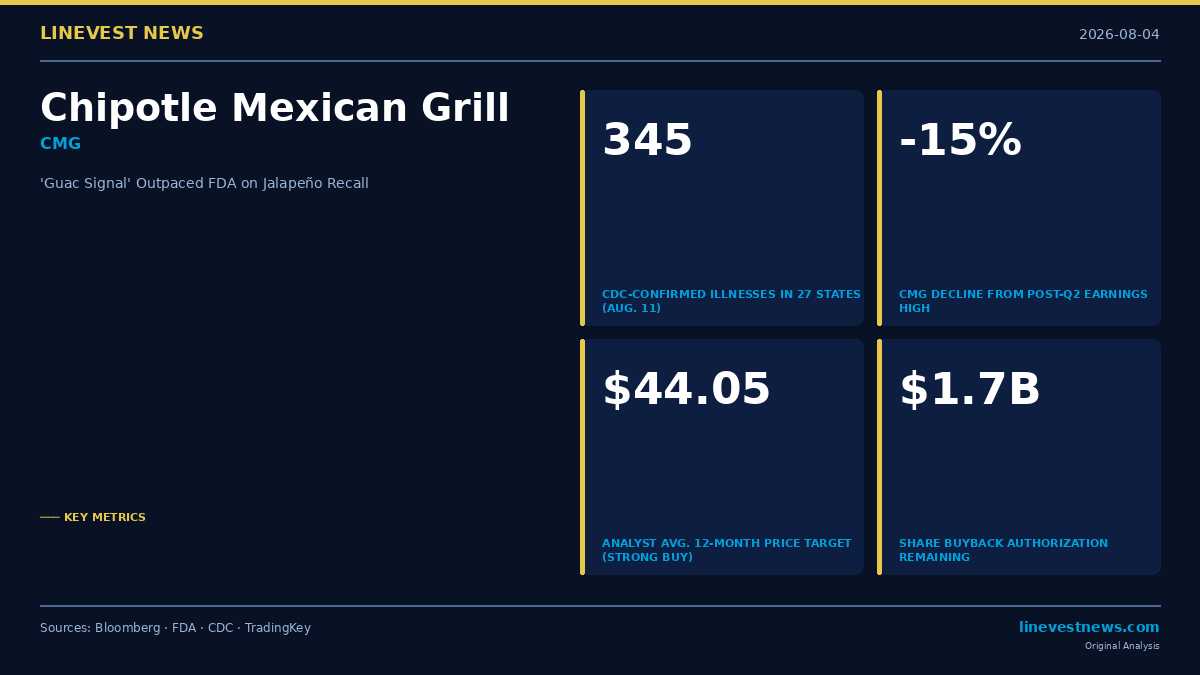
Restaurant exposure windows ran from June 14 through July 14. By Aug. 11, the CDC had recorded 345 confirmed illnesses in 27 states and 36 hospitalizations — no deaths have been reported. Ninety-three percent of interviewed patients reported eating at Mexican-style restaurants in the period before falling ill.
The outbreak extended well beyond Chipotle. QDOBA halted jalapeño service on July 28. On Aug. 9, Taylor Fresh Foods recalled jalapeño-containing ready-to-eat products — burritos, bowls, guacamole, salsas, wraps — sold under the Taylor Farms brand at Kroger, Stop & Shop, Hannaford, Target, Trader Joe's, Walmart, and Whole Foods.
The 'Guac Signal': Chipotle's Automated Defense
What sets Chipotle's response apart is not just its speed but its independence from federal regulators. According to Bloomberg's Aug. 11 reporting, Chipotle's RFID-based ingredient traceability system — dubbed the "Guac Signal" — identified the contaminated lot and began automated notifications to restaurants within hours of pinpointing the source grower.
The system called restaurants repeatedly, ordering destruction of all jalapeños from the implicated Coast Citrus shipment. Chipotle replaced the ingredient with supply from separate growers and switched suppliers across affected stores beginning July 20 — more than two weeks before the FDA formally linked the Mexican jalapeños to the outbreak on Aug. 5.
In a public statement, the company emphasized its "robust ingredient traceability system" and confirmed it stopped serving jalapeños at relevant locations as a precautionary measure. The swift action demonstrates the operational value of the traceability infrastructure Chipotle built after its 2015–2018 food safety crisis — a succession of E. coli, norovirus, Salmonella, and Clostridium perfringens outbreaks that cost the company years of traffic and billions in market capitalization.
Part B: Investor Analysis
The Two-Act Stock Story
For CMG shareholders, August 2026 has unfolded in two jarring chapters. In the first, Chipotle reported Q2 2026 results on July 29 that beat estimates across the board: revenue of $3.35 billion topped the $3.33 billion consensus, comparable-store sales rose 2.2% (1.2 percentage points from transaction growth and 1.0 point from ticket size), and adjusted EPS of $0.33 edged past the $0.32 forecast. Management raised annual sales guidance to "low-single-digit" same-store growth and reaffirmed plans to open 350–370 new restaurants in 2026, with 80% including a Chipotlane drive-through pickup lane. The market rewarded those results with a +12% one-day rally, the stock reaching the mid-to-upper $30s.
The second chapter arrived Aug. 4 when the Minnesota Department of Health linked 110 cases to Chipotle. The stock dropped 9.7% to $33.83, with trading volume surging to 48 million shares — 146% above the three-month average of 19.5 million. By Aug. 11, CMG was trading near $32.00, a decline of approximately 15% from its post-earnings high, and down 13.5% year-to-date.
How This Compares to 2015–2018 — and Why the Comparison Matters
Investors instinctively reach for the historical template: the 2015–2018 multi-outbreak crisis during which CMG fell more than 50% peak-to-trough and took years to recover same-store traffic. That template arguably does not apply here, for several structural reasons.
First, the 2015–2018 crisis involved successive outbreaks across multiple pathogens at Chipotle's own restaurant-level operations — implicating the company's kitchen procedures directly. The current outbreak traces to a third-party ingredient supplier, Coast Citrus Distributors, and affected multiple restaurant chains and retail brands simultaneously. Chipotle is one node in a broader recall, not the sole vector.
Second, the operational response speed is categorically different. In 2015, the chain struggled for months to identify sources while outbreaks continued. In 2026, the "Guac Signal" traced the grower and replaced supply within days, demonstrating that the company's post-crisis food safety investment — which has been a significant operating expense since 2016 — has functional value.
Third, the scale is distinct. The 2026 CDC investigation covers 345 illnesses over a roughly one-month window; the 2015 E. coli outbreak was narrower in case count but caused more reputational damage because Chipotle could not quickly pinpoint the source. The current situation carries litigation risk, but the legal exposure is likely shared across the supply chain.
Q2 2026: The Financial Foundation Underneath the Headlines
The outbreak does not change the Q2 results, but it overlays them with uncertainty. Investors should be aware of several financial dynamics:
| Metric | Q2 2026 | Year-Over-Year |
|---|---|---|
| Revenue | $3.35B | Beat $3.33B est. |
| Same-store sales growth | +2.2% | Traffic +1.2pp / Ticket +1.0pp |
| Adj. EPS (non-GAAP) | $0.33 | Beat $0.32 est. |
| Restaurant-level op. margin | 25.2% | Down from 27.4% |
The margin compression is real: restaurant-level operating margin fell 220 basis points year-over-year to 25.2%, driven by food costs and wage pressure. On a GAAP basis, net income declined to $403.5 million from $436.1 million in the prior-year period — a 7.5% drop despite higher revenue, reflecting those same cost pressures.
The company also flagged a Cyclospora-related incident that struck within Q3 (Chipotle's Q3 runs July–September) and is estimated to have cost roughly two percentage points of comparable sales — separate from the salmonella issue. Combined with the jalapeño recall, Q3 same-store sales are already under meaningful pressure from the outset of the quarter.
Buyback as a Floor Signal — and What Analysts Say
One data point that matters for long-term investors: Chipotle deployed $631 million in Q2 buybacks at an average price of $32.55 per share, with $1.7 billion remaining under its current authorization. The company was actively repurchasing at levels near where the stock currently trades. Whether management continues or accelerates buybacks at these levels will be a signal watched closely in Q3 commentary.
On the analyst side, 24 research firms hold a Strong Buy consensus, with an average 12-month price target of $44.05 — implying approximately 38% upside from the Aug. 11 level near $32. The lowest target visible in current coverage sits around $34; the high end extends toward $50. On the valuation side, Chipotle's P/E ratio around 29–33x forward earnings is below its own historical averages, providing some cushion for long-term investors if food safety concerns resolve quickly.
The key uncertainty investors face is traffic normalization timing. In 2015–2018, CMG's same-store traffic did not recover for roughly three years. In 2026, the question is whether the speed and decisiveness of the "Guac Signal" response, combined with the multi-chain nature of the outbreak, will truncate the consumer confidence damage to weeks rather than years. Early data — expected in Q3 guidance commentary — will be the first real test.
Sources: - Bloomberg: 'Guac Signal' Sparked Chipotle's Frantic Bid to Recall Jalapeños (Aug. 11, 2026) - FDA: Outbreak Investigation of Salmonella — Jalapeño, August 2026 - CDC: Salmonella Javiana Outbreak — Jalapeños - TradingKey: Chipotle Q2 2026 — Sales Beat but Salmonella Scare Hits Stock - Motley Fool: Chipotle Stops Serving Jalapeños at Certain Restaurants (Aug. 4, 2026) - CNBC: Taylor Farms Recalls Salsa, Guacamole on Salmonella Outbreak (Aug. 9, 2026) - Chipotle Newsroom: A Statement from Chipotle on Food Safety (Aug. 4, 2026)
This article is for informational purposes only and does not constitute investment advice or a recommendation to buy or sell any security. All figures cited from public company filings, FDA/CDC releases, and third-party analyst reports.