TL;DR - Former Disney CEO Bob Iger and Thrive Capital's Joshua Kushner have agreed to acquire Mark Walter's controlling stake in the Los Angeles Lakers at a $12.5 billion valuation — a record for any U.S. sports franchise, pending NBA Board of Governors approval. - The deal values the franchise 25% above Walter's own $10 billion purchase in June 2025; his rapid exit follows reports of a DOJ and SEC investigation into his insurance companies — Delaware Life Insurance and Clear Spring Life — and their business relationship with Guggenheim Partners. - The NBA's $76 billion, 11-year media rights package with Disney/ESPN, Amazon, and NBC, which launched in the 2025–26 season, established a structural pricing floor for franchise values ahead of this transaction. - Jeanie Buss retains her separate minority ownership stake and remains team governor; the Buss family's shares are not part of this sale.
The $12.5 Billion Agreement
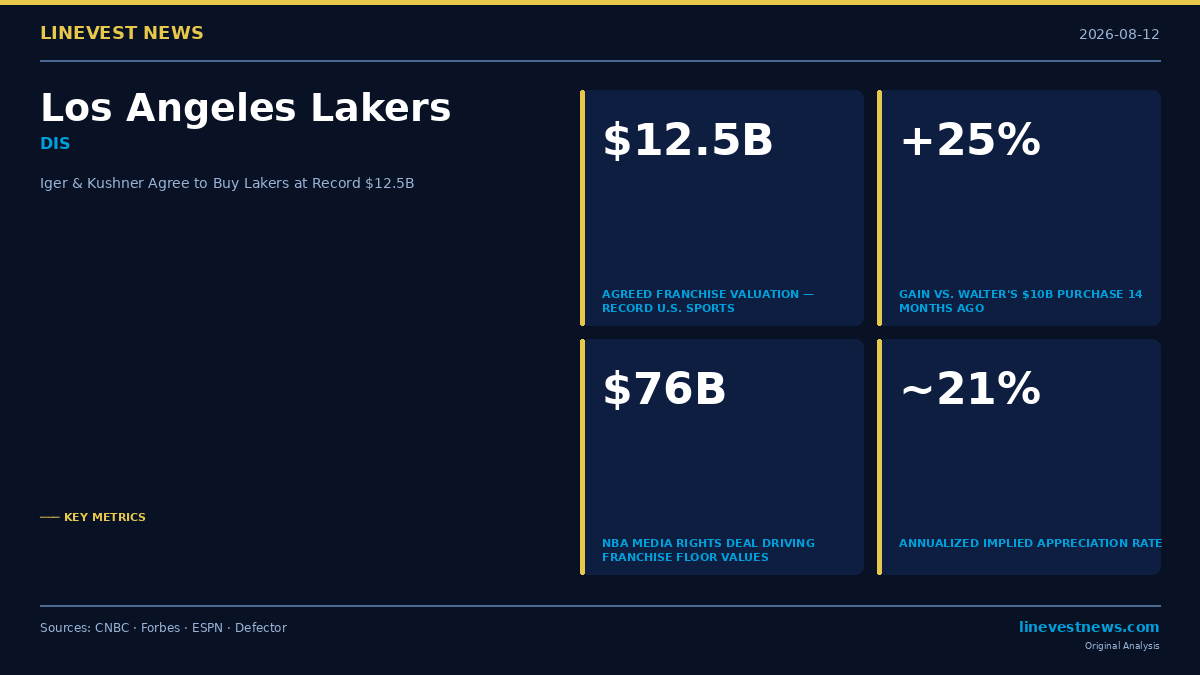
Bob Iger and Joshua Kushner have reached an agreement to acquire Mark Walter's controlling interest in the Los Angeles Lakers at a valuation of approximately $12.5 billion, sources told CNBC on August 12. Pending NBA Board of Governors approval, the deal would set a new record for the highest valuation paid for a U.S. professional sports franchise, surpassing Walter's own $10 billion acquisition from the Buss family in June 2025, which had itself broken the prior benchmark set by the Boston Celtics' $6.1 billion sale in March 2025.
Key Transaction Details
| Item | Detail |
|---|---|
| Implied franchise valuation | $12.5 billion (agreed price; pending approval) |
| Sellers | Mark Walter (controlling stake only) |
| Buyers | Bob Iger + Joshua Kushner (consortium) |
| Prior franchise record | $10B (Lakers, June 2025) |
| Record before that | $6.1B (Boston Celtics, March 2025) |
| Valuation appreciation | ~$2.5B (+25%) since Walter's purchase |
| Jeanie Buss | Retains separate minority stake, remains governor |
| Pending | NBA Board of Governors approval |
The agreement covers only Walter's shares. Jeanie Buss, daughter of late owner Jerry Buss, retains her separate minority stake and will continue to serve as governor of the franchise.
According to reporting by ESPN and Forbes, Iger and Kushner had originally engaged in the NBA's process to award an expansion franchise in Las Vegas. In a sudden pivot, the duo made an aggressive offer to acquire the Lakers outright, and the deal reportedly came together in a matter of days — an unusual timeline for a transaction of this size.
Walter's Quick Exit — and the Investigation Shadow
Mark Walter — chairman and chief executive of TWG Global, and the controlling owner of the Los Angeles Dodgers — purchased his Lakers controlling stake in June 2025. His exit roughly 14 months later is being scrutinized in the context of a federal investigation.
The U.S. Attorney's Office in Manhattan and the Securities and Exchange Commission have been investigating potential financial improprieties involving Walter's insurance companies — Delaware Life Insurance and Clear Spring Life — and their business relationship with Guggenheim Partners. The Wall Street Journal previously reported that billions of dollars in loans extended to companies connected to Walter or TWG Global ended up on the books of the insurance companies after passing through a third entity. Insurance companies face strict regulatory oversight because policyholder funds must remain available to meet claims.
The investigation's key timeline: - September 2025: Federal agents seized laptops and phones at Walter's firm — three months after his Lakers purchase - February 2026: Insurance companies received subpoenas - July 2026: Credit agencies placed Delaware Life on negative watch
Walter has stated no plans to sell his ownership stake in the Dodgers; the Lakers agreement involves only his Lakers shares.
The Buyers: Iger, Kushner, and the Thrive Connection
Joshua Kushner, 41, is the founder and managing partner of Thrive Capital, a New York-based venture firm. Thrive's portfolio includes early positions in Instagram, Spotify, Stripe, and OpenAI — a track record that places Kushner in the top tier of technology and alternative-investment circles. He is the younger brother of Jared Kushner.
Bob Iger, who led Disney for nearly two decades across two separate stints, stepped down from the CEO role in March 2026. Following his departure, he took on an advisory role at Thrive Capital — the relationship that positioned the two men to pursue an NBA expansion franchise in Las Vegas and, ultimately, to redirect their ambitions toward acquiring the existing Lakers franchise.
Iger's Disney tenure is directly relevant here: under his leadership, Disney signed a $2.6 billion per season agreement that retained ABC and ESPN's NBA rights as part of the league's broader $76 billion media package. He understands the structural economics of NBA rights at a level few other potential buyers could claim.
NBA rules allow institutional investors — including private equity — to hold up to 20% of a single franchise (individual funds are capped at 20%, with an aggregate institutional ownership ceiling of 30% per team), a framework approved in 2020 that has accelerated the flow of institutional capital into professional sports.
The Media Deal That Reset NBA Values
The most significant structural change affecting NBA franchise valuations is the league's media rights agreement, finalized in July 2024 and effective starting the 2025–26 season — predating Walter's June 2025 $10 billion purchase and therefore already embedded in that benchmark price.
| Partner | Annual Value | Key Rights |
|---|---|---|
| Disney (ESPN / ABC) | $2.6 billion | Largest package; NBA Finals exclusive |
| Amazon (Prime Video) | $1.8 billion | 66 regular-season games; NBA Cup knockout rounds and final |
| NBCUniversal (NBC / Peacock) | Remainder | Regular season (second package) |
| Total | ~$6.9 billion/year | 11-year term through 2035–36 |
The new deal represents a 160% increase per season versus the prior contract. Because this repricing was publicly signed before Walter's $10 billion purchase, the subsequent $2.5 billion appreciation from $10 billion to $12.5 billion must be attributed to additional factors: further conviction about monetization timelines, scarcity of available top-tier franchises, and competitive buyer interest from high-net-worth individuals and institutional capital.
Historical context underscores how quickly these valuations have moved:
| Year | Transaction | Price |
|---|---|---|
| 1979 | Jerry Buss buys Lakers (+ Kings + The Forum) | $67.5 million |
| March 2025 | Boston Celtics | $6.1 billion |
| June 2025 | Lakers (Buss family → Walter) | $10 billion |
| August 2026 | Lakers (Walter → Iger/Kushner) | ~$12.5 billion |
Investor Analysis: What This Means for Public-Market Investors
1. Media Partners Are the Structural Beneficiaries
For investors who cannot buy private sports franchises, the nearest listed proxies are the companies whose rights payments underwrite franchise economics:
- Disney (NYSE: DIS) — ESPN/ABC's $2.6 billion annual commitment is the cornerstone of the NBA's revenue model. Iger's personal move from running Disney to owning an NBA franchise is a notable coda: the architect of Disney's NBA deal now sits on the receiving end of its economics as a franchise owner.
- Amazon (NASDAQ: AMZN) — At $1.8 billion per year, Prime Video's NBA deal is part of the broader strategy to use live sports to sustain Prime membership engagement and video monetization.
- Comcast (NASDAQ: CMCSA) — NBCUniversal returns to NBA broadcasting after more than two decades away (it previously held rights through 2002), a strategic bet on live sports as linear cable's most durable content format.
2. Franchise Scarcity Commands a Meaningful Premium
A 25% appreciation in roughly 14 months on a $10 billion franchise valuation implies an annualized gain of approximately 21% — performance that compares favorably with top-tier private equity vintages. Unlike public equities, NBA franchises are illiquid, non-dividend-paying, and trade infrequently; the NBA itself controls who may own teams. That structural scarcity creates a persistent premium above what standard cash-flow models would justify.
3. The Distressed-Selling Question
Walter's accelerated exit, in the context of the ongoing federal investigation, raises a question sophisticated investors will ask: did selling pressure from the probe constrain his negotiating position? The deal reportedly came together in days, not months. It is possible that the $12.5 billion — while a nominal record — understates what a patient, non-pressured seller might have extracted in a fully competitive process. For investors, this is a reminder that transaction prices in illiquid alternative assets are set by the specific circumstances of buyers and sellers, not by arm's-length market clearing.
4. Las Vegas Expansion as the Next Catalyst
By pivoting away from a Las Vegas expansion bid, Iger and Kushner leave a slot open for another buyer at a likely lower entry price than $12.5 billion. NBA Commissioner Adam Silver has signaled expansion into Las Vegas remains a league priority. An expansion franchise announcement would re-anchor valuations across the league and generate renewed investor focus on NBA-adjacent assets including media rights holders and arena operators.
Disclaimer: This article is journalism, not investment advice. LineVest is an independent publication and has no financial relationship with any company or individual mentioned. Past franchise appreciation is not indicative of future returns.
Sources: - CNBC: Bob Iger, Joshua Kushner buy Los Angeles Lakers at a $12.5 billion valuation - Forbes: Billionaire Josh Kushner, Former Disney CEO Bob Iger Buy LA Lakers for Record $12.5B - Forbes: Why Lakers' $12.5B Sale Raises Questions - ESPN: Josh Kushner, Bob Iger to buy Lakers for $12.5B - Defector: Lakers Owner Mark Walter Suddenly Sells Team Amid Federal Investigation - CBS Sports: NBA signs new $76B TV deal with ESPN, NBC, Amazon - Yahoo Sports: Will Lakers sale impact Dodgers?