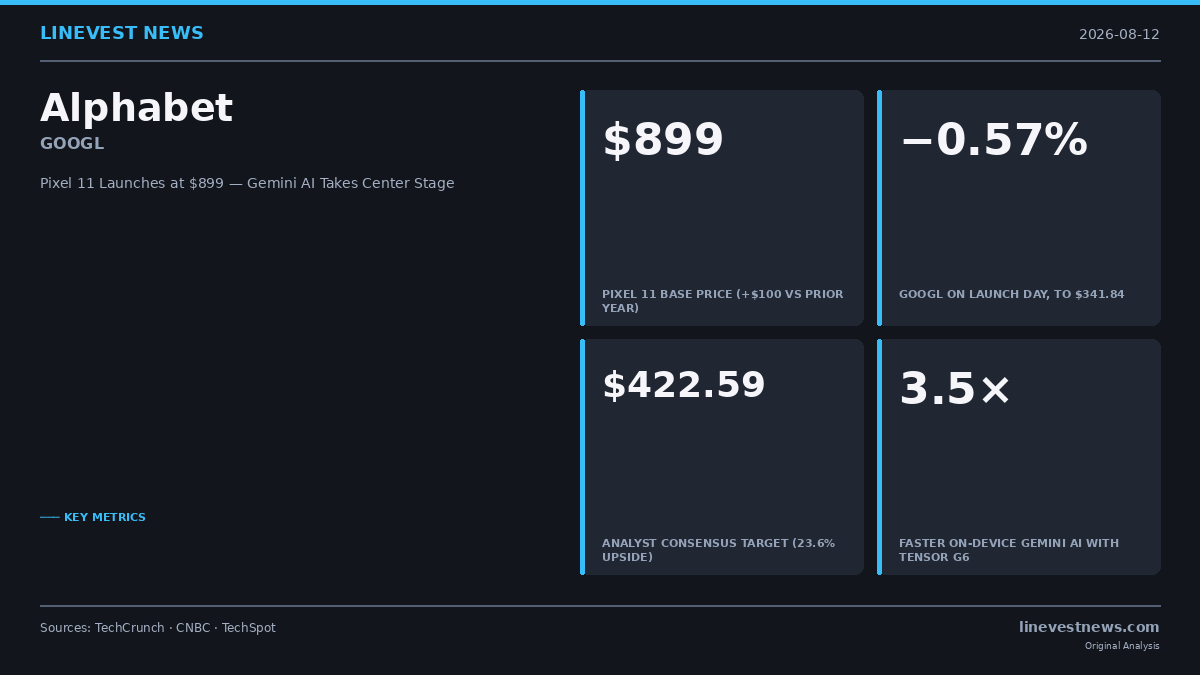
TL;DR - Google launched Pixel 11 / 11 Pro / 11 Pro XL / 11 Pro Fold on August 12, all $100 pricier than 2025 predecessors - Tensor G6 (TSMC 2 nm) delivers 50% more TPU compute and significantly faster, more power-efficient on-device Gemini AI vs. Tensor G5 - Gemini AI can autonomously book rides, order groceries, and call businesses on users' behalf - GOOGL fell 0.57% to $341.84 on launch day; stock sits more than 16% below its 52-week peak - 25 of 30 analysts maintain Buy; consensus target $422.59 — 23.6% upside from current price
Part A — What Google Announced
Google held its annual "Made by Google" hardware event in New York on August 12, 2026, unveiling four devices under the Pixel 11 family. The lineup runs on the Tensor G6, Google's first chip built on TSMC's 2 nm (N2) process, paired with Android 17 and the company's broadest Gemini integration to date.
Device Lineup & Pricing
| Model | Price | Base Storage |
|---|---|---|
| Pixel 11 | $899 | 256 GB |
| Pixel 11 Pro | $1,099 | 256 GB |
| Pixel 11 Pro XL | $1,299 | 256 GB |
| Pixel 11 Pro Fold | $1,899 | 256 GB |
All prices are $100 higher than the equivalent 2025 models. Google simultaneously expanded the entry-level storage from 128 GB to 256 GB — the price per gigabyte actually falls sharply with that upgrade — but the higher sticker price places the base Pixel $100 above Apple's comparable iPhone 17 entry tier.
Tensor G6 — What Changed
The Tensor G6 packs 50% more TPU compute than its predecessor. Google claims the chip runs on-device Gemini Nano at 3.5× the speed with significantly lower energy consumption than the Tensor G5. Camera performance also improved: the base Pixel 11 now supports 30× zoom (up from 20×), and Pro models reach 120× (up from 100×), with a new main sensor capturing 32% more light per frame.
Gemini AI — The Agentic Leap
Google's biggest marketing claim is agentic AI — Gemini performing multi-step tasks without constant user intervention. U.S. buyers can instruct Gemini to:
- Order groceries or coffee from partner apps
- Book a ride via Uber or Lyft integrations
- Call a restaurant or business on the user's behalf to make reservations, with a transcript saved automatically
Additional features include Rambler (real-time dictation), live video and podcast translation, sign-language translation, and Magic Capture (automatic frame selection and unblurring from video). These capabilities mirror the agentic direction Apple previewed for iOS 27, framing the Pixel 11 as Google's competitive answer ahead of iPhone 18.
All Pixel 11 Pro, Pro XL, and Pro Fold buyers receive six months of Google AI Pro — a $119.94 value at the $19.99/month list price — positioning the hardware sale as a funnel into paid AI subscriptions.
Part B — What Investors Should Watch
GOOGL Stock: "Sell the News" on Launch Day
Alphabet shares fell 0.57% to $341.84 on August 12, extending a rough stretch. The stock is now more than 16% below its 52-week peak and has not recovered from a 3.8% drop earlier in the week. The market's lukewarm reception reflects a straightforward concern: Pixel hardware is structurally too small to move the Alphabet needle alone.
The Subscriptions, Platforms & Devices segment — which houses Pixel hardware, YouTube Premium, and Google One — generated $12.9 billion last quarter. Even a blockbuster Pixel cycle, rare by historical standards (Google's global smartphone share is in the low single digits), would not materially change quarterly earnings per share.
The Real Bet: AI Subscription Conversion
Alphabet's actual thesis here is not hardware margins — it is the free trial–to–paid subscriber conversion funnel. Each Pro buyer who activates the six-month Google AI Pro trial is a prospective $19.99/month recurring revenue stream.
Google has not disclosed its AI subscription subscriber count publicly. But Alphabet's full-year 2026 capital-expenditure guidance of $195–$205 billion — among the highest in corporate history — signals that management is betting AI infrastructure investment pays off through exactly this kind of recurring monetization. Investors who believe Google can convert hardware trial users into AI subscribers at meaningful scale have a legitimate bull case. Those who doubt the conversion rate are right to be skeptical of hardware-centric metrics.
Free Cash Flow: The Pressure Point
Alphabet reported negative free cash flow of $5.9 billion in Q2 2026, a direct consequence of its CapEx surge. FCF has historically been a valuation anchor for GOOGL; sustained negativity while the AI subscription revenue ramp remains opaque is creating uncertainty. Until Google begins disclosing AI subscriber numbers — or until Services revenue growth visibly accelerates — the market may continue discounting the hardware-as-funnel thesis.
Competitive Landscape: The Gemini Platform Play
The strategic subtext of the Pixel 11 launch is Gemini's expanding reach beyond Android. Reports indicate Apple is using Gemini as a backend model powering certain Siri AI capabilities in iOS, making Google's AI both a direct-to-consumer product (via Pixel) and an infrastructure layer inside the world's most profitable smartphone franchise. That dual positioning — own hardware and partner platform — differentiates Google from peers like Microsoft (which also bets on OpenAI integration) but concentrates AI revenue risk on subscription uptake across both channels.
Analyst Consensus
| Metric | Value |
|---|---|
| Current Price (Aug 12) | $341.84 |
| Analyst Buy Ratings | 25 / 30 |
| Consensus Price Target | $422.59 |
| Implied Upside | +23.6% |
The bull case rests on three pillars: (1) Gemini becoming the dominant AI layer across Android and iOS, (2) AI subscription conversion exceeding market expectations, and (3) CapEx eventually tapering as infrastructure buildout matures. Bears point to execution risk on all three, plus near-term FCF pressure.
Bottom Line for Investors
The Pixel 11 launch is best read as a proof-of-concept deployment for Gemini's agentic capabilities rather than a hardware revenue event. The $100 price increase tests consumer willingness to pay for AI-differentiated hardware — a data point Google will analyze closely as it sets its own future device strategy. GOOGL's near-term path depends less on Pixel unit volumes and more on whether Q3 2026 earnings show AI subscription revenue beginning to scale. Investors comfortable with that timeline and the ongoing CapEx burn have an above-consensus target to point to; those who need near-term FCF confirmation will likely remain on the sidelines.
Sources - TechCrunch: Pixel 11 has few hardware changes and more Gemini - CNBC: Google's new Pixel 11 puts Gemini at center of AI phone battle with Apple - TechSpot: Google unveils Pixel 11 featuring Tensor G6 SoC, starting at $899 - ts2.space: Alphabet Stock Drops as Pixel 11 Turns $100 Price Hike Into AI Subscription Test - Engadget: Google Pixel 11 launch live blog
This article is for informational purposes only and does not constitute investment advice. LineVest News is an independent financial news publication and is not a registered investment adviser.