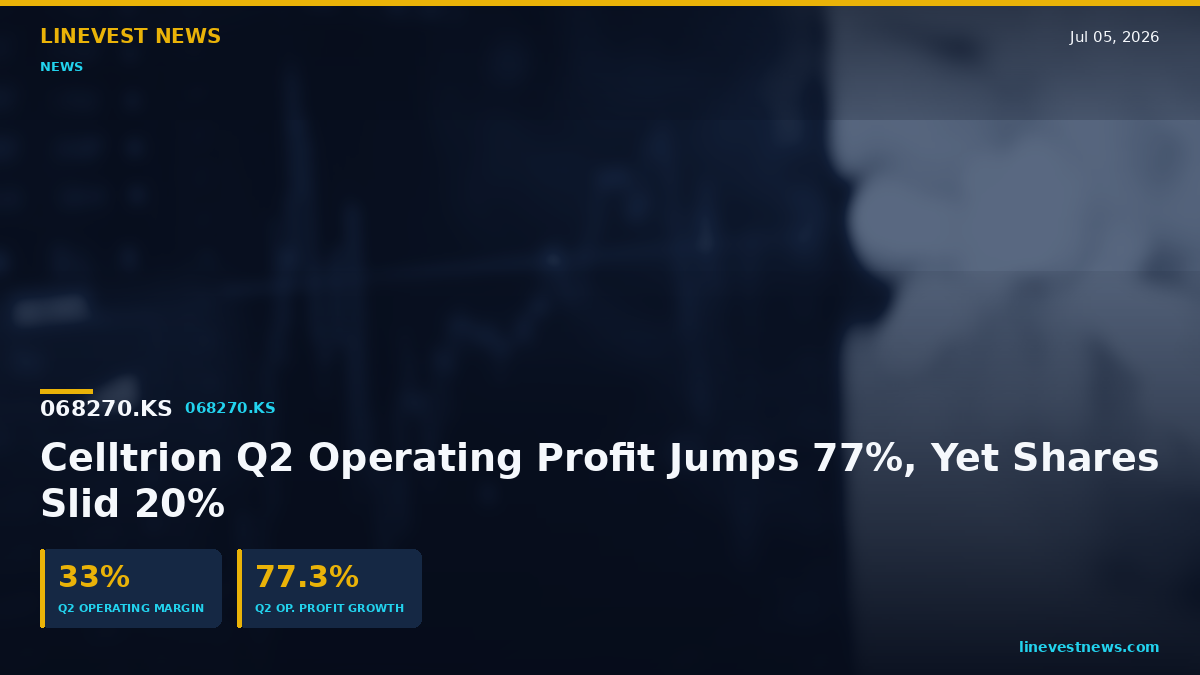
Celltrion (068270.KS), South Korea's largest biosimilar maker, reported preliminary second-quarter 2026 results on July 3 showing operating profit up 77.3% to ₩430 billion ($314 million) and revenue up 35.2% to ₩1.3 trillion ($949 million) — clearing its own targets by a wide margin, and yet the stock entered earnings down roughly 20% over the prior four months, per Hankyung. For a fund manager, the immediate question is not whether the quarter was good. It plainly was. The question is why an operational beat this clean has coincided with a de-rating, and whether the numbers change that setup.
The beat, in numbers
Revenue came in at ₩1.3 trillion ($949 million), up 35.2% year-on-year and the company's highest-ever second quarter, according to Maeil Business Newspaper and Seoul Economic Daily. Operating profit rose 77.3% to ₩430 billion ($314 million), per Maeil Business Newspaper and KED Global. Critically, that figure beat the ₩400 billion ($292 million) second-quarter operating-profit target Celltrion itself flagged earlier in the year, Seoul Economic Daily and The Korea Times reported — a self-imposed bar the company cleared rather than a soft consensus it merely nudged past.
The margin story is the real signal. Operating margin widened to 33% from 25% a year earlier, Seoul Economic Daily reported. The driver: newer, higher-margin biosimilars — including Remsima SC (branded Zymfentra in the U.S.), Yuflyma and Steqeyma — now account for more than 60% of sales, per The Korea Times and Seoul Economic Daily. In other words, the profit jump came from what Celltrion is selling, not just how much.
Sizing it against the half
Stacking the two quarters together, first-half revenue reached ₩2.445 trillion ($1.78 billion), up 35.6% year-on-year, while first-half operating profit hit ₩751.9 billion ($549 million), up 91.9%, according to Hankyung. A half-year operating profit nearly doubling year-on-year is not a one-quarter mix quirk; it is the trajectory the margin expansion implies.
The disconnect
So why the 20% slide into earnings? The tension is that the market had already priced a strong 2026. Brokerages spent the first half raising targets — DB Securities set a ₩290,000 ($212) target in May 2026, and the six-month average brokerage target sat around ₩272,000, per Nate News; SK Securities separately lifted its target to ₩260,000, per Business Post. When expectations are elevated, even a genuine beat can struggle to move a stock that had run ahead of itself and then corrected. The four-month drawdown reflects that reset in sentiment more than any deterioration in the business the July 3 print revealed.
Precedent: this is the 2025 playbook repeating
The quarter rhymes with Celltrion's full year 2025, when operating profit more than doubled — up 137.5% to ₩1.17 trillion — on revenue of ₩4.16 trillion, with operating margin expanding to 28.1%, according to KED Global. That surge was driven by the same mechanism now visible in Q2 2026: high-margin newer biosimilars taking share of the mix, plus a falling cost-of-sales ratio as post-merger cost pressures from the 2023 Celltrion–Celltrion Healthcare combination eased. The Q2 2026 margin of 33% extends that 2025 trend rather than breaking new ground conceptually — it is the structural cost story compounding.
The open question
The number that will confirm or refute the thesis is whether Celltrion converts first-half momentum into its full-year targets. Management said it expects "stronger earnings momentum in the second half" as sales in major markets and new-product growth are fully reflected, per The Korea Times, and is building toward a portfolio of 18 biosimilars by 2030 and 41 by 2038. With half-year operating profit already at ₩751.9 billion, the third-quarter release — and whether newer products hold above the 60% mix threshold — is the next hard data point that either validates the elevated brokerage targets or explains why the shares corrected ahead of them.
This article is journalism, not investment advice. LineVest is not a registered investment adviser. Figures are preliminary consolidated results as disclosed by Celltrion and reported by cited outlets; USD equivalents use an approximate rate of 1 USD = 1,370 KRW and are for reference only.