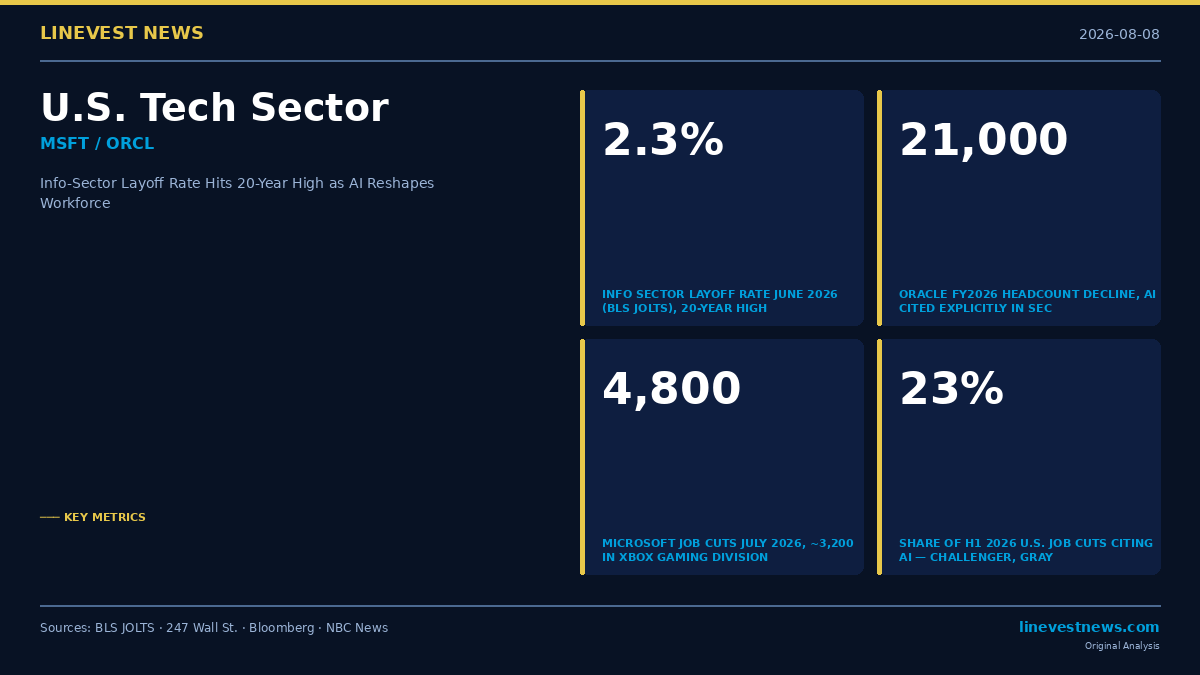
TL;DR - BLS JOLTS June 2026: U.S. information sector layoff rate hit 2.3% — the highest sustained reading in 20 years, surpassing the 2008 financial crisis peak and excluding the brief COVID spike of April 2020, per 247 Wall St. - Oracle (NYSE: ORCL) reported a headcount decline of approximately 21,000 employees (13%) in FY2026; its SEC 10-K filing explicitly attributes the reductions to AI deployment - Microsoft (NASDAQ: MSFT) announced 4,800 job cuts (about 2.1% of global headcount) in July 2026, including approximately 3,200 in the Xbox gaming division - AI cited in 23% of H1 2026 U.S. job-cut announcements tracked by Challenger, Gray & Christmas — approximately 101,743 announced positions attributed to AI out of roughly 440,000 total all-industry tracked cuts through June 2026
Part A — What the Data Shows
Information Sector Layoffs Reach a 20-Year High
The Bureau of Labor Statistics' June 2026 Job Openings and Labor Turnover Survey (JOLTS) put the U.S. information sector's layoff-and-discharge rate at 2.3%. According to analysis by 247 Wall St. and the Yale Budget Lab, this represents a 20-year high for the sector, surpassing the peak seen during the 2008 financial crisis.
April 2020 produced a sharp but brief COVID-driven spike that reversed within months. The current 2.3% reading is structurally different — driven by deliberate, permanent workforce reductions rather than demand disruption — and represents the highest sustained rate in two decades.
| Period | Comparison |
|---|---|
| 2008 Financial Crisis | Surpassed by June 2026's sustained 2.3% reading |
| April 2020 COVID Shock | Temporary spike; reversed within months; excluded from sustained comparison |
| June 2026 | 2.3% — 20-year high per BLS JOLTS / 247 Wall St. |
Source: BLS JOLTS (June 2026), 247 Wall St. analysis.
Separately, outplacement firm Challenger, Gray & Christmas tracks AI as the explicit reason for 40% of all U.S. job cuts in May 2026 (a record) and 31% in June — across all industries, not just tech. Through H1 2026, Challenger counted approximately 101,743 announced positions attributed to AI or automation out of roughly 440,000 total all-industry announcements — roughly 23% of every U.S. job cut announcement tracked in the first half of the year.
Oracle: AI Restructuring on Record in an SEC Filing
Oracle (NYSE: ORCL) is the most prominent individual driver of the 2026 tech employment wave. By the end of its fiscal year 2026 (ending May 31, 2026), Oracle's headcount had declined by approximately 21,000 employees (13%), from about 162,000 to 141,000. The company booked USD 1.84 billion in restructuring costs — nearly five times the USD 374 million charged in the prior year.
Oracle's fiscal 2026 10-K filing states:
"The adoption and deployment of AI technologies across our operations have resulted, and may continue to result, in reductions to our workforce."
This is one of the most explicit instances of a major public company using a formal SEC filing to directly attribute a large workforce reduction to AI. Oracle's SEC filing also provides investors with the clearest disclosure of how AI-driven efficiency gains translate into headcount decisions at the enterprise level.
Microsoft's Xbox Restructuring (July 2026)
After the June JOLTS period closed, Microsoft (NASDAQ: MSFT) announced in July 2026 that it was eliminating approximately 4,800 positions (about 2.1% of global headcount). The deepest cuts were in gaming: approximately 3,200 positions in the Xbox division — a major consolidation of first-party studio and publishing operations. The remaining roughly 1,600 cuts were spread across other Microsoft business units.
Microsoft's stated rationale centered on gaming strategy — streamlining studio operations and consolidating publishing functions — rather than AI substitution. The announcement follows a pattern of the company increasing capital expenditures for Azure AI capacity while pursuing headcount reductions in non-core areas.
Other Notable 2026 Cuts
| Company | Headcount Reduction | Approx. % of Workforce | Cited Driver |
|---|---|---|---|
| Oracle | ~21,000 | ~13% | AI deployment (10-K) |
| Microsoft | ~4,800 | ~2.1% | Gaming restructuring |
| Cisco | ~4,000 | ~4–5% | AI infrastructure pivot |
| Intuit | ~3,000 | ~16% | AI-driven efficiency |
| ClickUp | Undisclosed | ~22% | AI automation |
| Groupon | ~400 | ~15% | Cost reduction |
Part B — What It Means for Investors
Labor Costs Converted Into AI Capex
The most significant investment theme from the current data is the labor-to-capex conversion trade. Companies reducing headcount are routing savings directly into AI infrastructure rather than banking them. Oracle's fiscal 2026 10-K and restructuring disclosures illustrate the pattern most clearly: significant severance costs in year one are expected to be offset by lower personnel expenses and higher AI-driven output in subsequent periods.
This creates a distinctive accounting outcome: operating expenses fall (fewer salaries and benefits), operating margins improve, but capital expenditures rise sharply during the AI investment cycle. For investors tracking operating income, the improvement is genuine. Free cash flow may remain compressed as capex absorbs labor savings, but the medium-term trajectory is structurally favorable if productivity gains materialize.
Markets have broadly rewarded AI-framed restructuring announcements when paired with strong operational metrics. Tech companies that have disclosed AI-driven workforce reductions alongside credible productivity narratives have generally seen positive equity reactions, suggesting investors are treating these cuts as capability-upgrade signals rather than distress indicators.
Productivity Gains Are Real — But Unevenly Distributed
The Yale Budget Lab's analysis of BLS data finds the current tech layoff pattern consistent with structural AI substitution as a partial explanation, though the data does not definitively rule out cyclical factors. Many companies cutting headcount are simultaneously reporting strong top-line revenue growth — implying rising revenue per employee.
However, the distribution is uneven. Workers in software QA, basic coding, content moderation, and back-office IT support are experiencing concentrated losses. Simultaneously, companies are actively hiring for AI-adjacent roles: model operations, prompt engineering, and AI infrastructure management. The result is a dual labor market inside tech: strong demand for a narrower set of high-value skills, structural decline for routine cognitive tasks.
The "AI Washing" Question
Not every company citing AI as a layoff driver is accurately describing what's happening. Challenger, Gray & Christmas noted that companies may use the "AI transformation" framing to dress up routine cost-cutting in an investor-friendly narrative. The distinction matters:
- Genuine AI substitution shows up as rising output per worker and measurable capability gains — Oracle's explicit 10-K disclosure sets a high bar for transparency in this category
- AI-washed cost-cutting delivers a one-time margin improvement but no durable competitive advantage
Investors evaluating tech companies should track whether headcount reductions coincide with measurable capability improvements — not just lower operating expenses.
Portfolio Considerations for U.S. Tech Investors
For investors in U.S. tech equities, the current data points to three themes:
1. Enterprise AI beneficiaries beyond hyperscalers. Companies capturing displaced labor budgets extend beyond cloud hyperscalers. Enterprise software vendors and AI infrastructure providers are direct beneficiaries as corporations redirect labor savings into AI tools and compute.
2. Tech employment as a structural signal. The information sector's layoff rate reaching a 20-year high is a significant structural signal. If AI-driven substitution spreads from tech into adjacent knowledge-work industries, it could create lasting employment pattern shifts with implications for consumer spending and sector valuations beyond technology.
3. The capex productivity test. The current wave of AI investment is inflating capex across the sector. If productivity gains materialize, this represents a durable margin improvement cycle. If the productivity case underdelivers, companies face elevated depreciation charges without a sustainable cost reduction path.
The BLS JOLTS monthly readings will remain a key signal through the remainder of 2026. A sustained 20-year high in information-sector layoffs — if the 2.3% rate holds or rises through Q3 — would mark one of the most significant structural labor shifts in U.S. technology history.
Sources: - 247 Wall St. — AI is Hollowing Out Tech Sector Jobs - BLS JOLTS — June 2026 Summary - Foreign Policy Journal — AI Surge Drives Tech Sector Layoff Rate to 20-Year High - Bloomberg — Oracle Layoffs Fueled by AI, Reduces Workforce by 21,000 - Forbes — AI Cost 21,000 Jobs at Oracle This Year - NBC News — Microsoft Cuts 4,800 Jobs, Plans Restructuring of Xbox - Yale Budget Lab — The Recent Rise in Information-Sector Layoffs and AI
This article is for informational purposes only and does not constitute investment advice. LineVest is an independent financial news publication, not a registered investment adviser.