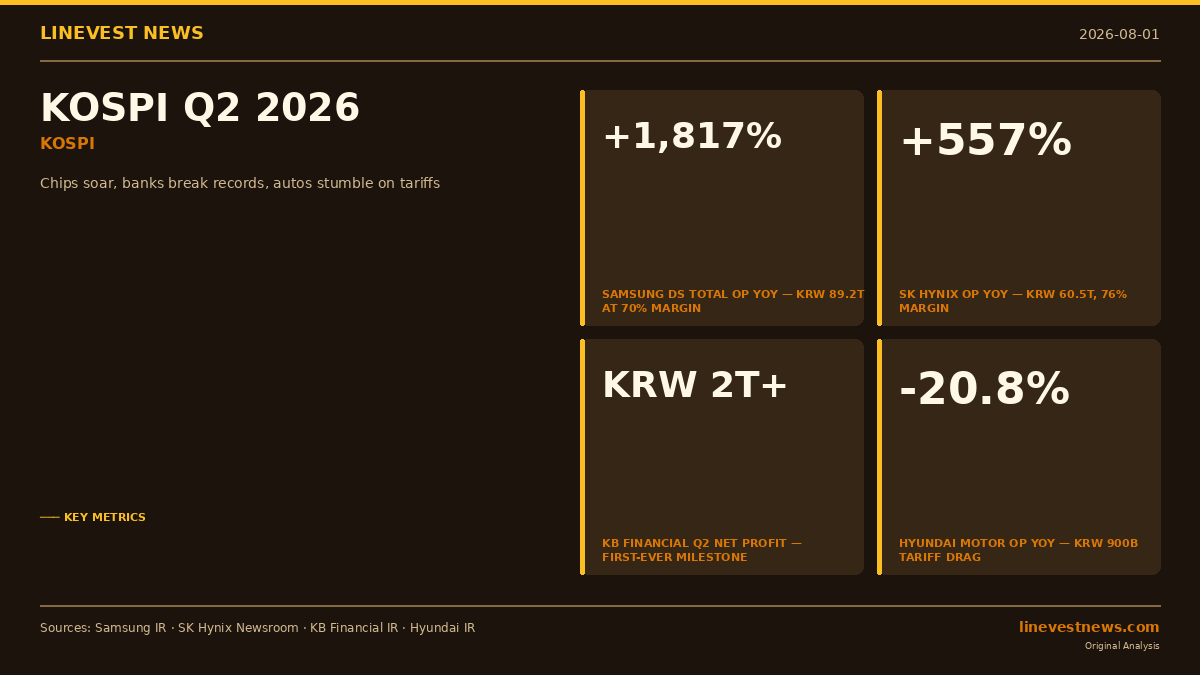
TL;DR - Semiconductors dominated: Samsung DS Division posted KRW 89.2T in operating profit at a 70% margin; SK Hynix delivered KRW 60.54T OP (+557% YoY) despite narrowly missing elevated consensus. - All four major banks outperformed: KB Financial crossed KRW 2T quarterly net profit for the first time; Shinhan, Hana, and Woori all beat — the Bank of Korea's first rate hike in 3.5 years is widening margins. - Autos stumbled: Hyundai Motor OP fell 20.8% YoY on a KRW 900B-per-quarter U.S. tariff drag; Kia OP fell 4.9% despite record revenue. - Still to report: Naver (Aug 7) and SK Telecom (Aug 8) close out the season.
Why This Scorecard Matters
Korea's Q2 2026 earnings season ran from late July through early August, spanning the country's largest memory chip manufacturers, commercial banks, and automakers. For foreign investors tracking KOSPI exposure, the results paint a bifurcated picture: the artificial intelligence capex boom is lifting chip revenues to historic levels, the BoK's rate-hike cycle is widening bank net interest margins, and the auto sector is absorbing the full cost of U.S. trade policy.
Part A: What Was Reported
Semiconductors: AI Capex Cycle Delivers Historic Margins
Samsung Electronics (005930.KS) — Results: July 30, 2026
Samsung's Q2 2026 results were dominated by the Device Solutions (DS) Division, which encompasses DRAM, NAND Flash, and High Bandwidth Memory (HBM). The following figures are drawn from Samsung's official earnings release dated July 30, 2026.
| Metric | Q2 2026 (Company-Reported) |
|---|---|
| Total Revenue | KRW 171.5T |
| Total Operating Profit | KRW 89.5T |
| Total OP Margin | 52.2% |
| DS Division Operating Profit | KRW 89.2T |
| DS Division OP Margin | 70.0% |
| Total OP YoY Change | +1,817% |
The DS Division's KRW 89.2T operating profit at a 70% margin reflects the compound effect of HBM premium pricing, recovering DRAM spot prices, and increasing enterprise NAND mix. Samsung confirmed that HBM4 will account for more than 60% of total HBM revenue in H2 2026, accelerating its transition to the next-generation architecture.
The Mobile Experience (MX) Division — smartphones and tablets — swung to a quarterly operating loss, its worst result in many years, as aggressive AI-feature subsidization and intensifying competition in the premium tier pressured margins. This made the DS Division's contribution even more dominant for the consolidated group.
SK Hynix (000660.KS / Nasdaq: SKHY) — Results: July 29, 2026
SK Hynix delivered the highest operating margin in its history, though results came in slightly below the elevated sell-side consensus. The following figures are from SK Hynix's official Q2 2026 earnings release.
| Metric | Q2 2026 (Company-Reported) | YoY Change |
|---|---|---|
| Revenue | KRW 79.32T | +257% |
| Operating Profit | KRW 60.54T | +557% |
| Operating Margin | 76% | +35 pp |
Consensus expectations (KRW 64.1T OP, KRW 84.1T revenue) were missed by approximately 5–6%, reflecting a faster-than-expected NAND pricing normalization and conservative HBM4 volume ramp. Source: sell-side consensus compiled pre-release.
Reported net income of KRW 93.92T exceeded operating profit because it includes a non-cash mark-to-market revaluation of SK Hynix's 14% equity stake in Kioxia Holdings (TYO: 285A, listed December 2024), whose share price has appreciated sharply since its IPO. This non-cash accounting gain does not represent cash received and is not part of SK Hynix's core operating performance — investors should use operating profit as the primary profitability metric.
On Nasdaq, SK Hynix's U.S.-listed SKHY shares fell 8.98% on results day, briefly trading at USD 130.17 — below the approximately USD 149 early listing price. The stock's post-result decline reflected the consensus miss and broader concern over near-term HBM allocation pace.
Management's Q3 2026 guidance: DRAM bit shipments +approximately 10% QoQ, NAND bit shipments +low single digits QoQ, with full-year capital expenditure raised to the high-KRW 40T range.
Banks: BoK Rate Hike Is the Earnings Catalyst
The Bank of Korea raised its benchmark rate 25 bps to 2.75% on July 16, 2026 — its first rate hike in 3.5 years. The shift triggered a positive net interest margin (NIM) re-rating across all four major financial holding groups that reported Q2 results.
| Group | Q2 2026 Net Profit | YoY Change | vs Consensus |
|---|---|---|---|
| KB Financial (105560.KS) | >KRW 2.0T | Record — first KRW 2T quarter in history | Beat by approximately 4.2% |
| Shinhan Financial (055550.KS) | KRW 1.82T | +17.5% | Beat by approximately 7.0% |
| Hana Financial (086790.KS) | KRW 1.17T | Record quarter | Beat; announced KRW 200B fresh buyback |
| Woori Financial (316140.KS) | KRW 1.0046T | +66% QoQ | Beat pre-report consensus of approximately KRW 958B |
What drove the beats: NIM expansion from the BoK's July hike (typically adds 2–4 bps per 25 bps hike within 2–3 quarters), combined with solid loan growth, lower provisioning (Woori cleared Indonesia-related reserves that had depressed Q1), and robust fee income from capital markets activity.
Key capital return announcements: - KB Financial: maintains record-low valuation relative to peers despite the milestone quarter - Shinhan: H1 2026 net income reached a record KRW 3.23T - Hana: announced KRW 200B additional buyback; H1 net income KRW 2.30T - Woori: restored the KRW 1T quarterly profit threshold; H1 net income KRW 1.609T (+3.7% YoY)
With the BoK widely expected to raise rates further toward 3.0% by year-end, NIM expansion is the clearest structural earnings theme heading into H2 2026.
Autos: Record Revenue, Collapsing Margins
Hyundai Motor and Kia both reported record Q2 revenues, but the bottom line reflected the full cost of U.S. trade policy and a manufacturing disruption.
Hyundai Motor (005380.KS) — Results: July 23, 2026
| Metric | Q2 2026 | YoY Change |
|---|---|---|
| Revenue | KRW 49.22T | +1.9% (record) |
| Operating Profit | KRW 2.8509T | -20.8% |
| OP Margin | 5.8% | -1.7 pp |
Sell-side consensus was missed by approximately 8–11%. Key headwinds: U.S. tariff impact of KRW 900B for the quarter (Hyundai-specific), disruption from the Anjeon Industrial fire affecting Santa Fe production (approximately KRW 200B impact), elevated warranty reserves (approximately KRW 400B), and raw materials pressure (approximately KRW 400B). Combined, these headwinds totaled approximately KRW 1.9T. Hyundai's stock declined 7.2% to KRW 401,000 on results day.
Kia (000270.KS) — Results: July 24, 2026
| Metric | Q2 2026 | YoY Change |
|---|---|---|
| Revenue | KRW 33.037T | +12.6% (record, company-reported) |
| Operating Profit | KRW 2.6285T | -4.9% |
| OP Margin | 8.0% | -1.4 pp |
Kia's electrified vehicle mix expanded to 296,000 units (+60% YoY), with battery electric vehicles at 110,000 (+88.4%), partially cushioning U.S. tariff pressure specific to Kia's product mix. Despite a smaller operating profit decline than Hyundai, Kia's stock fell 12.9% to KRW 130,500 on results day.
Both companies maintained their FY2026 operating margin guidance (Hyundai: 6.3–7.3%; Kia: high-single digits), citing expectations that tariff arrangements will partially normalize in H2 and that one-time disruptions (Anjeon fire) will not recur.
Part B: Investment Implications for Foreign Investors
Semiconductor Sector: AI Cycle Is Real, But Execution Risks Are Rising
Q2 2026 confirms that the AI infrastructure build-out is generating real, sustained semiconductor demand. Samsung DS at 70% operating margins and SK Hynix at 76% represent a structural shift from commodity DRAM cycles to value-added HBM and enterprise-grade memory — categories where Korea's top two producers hold dominant positions.
However, foreign investors should monitor two nuances:
SK Hynix missed elevated consensus on both revenue and operating profit, suggesting that sell-side expectations had run ahead of actual execution pace. The SKHY Nasdaq listing declining after results indicates that the AI premium is not unlimited — the market will demand consistent execution against increasingly high expectations.
Samsung's MX Division loss is a structural concern: the handset business, historically a group-level profit anchor, is now a drag. HBM and enterprise DRAM profits are effectively cross-subsidizing consumer device ambitions. This creates earnings quality risk if the AI capex cycle softens.
For KOSPI investors, semiconductor stocks remain the primary driver of index-level returns in 2026. Key monitoring points: HBM4 customer allocation updates from both Samsung and SK Hynix in Q3 reporting, and any changes to hyperscaler AI capex budgets from Meta ($130–145B in 2026), Microsoft ($115.9B FY2026), and Alphabet.
Banking Sector: NIM Expansion Is a Structural Tailwind Through 2027
All four major banks beat consensus and delivered record or near-record profits. The setup for H2 2026 is structurally positive:
- NIM expansion: BoK's July hike is beginning to flow through loan books; potential additional hikes (market expects a path toward 3.0%) provide further upside.
- Shareholder returns: Multiple groups announced or executed buybacks in Q2, signaling confidence in capital adequacy.
- Key downside risk: SME loan quality and any residual overseas provision exposure (particularly at Woori) are the primary credit risk variables.
Korean bank stocks have historically traded at significant discounts to book value relative to global peers. Sustained record profits and improving ROE, combined with the government's Value-Up Program incentives for shareholder returns, represent a multi-year re-rating opportunity.
Autos: Watch for Tariff Clarity in H2
Both Hyundai and Kia maintained FY2026 guidance, implying a sharp H2 recovery. The bull case rests on: (1) partial tariff relief or mitigation from increased U.S. domestic production at the Georgia manufacturing hub (HMGMA), and (2) the Anjeon fire disruption being limited to Q2. The bear case — sustained tariffs combined with FX pressure and no production recovery — would require guidance cuts in Q3 reporting.
What's Still to Come
| Company | Report Date | Consensus OP | Key Watch Point |
|---|---|---|---|
| Naver (035420.KS) | Aug 7, 2026 | KRW 572.7B (+9.8% YoY) | FIFA cost allocation, AI Briefing ad launch |
| SK Telecom (017670.KS / SKM) | Aug 8, 2026 | KRW 527.9B (+56.1% YoY) | USIM hack base recovery, AI data center growth |
See LineVest's dedicated preview articles for Naver and SK Telecom published August 1, 2026.
Quick Summary Table
| Company | Q2 2026 OP / Net Profit | YoY | vs Consensus | Key Story |
|---|---|---|---|---|
| Samsung Electronics (005930.KS) | KRW 89.5T OP | +1,817% (company-reported) | Beat | HBM4 ramp, DS at 70% margin |
| SK Hynix (000660.KS) | KRW 60.54T OP | +557% | Miss ~5–6% | AI memory leader, SKHY below listing price |
| KB Financial (105560.KS) | >KRW 2.0T NP | Record | Beat ~4.2% | First KRW 2T quarter |
| Shinhan (055550.KS) | KRW 1.82T NP | +17.5% | Beat ~7.0% | H1 record KRW 3.23T |
| Hana (086790.KS) | KRW 1.17T NP | Record | Beat | KRW 200B buyback |
| Woori (316140.KS) | KRW 1.0046T NP | +66% QoQ | Beat | Indonesia provisions cleared |
| Hyundai Motor (005380.KS) | KRW 2.8509T OP | -20.8% | Miss ~8–11% | Tariffs KRW 900B + Anjeon fire |
| Kia (000270.KS) | KRW 2.6285T OP | -4.9% | Miss | Record revenue; EV mix +60% |
This article is for informational purposes only and does not constitute investment advice. LineVest News is an independent publication not affiliated with any brokerage or investment advisory firm.
Sources
- Samsung Electronics Q2 2026 Earnings Release (July 30, 2026), investor.samsung.com
- SK Hynix Q2 2026 Earnings Release / SK Hynix Newsroom (July 29, 2026)
- Hyundai Motor Q2 2026 Earnings Release (July 23, 2026), hyundai.com/kr/en
- Kia Q2 2026 Earnings Release (July 24, 2026)
- KB Financial Group Q2 2026 Earnings Release (July 23, 2026)
- Shinhan Financial Group Q2 2026 Earnings Release (July 23, 2026)
- Hana Financial Group Q2 2026 Earnings Release (July 24, 2026)
- Woori Financial Group Q2 2026 Earnings Call Transcript, Motley Fool (July 24, 2026)
- Bank of Korea Monetary Policy Decision, July 16, 2026
- LineVest News: "Naver Q2 2026 Earnings Preview" (August 1, 2026)
- LineVest News: "SK Telecom Q2 2026 Earnings Preview" (August 1, 2026)