TL;DR
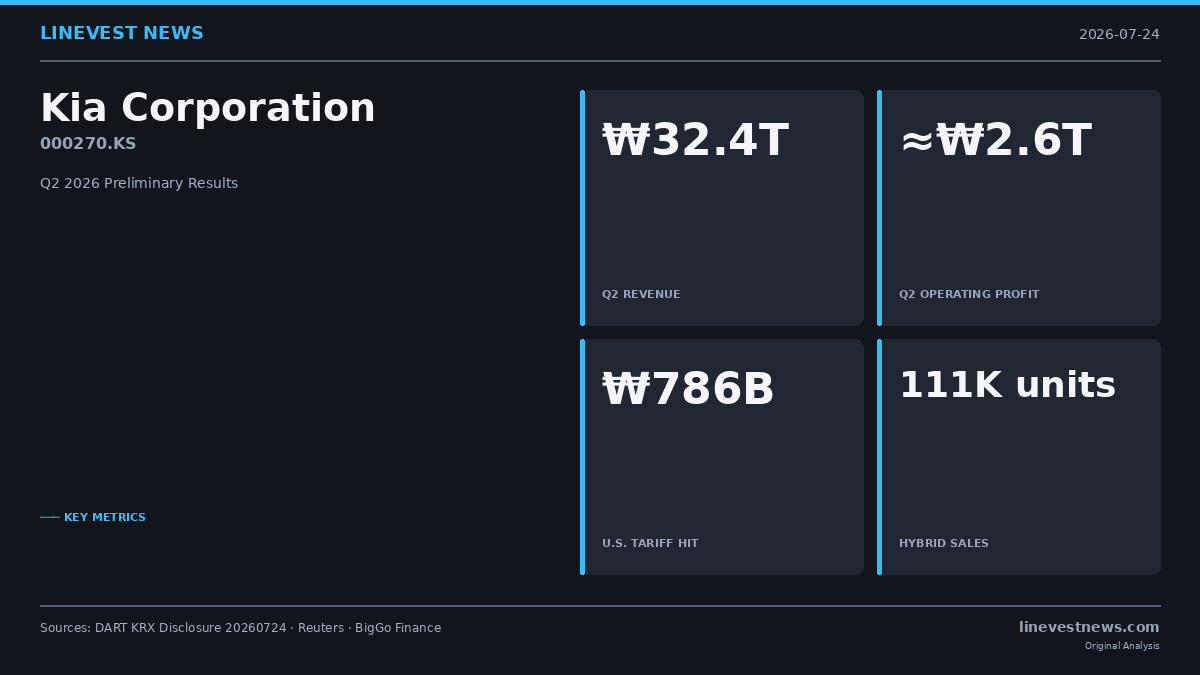
- Q2 2026 revenue: ₩32.4T (+10.3% YoY) — record second-quarter top line
- Operating profit: ~₩2.6T, -24% YoY — tariff drag overwhelms revenue growth
- U.S. tariff hit: ₩786B ($570M) in the April–June quarter alone
- Kia's underlying profitability, ex-tariff, was roughly flat year-over-year
- Hybrids surged 23.9%; first-half global sales hit an all-time company record
Part A — Preliminary Earnings Disclosure
Kia Corporation (000270.KS) filed its Q2 2026 preliminary consolidated results with Korea Exchange on July 24, 2026 (DART rcept_no 20260724800340), kicking off the domestic auto earnings season one day after parent company Hyundai Motor's equivalent release.
Key headline figures for the April–June 2026 quarter:
| Metric | Q2 2026 | Q2 2025 | YoY |
|---|---|---|---|
| Revenue | ~₩32.4T (~$21.9B) | ~₩29.4T | +10.3% |
| Operating Profit | ~₩2.6T (~$1.76B) | ~₩3.4T | ~-24% |
| OP Margin | ~8.0% | ~11.6% | -360bps |
| U.S. Tariff Impact | ₩786B ($570M) | — | — |
Revenue is consistent with sell-side consensus (FnGuide median: ₩32.38T); operating profit came in well below consensus of ₩2.79T (+0.7%).
Kia's preliminary disclosure captures consolidated financials under K-IFRS. Full detailed earnings — including net profit, segment breakdowns, and management guidance — are expected during a formal investor conference within the coming weeks.
The Tariff Math
The U.S. 25% automobile tariff, implemented in April 2025, extracted ₩786 billion ($570 million) from Kia's Q2 2026 operating income — the single largest quarterly tariff burden the company has disclosed to date. On an annualized run rate, that implies roughly $2.3 billion in tariff drag per year, identical to the ₩3.4T hit management cited for all of FY2025 (Bloomberg, January 2026).
Crucially, stripping out the tariff hit: - Ex-tariff OP: ~₩2.6T + ₩0.8T = ~₩3.4T - Q2 2025 OP: ~₩3.4T - Underlying OP: essentially flat year-over-year
This means Kia's core manufacturing operations, mix management, and cost controls offset every other external headwind — leaving tariffs as the sole explanation for the reported profit decline.
Part B — Market Analysis: What the Numbers Mean for Korea Investors
The Hyundai-Kia Divergence Sharpens
Juxtaposing Thursday's Kia disclosure with Hyundai Motor's Q2 2026 results (released July 23) reveals a clear divergence in resilience:
| Hyundai Motor (005380.KS) | Kia (000270.KS) | |
|---|---|---|
| Q2 2026 OP | ₩2.85T | ~₩2.6T |
| YoY change | -20.8% | ~-24% |
| Revenue YoY | +1.9% | +10.3% |
Kia's deeper profit decline is partly explained by its higher U.S. production dependency: a greater share of Kia's lineup is assembled in Korea, making each unit exported to America fully tariff-exposed. By contrast, Hyundai's U.S.-assembled models (Ioniq 5, Ioniq 6, Santa Fe, Tucson) avoid the tariff on domestic production, partially insulating margins.
Yet Kia's revenue outperformance (+10.3% vs Hyundai's +1.9%) signals that consumers are still buying — and that Kia's pricing discipline and mix shift are working at the top line even as tariffs compress the bottom line.
U.S. Strategy Pivot: Redirecting Inventory
Kia's response to the tariff regime is a pragmatic two-pronged approach that emerged clearly in Q2:
1. Market reallocation. The company has been redirecting Korean-manufactured inventory originally destined for the U.S. market to Canada and other non-tariff markets, while increasing allocation of Georgia-plant output to U.S. dealers. This move is margin-positive: Georgia-assembled units carry zero import tariff.
2. Incentive rationalization. Kia has slashed retail incentives across its U.S. lineup, generating estimated savings of approximately $435 million through year-end, partially offsetting the tariff burden. U.S. first-half market share reached 5.1%, with management targeting above 6% for the second half — an ambitious goal that relies on sustaining volume without sacrificing margin.
Despite the strategic repositioning, U.S. retail sales still rose 5% year-over-year in Q2, showing that Kia has not sacrificed volume while cutting incentives — a rare combination that underscores brand strength.
Electrification: The Structural Tailwind
The most compelling number in Kia's Q2 report is the electrified vehicle surge:
| Segment | Q2 2026 Units | YoY |
|---|---|---|
| Hybrid | ~111,000 | +23.9% |
| BEV | ~59,000 | +8.3% |
| Combined XEV | ~170,000 | ~+18.5% |
Hybrid growth of 23.9% in Q2 reflects the structural shift in U.S. consumer demand toward electrification without full battery-electric commitment — a segment where Kia competes at scale with models including the Niro HEV, Sorento HEV, Sportage HEV, and the EV6/EV9 range. For the first half of 2026, Kia achieved a company record 1,630,988 global sales — its highest first-half volume since its founding in 1944.
Higher hybrid share contributes a dual benefit: elevated ASP (Average Selling Price) and lower tariff exposure per vehicle dollar relative to mass-market internal combustion units, since hybrid premium pricing partially offsets the tariff hit on a per-vehicle basis.
Second-Half Headwinds: A Tougher Environment Ahead
Management's language — "expect a tougher second half" — reflects two converging pressures:
U.S. EV tax credit expiry. The Inflation Reduction Act's $7,500 consumer EV credit for eligible Korean automakers lapses under current policy timelines, threatening demand for BEV models in the U.S.
Sustained tariff burden. With no U.S.-Korea tariff resolution in sight as of the date of this filing, the $570M quarterly drag is expected to persist through Q3 and Q4.
However, three structural offsets may limit the damage: - Rising U.S. assembly mix (Georgia plant capacity expansion underway) - Accelerating hybrid ASP premiums as EV adoption softens - H1 record sales base providing operating leverage
Stock and Valuation Context
Kia (000270.KS) closed at approximately ₩425,000 on July 17 — a 42% discount to the 31-analyst consensus target price of ₩733,000. Kiwoom Securities carries the most bearish target at ₩700,000; DS Securities the most bullish at ₩840,000. The stock's underperformance reflects tariff-era earnings uncertainty, but the consensus "Buy" rating reflects conviction in FY2026 H2 and FY2027 recovery driven by Georgia ramp-up and hybrid mix expansion.
The key watch: if Kia can restore OP margin above 10% by Q4 2026 — as Shinhan Securities projects (+80.3% YoY in Q4 on a low base) — the discount to target may compress sharply.
This article is based on Kia's preliminary consolidated earnings disclosure filed with Korea Exchange on July 24, 2026 (DART rcept_no 20260724800340). All figures are preliminary; confirmed financials will be released during the formal earnings conference. This is not investment advice. LineVest News is an independent financial journalism outlet.
Sources
- DART KRX Disclosure: Kia Q2 2026 Preliminary Results
- Kia Corp Takes $570M Tariff Hit in Q2 — Reuters via Yahoo Finance
- Hyundai Motor Q2 Operating Profit Seen Falling 14%, Kia Up 1% — BigGo Finance
- Kia Adjusts US Operations, Slashes Incentives Amid Tariff Impact — CBT News
- Kia Just Had Its Best June Ever As Hybrid Sales Skyrocket — Motor1
- Kia Announces Q1 2026 Business Results — Hyundai Motor Group