Korea's Petrochemical Shakeout: Yeosu Wins ₩700B — But S-Oil's $6.4B Shaheen Plant Blocks the Final Act
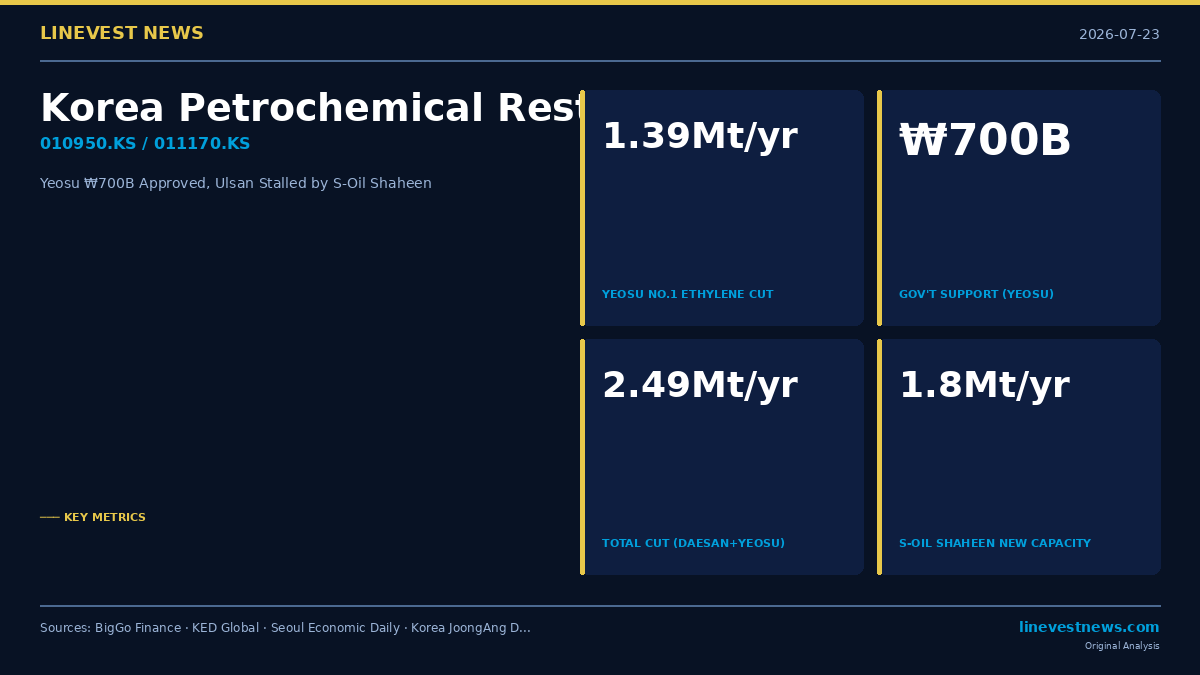
TL;DR - South Korea approved "Yeosu No. 1" petrochemical restructuring on July 22, 2026 - Yeochun NCC Plants 2 and 3 close: 1.39 million tons per year of ethylene eliminated - Government support: ₩700 billion ($473M) — one-third of the ₩2.1 trillion Daesan package - Daesan + Yeosu combined: 2.49Mt/yr cut = 68% of the 3.7Mt government target - S-Oil's (010950.KS) ₩9.26T Shaheen project (1.8Mt/yr new ethylene) has stalled Ulsan negotiations - LG Chem (051910.KS), with 26% domestic market share, has yet to submit a restructuring plan
Part A: What Was Approved
South Korea's Ministry of Trade, Industry and Energy on July 22 granted final approval to the "Yeosu No. 1" restructuring — the second state-sanctioned capacity reduction in the government's push to right-size a domestic petrochemical sector battered by Chinese oversupply.
Four companies — Yeochun NCC, Lotte Chemical (011170.KS), Hanwha Solutions (009830.KS), and DL Chemical — will merge the remaining Yeochun NCC Plant 1 with Lotte Chemical's adjacent Yeosu facility into a new integrated entity held in equal thirds. Yeochun NCC Plant 2 (920,000 t/yr) will be permanently decommissioned; Plant 3 (470,000 t/yr), already halted, will be formally closed. Total ethylene capacity removed: 1.39 million tons per year, reducing the Yeosu complex's total from 3.52Mt to 2.13Mt — a 40% cut.
| Project | Companies | Ethylene Cut | Gov't Support | Self-Rescue |
|---|---|---|---|---|
| Daesan No. 1 (Feb 2026) | Lotte + HD Hyundai | 1.10 Mt/yr | ₩2.1T+ ($1.5B) | ₩1.2T equity |
| Yeosu No. 1 (Jul 22, 2026) | YNCC + Lotte + Hanwha + DL | 1.39 Mt/yr | ₩700B ($473M) | ₩800B |
| Combined | 2.49 Mt/yr | |||
| Remaining gap to 3.7Mt target | 0.21–1.21 Mt/yr |
Government financial support for Yeosu No. 1 breaks down as: ₩450B from creditor institutions, ₩200B from the Korea Trade Insurance Corporation, and ₩34B in R&D grants, plus cost relief through tariff exemptions and heat-supply easing. The three participating companies — Hanwha and DL each contributing ₩272.5B in equity rights offerings — committed ₩800 billion in aggregate self-rescue, including ₩253.2B in infrastructure conversion for higher-value products including medical-grade LDPE and EV-related polyolefin elastomers.
Part B: Analysis and Market Implications
1. The Support Gap: Why Yeosu Received One-Third of Daesan
The most striking feature of the Yeosu approval is the 3-to-1 disparity in government backing versus the Daesan deal. Daesan No. 1 received over ₩2.1 trillion — including ₩1T in new credit, ₩1T in debt-to-perpetual-bond conversion, and designation as a "distributed energy special zone" providing a 4–5% electricity cost discount. Yeosu No. 1 received no perpetual bond conversion and no energy-cost zone status.
Ministry officials say the gap reflects corporate self-rescue depth. Lotte Chemical and HD Hyundai Oil Bank each injected ₩600B in Daesan (₩1.2T combined), while Hanwha and DL's combined contribution was ₩545B — roughly 45% less. The ministry has signalled explicitly that first movers get the most generous terms, and that subsequent rounds will reflect each applicant's demonstrated commitment. Government officials have also warned that companies that delay or refuse participation may face penalties.
Yeosu municipal authorities and employees have objected publicly: Yeosu 1's 1.39Mt cut is larger than Daesan's 1.1Mt, yet the smaller package leaves Yeochun NCC with a debt ratio of 223% and no perpetual-bond relief to accelerate deleveraging.
2. Lotte Chemical: A Two-Round Restructuring Play
Lotte Chemical (011170.KS) is the only company participating in both Daesan and Yeosu rounds. Hana Securities projects that once both restructurings reach full execution: total borrowings fall from ₩10.35 trillion to ₩7.14 trillion, the debt ratio declines from 76.0% to 52.8%, and the debt-dependence ratio drops from 32.4% to 24.9%. All three Korean credit rating agencies had moved Lotte Chemical's outlook to AA-/Negative amid the petrochemical downturn; the dual restructuring participation removes downgrade risk for participating companies, though analysts characterize these moves as defensive — "buying time to reduce financial burden rather than dramatically improving operating performance."
3. The S-Oil Paradox: Why Ulsan Is Stuck
The critical remaining cluster is the Ulsan Industrial Complex, home to S-Oil (010950.KS), SK Geo Centric, and Korea Petrochemical Ind. (Daehan Yuhwa). Consulting work began in late 2025, yet the Ulsan parties remain deadlocked — and S-Oil's Shaheen project explains why.
S-Oil, 63.4% owned by Saudi Aramco, has invested ₩9.26 trillion ($6.43 billion) in the Shaheen complex — the largest single petrochemical investment in Korean history. Deploying Saudi Aramco's proprietary thermal crude-to-chemicals (TC2C) technology — which delivers three to four times higher feedstock-to-petrochemical yield than conventional naphtha crackers — the Shaheen plant completed its mechanical build in the first half of 2026. Trial operations are scheduled for end-2026, with commercial production commencing in 2027. At full ramp-up, Shaheen will produce 1.8 million tons of ethylene per year, plus 770,000 t/yr propylene, 200,000 t/yr butadiene, and 280,000 t/yr benzene.
The arithmetic creates a near-paradox for Korea's restructuring program. Shaheen's 1.8Mt/yr in new supply equals half the government's maximum 3.7Mt reduction target across all clusters combined. Even if the Ulsan No. 1 restructuring removes a proportionate amount of old capacity, net capacity reduction in the Ulsan complex could approach zero once Shaheen is fully operational.
SK Geo Centric and Korea Petrochemical have argued that S-Oil must shoulder its share of industry-wide reduction, pointing to the state-backed effort that benefits the whole sector. S-Oil counters that an ultra-efficient, newly built plant operating at a structural cost advantage should not be treated like aging high-cost crackers targeted for closure. The government faces a politically delicate calculation: Saudi Aramco, S-Oil's controlling shareholder, is a key strategic partner for Korea's energy security, and penalising a ₩9.3T greenfield investment — approved and built within the policy environment the government itself created — risks diplomatic friction and signals adverse treatment to future large-scale industrial investors.
Industry observers suggest the earliest a coherent Ulsan No. 1 plan could emerge is early 2027, after Shaheen's actual efficiency data become visible in live commercial operations.
4. LG Chem (051910.KS): The Undecided Market Leader
Korea's largest domestic ethylene producer has yet to submit a restructuring plan. LG Chem controls an estimated 3.3 million tons per year of nameplate ethylene capacity across Yeosu (2.0Mt) and Daesan (1.3Mt), representing approximately 26% of Korea's total domestic capacity. Arithmetically, LG Chem's participation is necessary for the government to approach its full reduction target, regardless of whether Ulsan proceeds.
The company is reportedly in discussions with GS Caltex at Yeosu and Hanwha Total Energies at Daesan for potential joint-venture restructurings. However, both GS Caltex and Hanwha Total Energies carry 50% stakes held respectively by Chevron and TotalEnergies — foreign shareholders whose investment criteria and return expectations may not align with the Korean government's restructuring timeline and terms. Meaningful progress on "Yeosu No. 2" or "Daesan No. 2" involving LG Chem is widely expected but has not been announced.
5. Investor Implications
For investors tracking Korea's chemical sector, the restructuring program is unfolding across overlapping layers of speed and friction. Yeosu No. 1 demonstrates the government's capacity to execute multiple rounds, even with a more modest support package than the Daesan precedent. Yet the Ulsan and LG Chem chapters will ultimately determine whether the program translates into meaningful supply discipline or merely repositions capacity around Korea's petrochemical map while Shaheen adds 1.8Mt of new supply.
S-Oil (010950.KS): Shaheen's commercial ramp is the central operational event of 2026–2027. If margins on TC2C-based ethylene prove superior to the industry curve, S-Oil's resistance to participation in Ulsan capacity cuts gains economic and political durability.
Lotte Chemical (011170.KS): The Hana Securities deleveraging projection — debt ratio from 76% to 52.8% — represents the clearest near-term catalyst, but realisation depends on three-year execution under a smaller support package than Daesan received.
LG Chem (051910.KS): Any formal announcement of a Yeosu No. 2 or Daesan No. 2 plan involving LG Chem would act as a significant sector catalyst, signalling that the government's aggregate target is within reach. As the swing factor in the program's ultimate success, LG Chem's timing decision warrants close monitoring.
Globally, industry watchers note that Asia is bracing for approximately 28 million tons of new ethylene capacity coming online between 2026 and 2028, predominantly from China. Korea's restructuring, even at full execution, removes roughly 10% of that incoming global supply — underscoring that the structural challenge extends well beyond the domestic restructuring perimeter.
This article is for informational and journalistic purposes only. LineVest is not a registered investment adviser and this content does not constitute investment advice or a recommendation to buy or sell any security.
Sources: - BigGo Finance: "South Korea's Yeosu Petrochemical Restructuring Gains Momentum, While Ulsan Stumbles on Shaheen Project" - BigGo Finance: "South Korea Approves Yeosu Petrochemical Restructuring; Lotte Chemical, Others Expected to Fend Off Credit Downgrades" - KED Global: "S.Korea's 2nd petrochemicals overhaul kicks off as Yeochun NCC shuts plants" (July 22, 2026) - Seoul Economic Daily: "Lotte, Hanwha, DL Merge Yeosu Naphtha Crackers, Cutting Ethylene Output by 1.39 Million Tons" (July 22, 2026) - Korea JoongAng Daily: "S-Oil's $7B Shaheen project nears completion, hopes to lift Korea's chemical gloom" - Korea Herald: "S-Oil's Shaheen project to spark industry revival with record output"