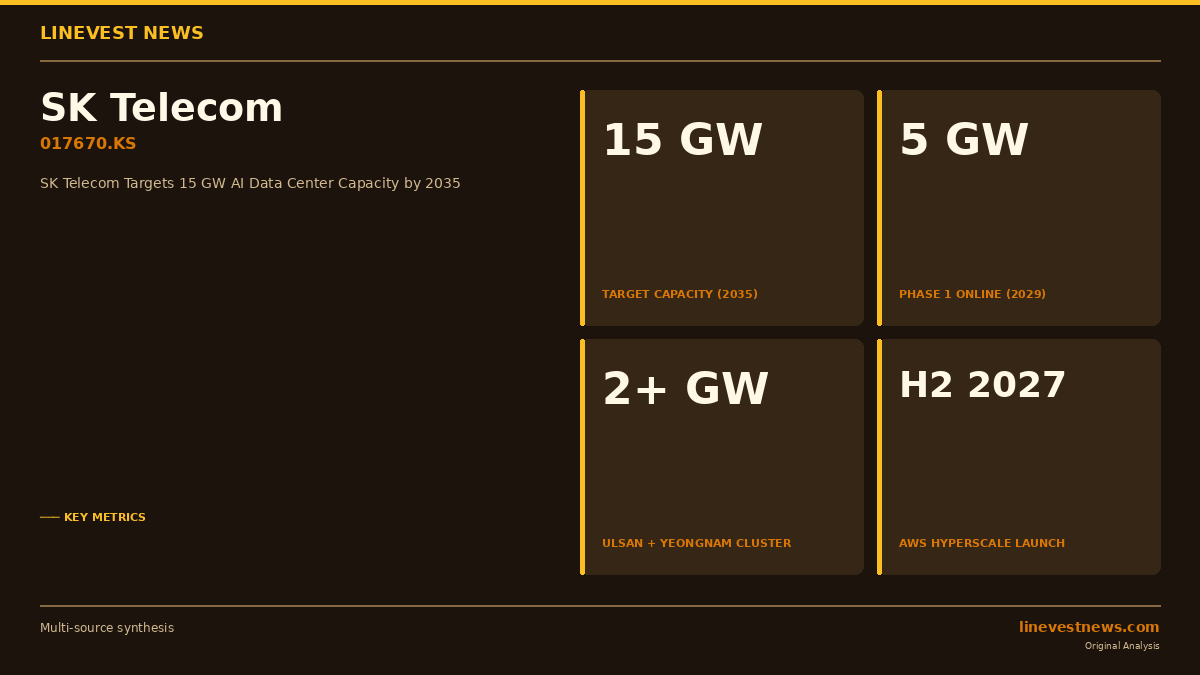
SK Telecom (017670.KS), South Korea's largest mobile carrier, has unveiled an ambitious roadmap to build 15 gigawatts of AI data center capacity by 2035 — a plan that positions the country as Asia's premier destination for energy-intensive artificial intelligence computing workloads.
The company said it will bring an initial 5 GW of capacity online in phases from 2029, anchored by a hyperscale facility in Ulsan developed in partnership with Amazon Web Services, which is expected to begin operations in the second half of 2027. A cluster of facilities across the Yeongnam region — covering Busan, Ulsan, Daegu, and the surrounding provinces — is set to exceed 2 GW, with an additional 1 GW earmarked for the southwestern region.
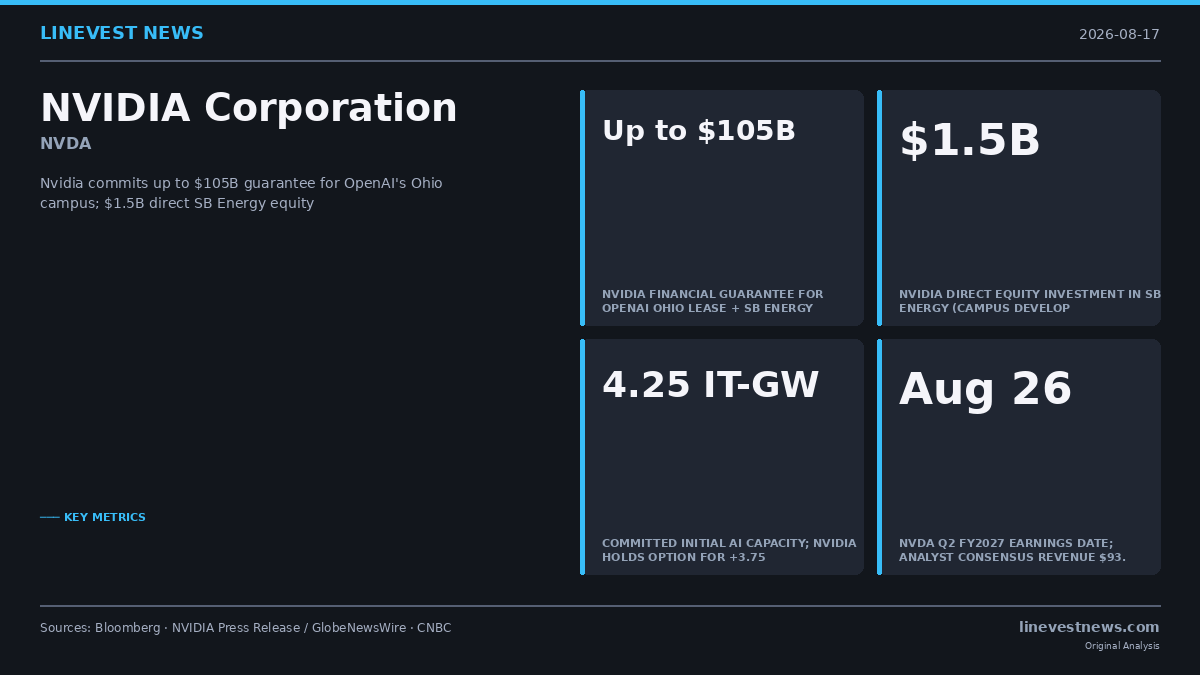
SK Telecom is also partnering with Nvidia to operate what it describes as an "AI factory" — dedicated infrastructure for running advanced AI model training and inference workloads at scale.
"This AI data center project is aimed at preemptively preparing the computing infrastructure needed for global AI ecosystem demands," CEO Jung Jai-hun said, framing the push as Korea's bid to become the indispensable hub for AI compute in Asia.
Part A — What Was Announced
The 15 GW target is one of the largest national AI infrastructure commitments disclosed by any non-hyperscaler globally. For context, a single gigawatt can support roughly 30,000 to 50,000 high-density GPU servers under typical configurations — meaning SK Telecom's 2035 buildout would represent compute capacity equivalent to hundreds of thousands of Nvidia H100-class accelerators.
The Ulsan facility, the flagship project in the consortium with AWS, may expand to over 1 GW on its own. SK Group affiliates will participate across the value chain: semiconductor supply (SK Hynix), energy provision (SK Innovation's E&S division), construction (SK Ecoplant), and data center operations.
The announcement did not disclose total capital expenditure figures. However, industry estimates for projects of this scale typically run in the range of KRW 5 trillion to KRW 10 trillion (approximately USD 3.6–7.2 billion) per gigawatt of high-density compute capacity, suggesting the full 2035 programme could represent tens of trillions of won in committed investment across the SK Group ecosystem.
Part B — Korea Market Implications
A Different Kind of AI Infrastructure Play
Most global AI infrastructure spending is dominated by the US hyperscalers — Microsoft, Google, Amazon and Meta — whose capital expenditure programmes run to hundreds of billions of dollars annually. SK Telecom's plan is structurally different: rather than a single operator building for its own workloads, it is positioning Korea itself as the jurisdiction of choice for third-party AI compute.
The strategic logic relies on three structural advantages Korea genuinely possesses.
First, power. Korea's relatively high share of nuclear energy — around 30% of the grid — provides stable, low-carbon baseload power that data center operators urgently need. LNG infrastructure provides redundancy. Competing AI hub markets such as Singapore and Japan face tighter power constraints.
Second, chips. SK Hynix (000660.KS) manufactures the world's most advanced High Bandwidth Memory (HBM) chips — the type of memory that directly determines how fast large AI models can process data. Collocating data centers with the HBM supply chain reduces logistics friction and positions Korea as a vertically integrated AI hardware-to-compute ecosystem.
Third, permitting and land. The Yeongnam cluster leverages existing industrial zones with established grid connections and faster permitting than greenfield sites in many Western markets.
Competitive Dynamics Within Korea
KT Corp (030200.KS) and LG Uplus (032640.KS), SK Telecom's two domestic telecom rivals, both operate data center businesses — but neither has announced a programme approaching this scale. KT's data center revenues have grown steadily, but the company remains a distant second in total capacity. This announcement materially widens the strategic gap between SK Telecom and its domestic peers.
For SK Telecom itself, data center services are a needed diversification. Korean domestic mobile ARPU growth has been constrained for years, and the company has been investing in AI-native businesses and enterprise cloud services. A 15 GW anchor position would give the company a recurring revenue stream tied to the global AI capex cycle — revenues that are more predictable and higher-margin than consumer wireless.
Investment Takeaways
SK Telecom's shares (017670.KS) trade at a modest valuation relative to global peers, reflecting the market's historically conservative view of Korean telecom growth. The AI data center pivot, if it progresses as announced, could re-rate the stock toward infrastructure-company multiples rather than traditional telecom.
Investors tracking this theme should also watch: - SK Hynix (000660.KS) — as the in-house HBM supplier, a direct beneficiary of any SK Group data center expansion - SK Ecoplant — the construction arm for the facilities (unlisted, SK Innovation subsidiary) - KT Corp (030200.KS) and LG Uplus (032640.KS) — domestic rivals whose relative positioning weakens with this announcement
The Ulsan-to-Yeongnam corridor is also relevant for the broader energy sector. Large AI data centers require firm power agreements, which could support demand for Korea's nuclear and LNG capacity expansion.
Sources: The Korea Herald