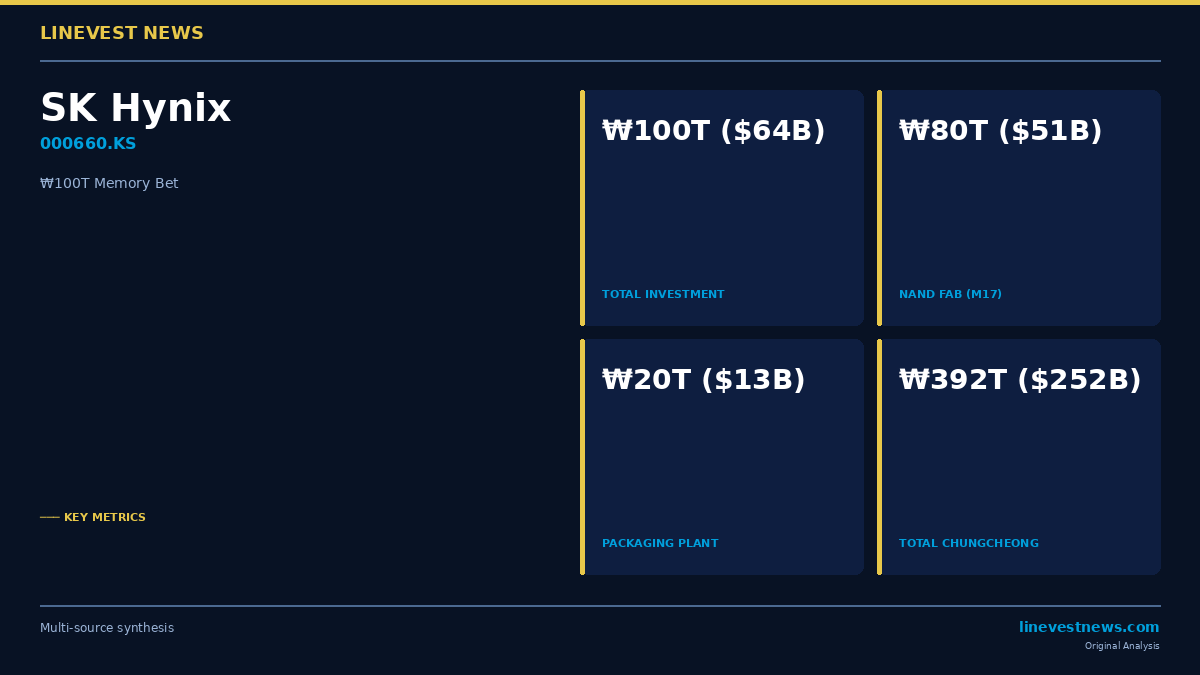
SK Hynix (000660.KS), South Korea's second-largest chipmaker and a leading supplier of high-bandwidth memory (HBM) to AI accelerator makers, said on July 2 it will invest about ₩100 trillion ($64 billion) to build new memory and packaging capacity in Cheongju, a city in North Chungcheong province. The timing was jarring: the pledge landed the same morning the KOSPI, South Korea's benchmark index, opened down 4.46% at 7,933.10 and briefly fell more than 5%—triggering a sell-side sidecar that briefly halted program trading—before clawing back above 8,000 (Chosun Biz).
For a fund manager, the one question is blunt: is SK Hynix pouring a full year of revenue into new supply just as the market starts pricing an AI-capex slowdown?
What the ₩100 trillion actually buys
SK Hynix CEO Kwak Noh-jung detailed the split, per Reuters (via Investing.com): ₩80 trillion ($51 billion) for a new NAND flash fab, the M17, targeted for 2029, and ₩20 trillion ($13 billion) for an advanced chip-packaging plant due by late 2027. Construction of the NAND line begins in 2027, with commercial output slated for 2029; the packaging facility handles AI memory including HBM (SK Hynix newsroom; DataCenterDynamics). Kwak said the company "remains confident in the long-term outlook for NAND memory despite recent volatility in AI-related stocks, noting that supply remains constrained even as demand continues to grow" (Investing.com/Reuters).
The scale is the story. SK Hynix posted record FY2025 revenue of ₩97.1 trillion ($63.8 billion) and net profit of ₩42.9 trillion ($28 billion), on capital spending of roughly ₩29 trillion ($19 billion) for the year (TrendForce). The Cheongju commitment therefore equals about one full year of the company's record revenue, spread across a multi-year build—and it sits on top of, not instead of, an already-elevated capex run-rate.
A national bet, not just a corporate one
The announcement came at a state briefing at Samsung Display's Asan campus, where Samsung Group and SK Hynix, alongside biosimilar maker Celltrion (068270.KS) and others, unveiled roughly ₩392 trillion ($252 billion) of planned Chungcheong-region investment in chips, displays, batteries and bio (Yonhap; Electronic Times). Samsung alone accounts for ₩140 trillion ($90 billion). Seoul is framing the region as an "AI materials-and-components cluster," and the labor ministry is separately discussing chip-workforce training to match the build-out (Yonhap). South Korea's stated goal, per Reuters, is to roughly double national memory capacity within five years.
The bear case arrived first
The market's reaction captured the tension. On July 1 in New York, memory-exposed names sold off hard—Micron −10.57%, SanDisk −10.62%, with AMD and Intel also selling off sharply—after a Bloomberg report that Meta may resell spare data-center compute stoked fears of slowing AI infrastructure spend (Chosun Biz). Michael Burry, the investor featured in "The Big Short," disclosed on June 30 short positions against Nvidia, Applied Materials, the iShares Semiconductor ETF and Caterpillar, and called the Korean spending spree "the beginning of the end," a peak signal for the cycle (Seoul Economic Daily; StockTwits; CNBC).
On July 2, foreign investors dumped more than ₩3.8 trillion ($2.4 billion) of Korean shares while individuals and institutions absorbed the selling (Chosun Biz). That outflow is chronic: the won has weakened about 8.1% this year to near 1,560 per dollar—its softest since March 2009—driven largely by record foreign equity selling (Chosun Biz; Bloomberg; Trading Economics).
What history says
The cyclical risk Burry points to is real. The last record-surplus memory supercycle, in 2017, gave way to gluts; and as recently as 2023, price pressure and losses forced Korean makers to curb expansion—an investment gap that helped create today's shortage (Chosun Biz). For now, demand is still outrunning supply: contract NAND prices have risen for 18 straight months, and the WSTS projects the 2026 chip market at $1.51 trillion, led by memory (Chosun Biz). S&P Global Ratings expects the supercycle to run at least through 2028, but warns that meaningful new capacity from 2028 onward—exactly what plants like M17 represent—could tip the supply-demand balance.
Governance is a second-order flashpoint: a domestic shareholder-activist group, the Korea Shareholders' Movement, is demanding that Samsung and SK explain the mega-projects' returns to minority investors (Maeil Business).
The data point that settles it
The first hard read arrives July 29, 2026, when SK Hynix reports Q2 results (Investing.com). Whether management reaffirms that supply stays "constrained"—and whether NAND's price streak holds—will show if this $64 billion commitment is a confident read of a multi-year shortage or, as Burry argues, capacity added at the top. The 2028 capacity inflection flagged by S&P is the longer fuse.
This article is for informational purposes only and does not constitute investment advice. Figures are converted at approximately ₩1,553 per US dollar, the prevailing rate cited by sources at the time of writing.
Sources: Reuters/Investing.com · SK Hynix Newsroom · DataCenterDynamics · Chosun Biz · Yonhap