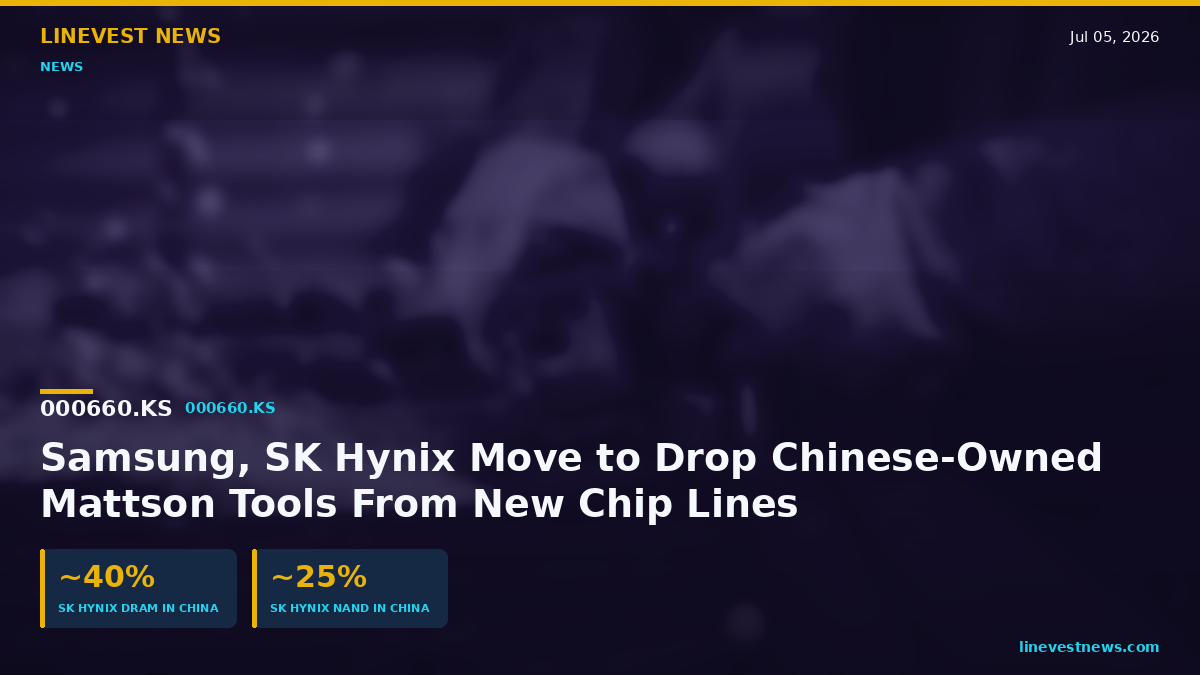
Samsung (005930.KS), SK Hynix Drop Mattson Ahead of US Curbs
Samsung Electronics (005930.KS), the world's largest memory-chip maker, and SK Hynix (000660.KS), the world's No. 2 memory maker and leading high-bandwidth-memory supplier, have begun stripping equipment from Chinese-owned Mattson Technology out of their newest production lines, according to reporting by Electronic Times (etnews, a Korean technology-industry daily). Both companies are "reviewing alternative suppliers for Mattson equipment in new production lines" and are already "in discussions with domestic and international" vendors on supply plans, etnews reported on July 3.
What is actually changing
The swap is narrow but pointed. It targets two specific tool categories, per etnews: photoresist (PR) strip equipment, which removes photoresist residue from wafers, and rapid thermal processing (RTP) tools, which apply controlled high-temperature steps during fabrication. In both niches Mattson Technology has long held a large share inside Korean fabs.
The reason is regulatory, not commercial. Samsung and SK Hynix describe the move as a "preemptive response to the possibility of strengthened US regulations against China," etnews reported. Mattson is not currently on the US Commerce Department Entity List (the trade blacklist maintained by the Bureau of Industry and Security, or BIS), but the concern is future exposure: tools from a Chinese-owned vendor could complicate the export-license posture of Korean fabs that ship US-origin technology.
Mattson's ownership is the crux. Once a Silicon Valley equipment maker, Mattson Technology was acquired in May 2016 by Beijing E-Town Dragon Semiconductor Industry Investment Center, a fund backed by the Beijing municipal government — the first successful purchase of a US integrated-circuit equipment company by Chinese capital (Yahoo Finance/company statement; PE Hub). That heritage is precisely what now makes the tools a policy liability.
The precedent that frames the move
Korea is following a path TSMC (Taiwan Semiconductor Manufacturing Company, the world's largest contract chipmaker) walked first. In 2025, TSMC moved to exclude Chinese-made tools — including Mattson and etch-maker AMEC — from its cutting-edge 2-nanometer production lines, qualifying only Japanese, American and European equipment as it ramped up in Hsinchu and Kaohsiung, citing US policy risk such as the proposed Chip EQUIP Act, which would bar recipients of US federal funding from sourcing equipment from "foreign entities of concern" (Tom's Hardware; TrendForce, August 2025). etnews frames the Samsung and SK Hynix decision as the Korean echo of that TSMC exclusion.
Why the timing matters
The shift lands weeks after a hard regulatory deadline. On September 2, 2025, BIS published a Federal Register notice revoking the Validated End-User (VEU) authorizations that had let three foreign-owned fabs in China import US tools license-free — Intel Semiconductor (Dalian), Samsung China Semiconductor, and SK Hynix Semiconductor (China) — effective December 31, 2025 (Federal Register notice 2025-16735; EE Times). The worst case was averted: reporting in late December indicated the US would instead permit shipments under an annual, site-by-site license review for 2026 rather than an outright cutoff (TrendForce, December 30, 2025). But the replacement regime is renewable and discretionary, which raises the cost of keeping any tool that Washington might later question.
That is what gives the Mattson decision its weight for a China-heavy manufacturing base. SK Hynix's Wuxi DRAM fab produces close to 40% of the company's total DRAM output, and its Dalian NAND fab — acquired from Intel — makes roughly a quarter of its NAND devices, according to reporting tied to the VEU revocation (EE Times). Samsung's Xi'an complex accounts for an estimated 40% of the company's NAND flash output (The Korea Herald). With that much capacity sitting inside China under a year-to-year license, reducing tool-level dependence on a Chinese-owned supplier removes one variable the companies can actually control.
The open question
What remains unclear is scale and speed: etnews describes reviews and supplier discussions on new lines, not a fixed replacement timetable or a figure for how much installed Mattson capacity is affected. The next concrete signals will be whether Mattson is named in any further BIS action, how the first 2026 annual site-license renewals for the Xi'an, Wuxi and Dalian fabs are decided, and whether Samsung or SK Hynix quantify equipment-transition costs in their upcoming quarterly disclosures. Until then, the move reads as risk management running ahead of any rule that names Mattson directly.
This article is journalism, not investment advice. LineVest is not a registered investment adviser. Figures are attributed to the sources cited inline; readers should verify against primary disclosures before making any decision.