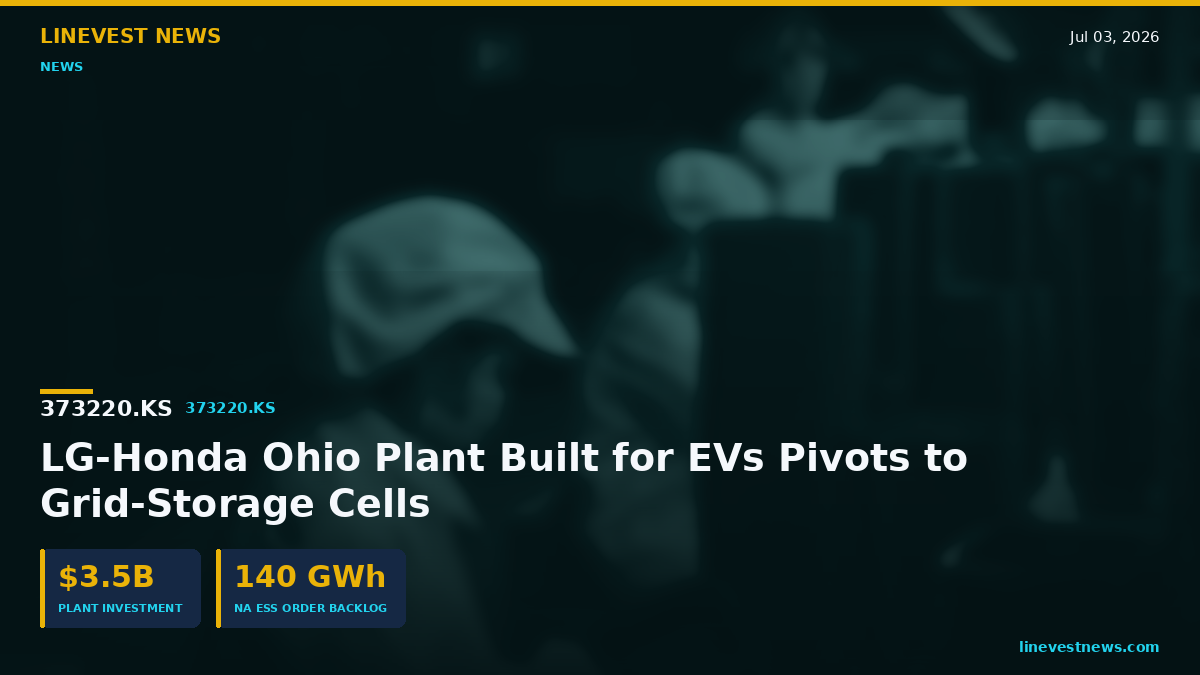
A $3.5 billion battery plant that Honda and LG Energy Solution broke ground on to build electric-vehicle cells has instead started churning out cells for the power grid. L-H Battery Company, the 50-50 joint venture between LG Energy Solution (Seoul-listed 373220.KS, Korea's largest EV-battery maker) and Japan's Honda Motor, began mass production of lithium-ion cells for energy storage systems (ESS) at its Jeffersonville, Ohio, plant on Thursday, U.S. local time, the company said (Korea Times, Yonhap, July 3).
The cells will be routed through LG Energy Solution Vertech, the Korean company's North American ESS system-integration subsidiary, into U.S. grid, commercial, industrial and residential storage projects, according to the companies' statements (Korea Times, Chosun Biz). That is a sharp turn from the plant's original mandate: the venture, formally established in 2023 near Jeffersonville in Fayette County, about 40 miles southwest of Columbus, was designed to supply cells for Honda and Acura EV models for North America (L-H Battery, lhbattery.com).
Why a plant built for EVs is making storage cells
LG Energy Solution said it shifted the plant's output toward ESS "in response to changes in the U.S. regulatory environment for EVs and the strong growth prospects of the energy storage market" (Korea Times, July 3). The reallocation was foreshadowed in December, when LG Energy Solution disclosed it would sell the plant's building and infrastructure assets, excluding land and equipment, to Honda Development and Manufacturing of America for $2.85 billion to "increase the operational efficiency" of the venture; the venture continues to operate the site under a lease, with the deal closing Feb. 28, 2026 (WardsAuto, citing LG Energy Solution's Dec. 23 filing).
The move fits a company-wide pivot. As EV demand cooled, LG Energy Solution's 2025 consolidated revenue fell to 23.7 trillion won ($17.3 billion) from 25.6 trillion won ($18.7 billion) in 2024, while operating profit was 1.3 trillion won ($949 million) (LG Energy Solution 2025 results, Jan. 28, 2026). The company has said it secured roughly 140 GWh of ESS order backlog in North America alone, driven by grid-scale projects and power demand from AI data centers (LG Energy Solution results materials).
Sizing the Ohio contribution
The Jeffersonville site is one of the venture's largest bets: a facility spanning more than 2 million square feet, built on an initial $3.5 billion investment commitment and slated to employ 2,200 workers at full capacity, with over 500 associates on site now (L-H Battery, lhbattery.com). The plant was planned for roughly 40 GWh of annual cell capacity under its original 2022 announcement. Chief Executive Koo Cha-hoon of L-H Battery framed storage as a lasting pillar, saying "ESS will become a core business axis alongside HEV [hybrid] battery-cell production" (Chosun Biz, Yonhap, July 3).
That flexibility is by design. The venture said it plans to keep a flexible product mix, adding cells for hybrid vehicles alongside ESS depending on demand rather than committing the line to a single end market (Korea Times, Chosun Biz, Yonhap).
What to watch
The open question is how fast the Ohio line scales and how much it feeds LG Energy Solution's stated 2026 targets: more than 90 GWh of new ESS orders and expansion of ESS production capacity above 60 GWh, with more than 80% of that in North America (LG Energy Solution results materials). The company's next quarterly results are the first checkpoint on whether the Jeffersonville ramp begins to show up in ESS revenue, and on how demand tied to AI-data-center power buildout holds up.
This article is for informational purposes only and does not constitute investment advice. Figures are drawn from company statements and cited reporting; currency conversions use an approximate rate of 1 USD = 1,370 KRW.