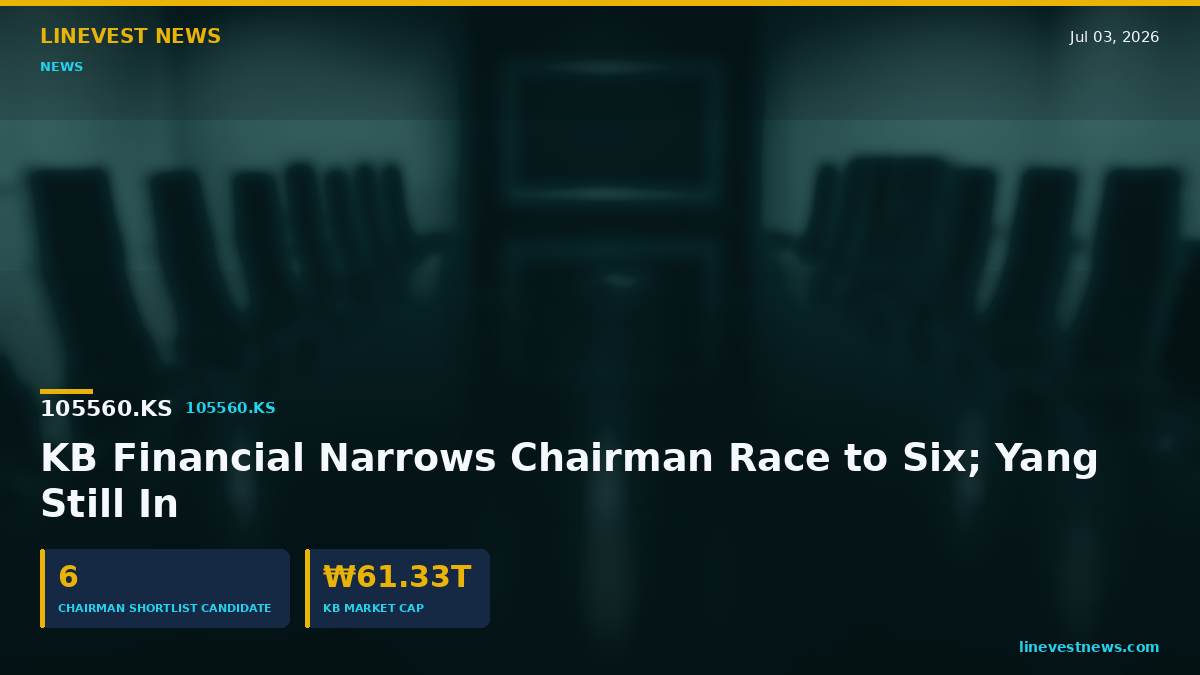
KB Financial Group (105560.KS), South Korea's largest financial holding company by market value, narrowed its chairman succession field to six candidates on July 3, cutting a 12-name pool in half, according to a joint statement carried by Yonhap News, Maeil Business Newspaper and ChosunBiz. Incumbent Chairman Yang Jong-hee made the cut, and local reporting frames him as the front-runner for a second term.
For a global investor, the immediate question is not the roster but the direction of travel: does this process point to continuity at a Korean megabank whose shareholder-return story has re-rated the stock, or to a leadership change — and when is it settled? The answer arrives in stages between late August and November.
Who is in the running
The shortlist splits four internal candidates against two external ones, ChosunBiz reported. The internal names are Chairman Yang; Lee Jae-keun, chief business officer for global, wealth management and corporate finance; Lee Chang-kwon, chief strategy officer; and Lee Hwan-ju, chief executive of KB Kookmin Bank, the group's flagship commercial lender. The external candidates are Kwon Kwang-seok, former chief executive of Woori Bank — the banking arm of big-four rival Woori Financial Group — and one applicant who requested anonymity, per ChosunBiz.
The six emerged from a longer funnel. KB's Chairman Candidate Recommendation Committee, the group's internal nominating body, drew up a 20-name long list (10 internal, 10 external), pared it to 12, and reached six after roughly two months of screening, ChosunBiz reported.
Why the seat matters
KB sits apart from its peers on valuation. It became the first Korean financial holding company to pass a 60-trillion-won market capitalization, reaching 61.33 trillion won ($41.55 billion) as of Feb. 12, 2026, The Korea Herald reported. It was also the only member of the country's big four — the others being Shinhan, Hana and Woori — trading above a price-to-book ratio of 1.0, against 0.88 for Shinhan Financial, 0.81 for Woori Financial and 0.79 for Hana Financial, per the same report. That premium rests heavily on a capital-return posture the next chair inherits, making the continuity-versus-change question a governance signal rather than a personnel footnote.
The precedent
KB's last transition was orderly but not automatic. Yang took office on Nov. 21, 2023 with a 97.52% shareholder-approval vote, Korea Herald reporting at the time showed. He succeeded Yoon Jong-kyoo, who led KB for nine years across three terms from 2014 to 2023, according to Korea Herald and KED Global reporting. That history cuts both ways: KB has shown it will renew a chair repeatedly, but its selection process now runs a wide external search rather than coronating the incumbent.
What to watch
The committee, chaired by Cho Hwa-jun, will interview the six on Aug. 27 and cut to three, ChosunBiz reported. A second round of in-depth interviews and a vote on Sept. 11 will produce a single nominee. After legal qualification checks, the committee and board are due to make their recommendation on Oct. 2, with an extraordinary shareholder meeting in November to formalize the appointment — the point at which Yang's current term ends, The Korea Herald reported.
The Aug. 27 cut to three finalists is the first hard read on whether the group is steering toward reappointment or a break. "We will continue our efforts so that the best CEO who meets the trust of shareholders and customers can be appointed through a transparent and objective candidate verification and evaluation process," committee chairman Cho said, per ChosunBiz.
Sources: Yonhap News · MK Economy · ChosunBiz
This article is for informational purposes only and does not constitute investment advice. Figures are drawn from the cited sources and reflect information available as of publication.