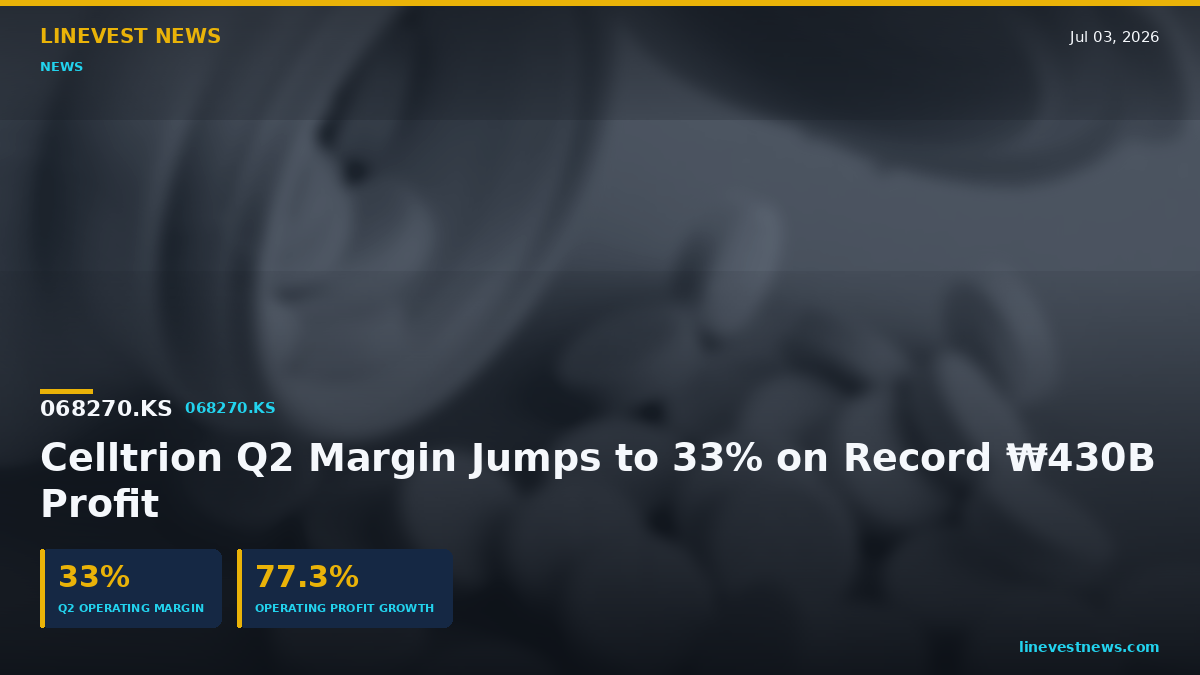
Celltrion (068270.KS), Korea's largest biosimilar maker, said its second-quarter operating margin leapt to roughly 33% — the sharpest profitability move in the company's recent history and the number that will dominate the read from any global healthcare investor. The immediate question is whether that margin is a structural step-up or a one-off flattered by cost items rolling off.
The beat, in numbers
On a preliminary consolidated basis, Celltrion reported revenue of ₩1.3 trillion ($837 million) and operating profit of ₩430 billion ($277 million) for the April–June quarter, according to disclosures reported by Chosun Biz and ET News on July 2–3. Revenue rose 35.2% and operating profit surged 77.3% from a year earlier — both records for a second quarter, the company said.
The margin story is starker than the top line. A year ago, in Q2 2025, Celltrion earned ₩242.5 billion ($156 million) of operating profit on ₩961.5 billion ($619 million) of sales, an operating margin of 25% (KED Global). This quarter's ~33% is roughly eight points higher. It also builds sequentially on the first quarter, when Celltrion posted ₩1.145 trillion ($737 million) in revenue and ₩321.9 billion ($207 million) in operating profit at a 28.1% margin (Korea Herald). (Won figures are converted at ₩1,554 to the dollar, the July 2 rate per Trading Economics.)
Why the margin moved — mix versus cleanup
Celltrion attributes the jump to two forces landing at once. The first is a revenue-mix shift: high-margin newer products passed 60% of total sales, per both Chosun Biz and ET News. The growth engines are its next-generation biosimilars — Zymfentra (the U.S. name for subcutaneous Remsima SC, an autoimmune therapy), Yuflyma and Steqeyma — which the company says are taking share in the U.S. and Europe, with Zymfentra setting successive U.S. prescription records. In Europe, first-mover Omlyclo and the bevacizumab biosimilar Vegzelma hold leading positions in major markets.
The second force is cost normalization, and this is where investors will probe sustainability. Celltrion says one-time expenses tied to its merger with sales affiliate Celltrion Healthcare have cleared, high-cost legacy inventory has been depleted, development-cost amortization has ended, and cell-culture yields ("titer improvement") have risen. Those items lifted margin this quarter but do not repeat once absorbed — so the durable question is how much of the ~33% rests on the mix shift, which recurs, versus the cleanup, which does not.
Does it fit guidance?
The ₩430 billion print sits within the roughly ₩400-billion range Celltrion had guided for Q2 under a stepwise quarterly profit plan flagged earlier in 2026. Management reiterated that biosimilar demand is seasonally back-half weighted — national tenders and year-end stocking concentrate in the second half — and said full-year results could exceed its 2026 targets of ₩5.3 trillion ($3.4 billion) in revenue and ₩1.8 trillion ($1.16 billion) in operating profit (Korea Herald).
Capacity and pipeline
Celltrion is expanding manufacturing alongside the earnings ramp. Domestically it is adding 180,000 liters (Plants 4 and 5) to an existing 250,000-liter base, and it has approved a 75,000-liter expansion at its Branchburg, New Jersey plant that would lift U.S. capacity to 141,000 liters upon completion — a hedge, the company says, against tariffs and supply-chain risk. Its pipeline includes CT-P55 (a biosimilar of the psoriasis drug Cosentyx) plus CT-P70 and CT-P71, both antibody-drug conjugates that were granted FDA Fast Track status (CT-P70 in December 2025 for metastatic non-small cell lung cancer, CT-P71 in April 2026 for urothelial cancer). The stated goal is 30 biosimilars by 2030 and 41 products by 2038.
What to watch
These are preliminary figures. The confirming data points are Celltrion's audited Q2 disclosure and, more decisively, its Q3 report: if the ~33% margin holds into the seasonally stronger back half — rather than fading once the one-time cost tailwinds are fully absorbed — the case that this is a structural re-rating rather than a cleanup quarter strengthens.
This article is for informational purposes only and does not constitute investment advice. Figures are preliminary and unaudited; currency conversions are approximate.