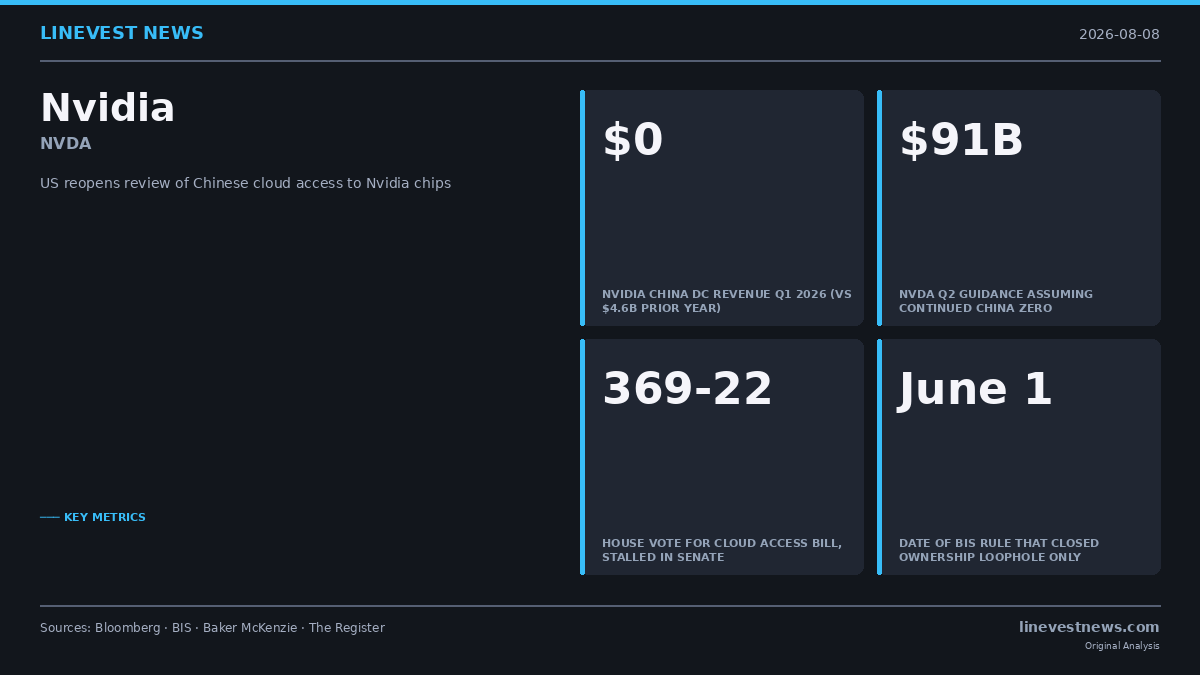
TL;DR - The U.S. is reviewing offshore cloud access to Nvidia chips — a channel its June BIS rule left open by targeting ownership, not usage. - Chinese engineers can still rent GPU time on Southeast Asian servers without triggering U.S. export law; that is the gap under review. - A bipartisan House bill (H.R. 2683, 369-22) would close the cloud loophole, but it has stalled in the Senate since January 2026. - NVDA Q2 guidance of USD 91.0B already assumes zero China Data Center revenue; whether offshore compute displaces or merely supplements that zero is the investor watch-point.
A key U.S. agency is reviewing how Chinese AI firms acquire and reach Nvidia (NASDAQ: NVDA) processors overseas — a channel Washington already declared shut in the spring. The rule it issued then reached ownership rather than usage: it made export licenses follow a buyer's Chinese parent company wherever that buyer is registered, while leaving alone the simpler route of renting time on machines somebody else owns — which the Commerce Department does not treat as an export at all.
Bloomberg reported the review on Friday, saying it follows "a spate of technological breakthroughs that highlighted their ability to use the cutting-edge hardware despite Washington's restrictions on shipments to the Asian country."
For a portfolio manager the immediate question is not whether new restrictions are coming. It is why a restriction announced ten weeks ago needs revisiting, and what that tells you about which lever Washington actually holds. The answer is unflattering to the June rule, and it points at a bill that has been sitting in a Senate committee since January.
What June's guidance did — and what it could not touch
On June 1, 2026, the Bureau of Industry and Security — the Commerce Department arm that writes and enforces U.S. export controls — said licensing requirements for advanced AI chips apply to all businesses with headquarters or a parent company in China.
Asked whether the pre-existing license requirement already covered such firms' foreign subsidiaries, BIS answered, per Al Jazeera's account of the guidance: "The answer is yes." The target was a purchasing channel running through places such as Malaysia and Singapore, where subsidiaries of Chinese groups could buy Nvidia's most advanced Blackwell parts without the paperwork their parents would have faced at home.
That guidance closed a door for buyers. It did nothing about tenants — a buyer takes title to the hardware, while a tenant merely borrows its output, and only the first leaves the kind of paper trail an export regime is built to follow.
Under current U.S. practice, providing cloud computing services is not an export. A Chinese engineering team that signs into a data center in Southeast Asia, rents capacity on processors owned by a non-Chinese operator, trains a model and logs off has moved no controlled item across any border. The chips never travel. The June test — who owns the company holding title to the hardware — simply never engages.
That is the gap this review walks into. It is not a newly discovered one, and it is no secret: the lawmakers who write these rules have been describing the same hole in public, in plain language, for months.
Congress voted 369-22 to close it, then nothing happened
On Jan. 12, 2026, the House passed the Remote Access Security Act by 369 votes to 22, according to Baker McKenzie's sanctions and export controls blog.
The bill would amend the Export Control Reform Act of 2018 to let BIS regulate remote access to controlled items, not merely their export, reexport and transfer. In plain terms, it would extend licensing requirements and penalties to computing power rented over a network — treating a login the way the law already treats a shipment.
Its sponsor described the problem in a sentence. "Our export controls are only as strong as the weakest link, and right now, the CCP has a real tool to sidestep these prohibitions," Rep. Mike Lawler (R-N.Y.) said, per The Register's account of the vote. Rep. John Moolenaar (R-Mich.) framed the remedy just as plainly: the bill "makes it clear that cloud compute is subject to U.S. export control law, just like physical chips."
The bill then went to the Senate Banking, Housing and Urban Affairs Committee and has awaited action there since, per Baker McKenzie. A companion measure, S. 3519, was introduced in December 2025 by Sens. Dave McCormick (R-Pa.) and Ron Wyden (D-Ore.). Nearly seven months after a lopsided bipartisan House vote, the statutory authority BIS would need to police rented compute still does not exist.
Set those two facts beside each other and the shape of the problem appears. The executive branch issued the rule it had authority to issue, and that rule covers ownership. The authority to cover usage requires legislation, and the legislation is stalled.
Why It Matters
The distance between what Washington can announce and what it can enforce is the story here, and it is a structural gap rather than a drafting error. Export control law was built around goods moving across a border, and its instruments — licenses, end-user checks, customs paperwork — all assume something is shipped. Renting computing time fits none of those categories.
That mismatch is why a channel can be declared shut in one season and reopened for review in the next. Ownership is a fixed attribute a regulator can test on paper; access is a behaviour that shifts with every contract signed outside American reach. The distinction that matters is between rules changing who may buy a chip and rules changing who may use one, because only the second moves where demand sits.
The revenue at stake is not in the line marked "China"
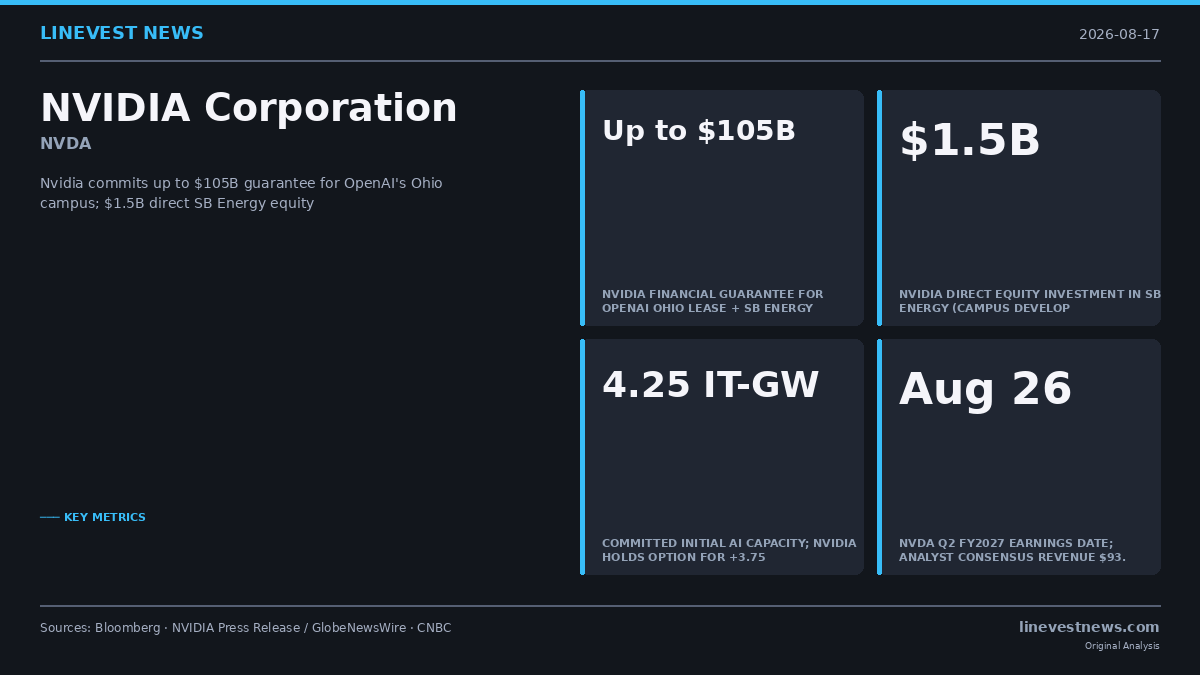
Here the arithmetic cuts against the intuitive read. In the quarter ended April 26, 2026, Nvidia reported $81.6 billion of revenue and said no Data Center Hopper products shipped to China during the quarter, against $4.6 billion a year earlier. Its guidance for the current quarter assumes no Data Center compute revenue from China.
That $4.6 billion is a product line, not a country: Hopper sales into China ran a little over a tenth of Nvidia's $44.1 billion of total revenue a year ago.
Nvidia's total China exposure was always larger than that one line. The company reports a separate geographic figure for China including Hong Kong covering gaming, networking and automotive alongside data center compute. Reading the Hopper figure as the whole of China understates what the market once contributed; reading the current quarter as a clean zero overstates how completely it has gone.
On that broader measure the retreat is real but partial. Nvidia's latest filing puts China including Hong Kong at $4.55 billion, against $9.66 billion a year earlier — roughly a fifth of the business then, closer to a twentieth now, while total revenue grew 85%.
So whatever this review concludes, it is unlikely to shock the China line itself: the compute revenue export policy targets has already been guided to nothing there. The exposure sits somewhere less obvious — in the offshore data centers where Chinese teams rent capacity. Nvidia now attributes geographic revenue to a customer's headquarters location, so a Southeast Asian facility serving Chinese engineers is booked to its operator's home country, not China. Squeeze that capacity, and the revenue disturbed is counted as something other than China.
That distinction matters for anyone reading the next set of disclosures. A restriction aimed at China that surfaces as softness in Singapore billings does not announce itself as such.
Precedent: the last two times Washington moved
The regime has swung in both directions inside sixteen months, and each swing produced a measurable result rather than a vague chill.
In April 2025 the U.S. government told Nvidia a license was required to export H20 products to China. Nvidia took a $4.5 billion charge that quarter for excess inventory and purchase obligations tied to the product, and said it could not ship a further $2.5 billion of revenue already expected from it.
The forward damage was larger than the charge. Nvidia guided to roughly $8.0 billion of lost H20 revenue in the quarter that followed. Restrictions on this product line have historically been expensive, and they have arrived quickly enough to hit a single reporting period.
The move in the opposite direction was cheaper and much quieter. On Jan. 13, 2026, BIS said it would review license applications for the Nvidia H200, the AMD (NASDAQ: AMD) MI325X and similar chips case by case, provided security conditions were met — independent third-party testing in the United States, verification of the Chinese purchaser's export compliance procedures, and evidence of no reduction in U.S. semiconductor capacity.
The asymmetry is worth noting on its own. Tightening arrived as a charge against earnings in a single quarter. Loosening arrived as a conditional process with security hurdles attached, which converts slowly if at all. A decision to restrict has historically registered far faster than a decision to permit.
What the "breakthroughs" actually were
The trigger Bloomberg cites is capability, not smuggling. The Financial Times reported in November 2025 that Alibaba (NYSE: BABA) and ByteDance, the privately held Chinese owner of TikTok, were among the groups training their latest large language models in Southeast Asian data centers to reach Nvidia hardware — a report Reuters relayed while noting it could not immediately verify it. In February 2026, a U.S. official told Reuters that DeepSeek, the Hangzhou-based AI lab behind China's best-known open models, had trained a model on Nvidia's best chip despite the ban.
The pattern across those accounts is consistent, and it is what makes an ownership test look inadequate. In none of them does a controlled chip enter China. The work travels to the hardware instead.
Meanwhile the substitution case has strengthened on the other side of the ledger. Meituan, the Chinese local-services and delivery platform, said in June 2026 that its LongCat-2.0 was "the industry's first trillion-parameter model to complete end-to-end training and inference on a 50,000-chip domestic compute cluster." Nvidia's own chief executive told analysts in May that the company has "really largely conceded that market" to Huawei, the privately held Chinese telecom-equipment maker now supplying domestic AI accelerators, per TrendForce's account of the earnings call.
A control regime tightening around a market whose principal target has partly exited is aiming at something that keeps moving. Each restriction changes not just what Chinese developers can buy but where they choose to build, and the second effect outlasts the rule that caused it.
The reading, and what would break it
LineVest last covered Nvidia on July 28, when the company convened a 37-member Open Secure AI Alliance built on the premise that meaningful control follows the infrastructure you run yourself; we have not previously covered the June BIS guidance or Nvidia's first zero-China quarter. This story inverts that July premise exactly. Washington's difficulty is that Chinese developers run Nvidia silicon on infrastructure they do not own, in jurisdictions where an ownership test does not bite.
The reading here is that the review is constrained by statute rather than by will, and that the binding variable sits in the Senate rather than at Commerce. The counter-argument deserves stating: if the review closes with enforcement guidance BIS judges sufficient under existing catch-all controls — the authority it invoked in 2025 to warn that supplying compute for AI training could itself trigger licensing — then this was ordinary oversight, the ownership rule was never the whole toolkit, and the stalled bill was never the real constraint.
Two dated checkpoints will settle which reading holds. The first is whether the Senate Banking Committee moves H.R. 2683 or S. 3519 out of committee. The second is Nvidia's next quarterly report, set against guidance of $91.0 billion that already assumes nothing from China — the geographic detail there will show whether offshore demand is being disturbed before any new rule is written.
Not covered here: the segment-level split between data center compute and networking, the four-quarter revenue and margin trend table, peer comparison against AMD and Broadcom, and the cash-flow bridge behind the H20 inventory charge are in the full report.
This article is journalism, not investment advice. LineVest is not a registered investment adviser and does not recommend the purchase or sale of any security. Figures are sourced as cited and were current at publication.
Sources
- Bloomberg — US Reopens Review of Nvidia China Cloud Access (August 8, 2026)
- Bureau of Industry and Security (BIS) — Export Control Guidance, June 1, 2026
- Baker McKenzie Sanctions News — US House Passes Remote Access Security Act (January 2026)
- The Register — Congress Votes on China GPU Cloud Access Bill (January 13, 2026)
- Al Jazeera — US Says Ban on AI Chip Shipments Applies to Chinese Firms Outside China (June 1, 2026)