TL;DR - Sony Group and TSMC are in advanced talks to invest approximately USD 6.3–6.4 billion in a joint venture in Kumamoto, Japan to mass-produce next-generation image sensors - Sony Semiconductor Solutions would hold ~60%, TSMC ~40%; formal JV agreement expected within fiscal 2026 (by March 2027) - Production targets 2029, focused on physical AI applications: autonomous vehicles and robotics - TSM carries a market cap of ~USD 2.18 trillion; analyst consensus remains Buy with price targets near USD 490
Part A: The Announcement
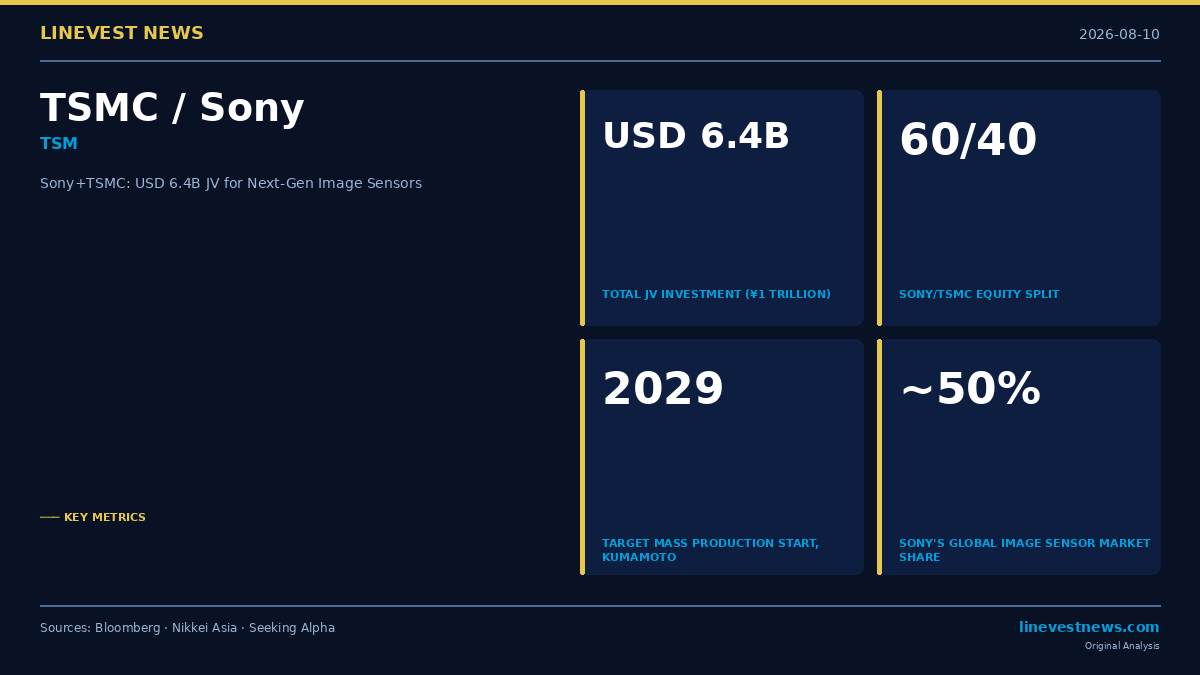
Sony Group Corporation and Taiwan Semiconductor Manufacturing Co. (NYSE: TSM) are in advanced talks to establish a joint venture (JV) capitalized at approximately ¥1 trillion — or USD 6.3–6.4 billion — to develop and mass-produce next-generation image sensors in Kumamoto Prefecture, Japan, according to Bloomberg and Nikkei Asia reports published August 10, 2026.
The two companies signed a non-binding memorandum of understanding in May 2026, with today’s reports disclosing the full capital commitment and equity structure for the first time. Under the proposed arrangement, Sony Semiconductor Solutions (SSS) would hold approximately 60% of the JV, with TSMC holding the remaining ~40%.
The new factory will be built at or adjacent to Sony’s existing fab in Koshi City, Kumamoto — the same region where TSMC already operates its Japan Advanced Semiconductor Manufacturing (JASM) facility. Mass production is targeted to begin as early as 2029. The partners are expected to reach a definitive agreement and formally establish the JV within the current fiscal year (ending March 2027).
Japanese government support is anticipated. Sony and TSMC are in discussions with Japan’s Ministry of Economy, Trade and Industry (METI) about potential subsidies — consistent with Tokyo’s strategy of anchoring advanced semiconductor manufacturing domestically. Japan previously pledged approximately USD 4.86 billion in additional subsidies to TSMC’s existing Kumamoto plant expansion in February 2024.
| Key Metric | Value |
|---|---|
| Total JV Investment | ~USD 6.3–6.4 billion (¥1 trillion) |
| Sony Stake | ~60% |
| TSMC Stake | ~40% |
| Location | Koshi City, Kumamoto, Japan |
| Production Start | As early as 2029 |
| JV Agreement | Within fiscal 2026 (by March 2027) |
| Sony Image Sensor Market Share | ~50% global |
| TSM Market Cap (Aug 2026) | ~USD 2.18 trillion |
| TSM Analyst Consensus | Buy |
| TSM Average Price Target | ~USD 490 |
Part B: What This Means for TSM Investors
Sony’s Sensor Dominance Meets TSMC’s Process Power
Sony currently commands roughly 50% of the global image sensor market — a lead that spans smartphone cameras, automotive vision systems, and industrial equipment. Despite this commanding position, scaling to next-generation node sizes and advanced 3D stacking architectures requires cutting-edge foundry capabilities that Sony does not fully possess in-house.
That is where TSMC enters. The world’s most advanced contract chipmaker brings sub-5nm process technology and 3D IC packaging expertise. By combining Sony’s sensor design intellectual property with TSMC’s manufacturing capabilities, the JV aims to produce sensors capable of meeting the performance demands of “physical AI” — an emerging category covering autonomous vehicles, humanoid robots, and AI-enabled industrial machines.
For TSM investors, the deal accomplishes several objectives at once.
1. Diversifies TSMC’s revenue beyond logic chips. TSMC’s core business is advanced logic processors — Nvidia GPUs, Apple silicon, AMD data center chips. The Sony JV expands TSMC’s foundry footprint into image sensing, a market set to grow substantially as autonomy and AI proliferate across physical hardware platforms.
2. Deepens Japan presence with government backing. TSMC’s existing JASM facility in Kumamoto benefited from significant Japanese government subsidy. A second major anchor in the same region — now in JV with Sony, Japan’s dominant imaging company — is likely to attract further Tokyo policy support, including potential METI grants tied to the physical AI and robotics industrial roadmap.
3. Captures the physical AI sensor upcycle. Demand for high-performance image sensors is accelerating well ahead of the 2029 production start. Sony’s Imaging & Sensing Solutions segment recorded a 26% year-over-year revenue increase to ¥512.7 billion and a 125% operating income jump to ¥122.2 billion in Q1 fiscal 2026 (April–June 2026) — evidence that the premium sensor market is already in an upswing. Sony lifted its full-year imaging operating income forecast by 5% to ¥420 billion on the strength of that quarter.
4. Validates TSMC’s long-cycle capital allocation strategy. TSM has repeatedly committed capital 3–5 years ahead of peak demand cycles. A 2029 mass production target on physical AI sensors positions TSMC at the front of the wave when autonomous vehicle and humanoid robot shipments begin scaling into mass-market territory — a period most forecasters place in the early-to-mid 2030s.
Risk Factors: Earthquake Exposure and Execution Risk
Not all news from Kumamoto has been positive. A July 2026 earthquake temporarily suspended operations at TSMC’s Kumamoto Technology Center after the site experienced seismic intensity of 5+. While production has since resumed, the incident highlights a geographic concentration risk: both of TSMC’s Japan fabs, plus the proposed Sony JV facility, are located within the same prefecture. A more severe seismic event could simultaneously disrupt multiple production lines.
Sony has not yet quantified the earthquake’s financial impact on its full-year forecast. The company also noted that mobile sensor revenues are expected to see slight softness in H2 2026 due to typical consumer electronics seasonality. Investors should note that the JV’s primary investment thesis targets not near-term smartphone demand, but the longer-dated physical AI ramp beginning in 2029 and beyond.
The JV itself remains subject to definitive legal agreements, closing conditions, and government subsidy negotiations. Until a formal agreement is signed and METI commitments are locked in, the deal remains in the “advanced talks” stage.
TSM’s Positioning After a 95% Year
TSM trades with a market capitalization of approximately USD 2.18 trillion as of August 2026, ranking it among the world’s six most valuable companies. The stock has returned roughly 95% over the trailing 12 months, driven primarily by AI infrastructure spending from hyperscalers and the continued ramp of TSMC’s advanced nodes (3nm, 2nm).
The Sony JV does not change near-term earnings guidance — the USD 6.3–6.4 billion investment is phased over multiple years and tied to market demand milestones. However, it reinforces TSMC’s strategic narrative: that the company is the indispensable manufacturing partner for frontier semiconductor applications, whether in logic, memory-adjacent architectures, or now advanced imaging.
Analyst consensus remains Buy, with price targets averaging near USD 490 on the NYSE-listed ADR (TSM), according to TipRanks data.
Sources: Bloomberg · Nikkei Asia · Seeking Alpha · BigGo Finance · Yahoo Finance – Sony TSMC Venture · TipRanks – TSM MOU Filing
This article is for informational purposes only and does not constitute investment advice.