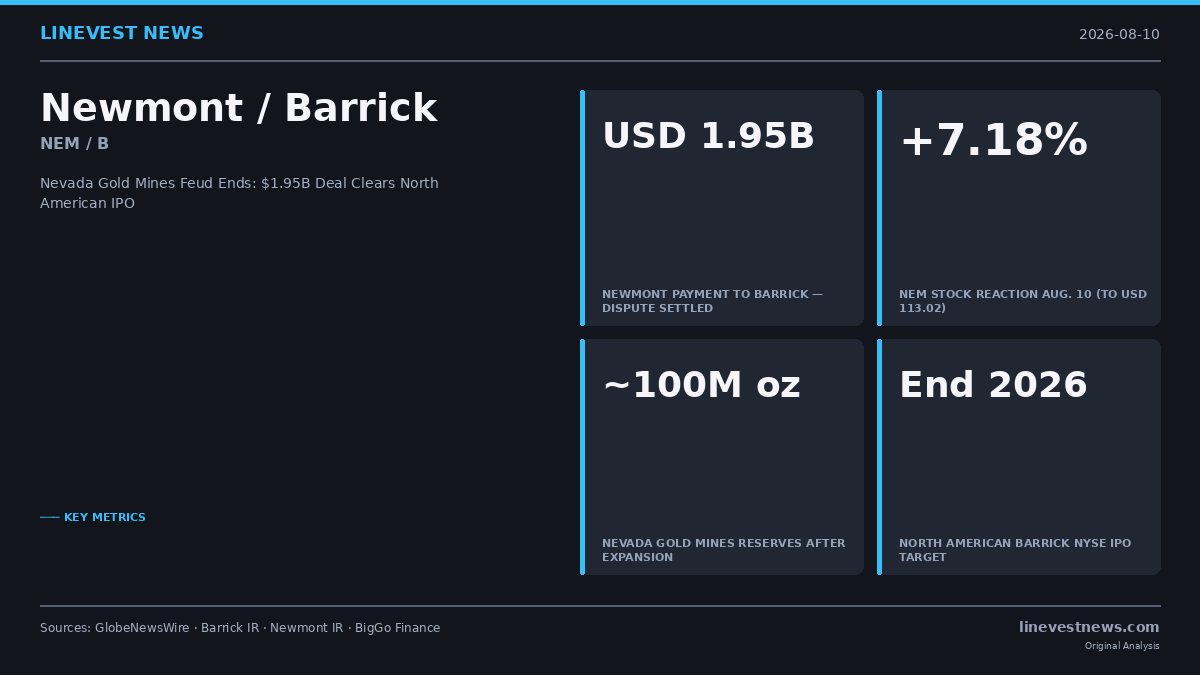
TL;DR - Newmont (NYSE: NEM) and Barrick Mining (NYSE: B) settled all Nevada Gold Mines JV disputes on August 10, 2026, with Newmont paying Barrick USD 1.95 billion for governance reforms and Fourmile's inclusion in the JV. - The deal expands the Nevada Gold Mines complex to nearly 100 million ounces of mineral reserves — the deepest gold reserve base in Nevada. - Newmont's consent clears the final contractual hurdle for North American Barrick's NYSE IPO, targeted for end of 2026 as a minority-stake offering. - Market reaction was sharply split: NEM +7.18% to USD 113.02, Barrick Mining -6.11% to USD 41.01 on the announcement date.
Part A — The Deal
The Nevada Gold Mines Joint Venture
Nevada Gold Mines (NGM) is the world's largest single gold-mining complex, operated by Barrick Mining with a 61.5% stake and Newmont holding 38.5%. The JV spans Nevada's Carlin Trend, the Battle Mountain–Cortez corridor, and the Turquoise Ridge–Twin Creeks operations, producing roughly 3.5 million combined ounces annually.
Since the JV was formed in 2019 — when Barrick and Newmont merged their overlapping Nevada operations — the two companies maintained persistent friction over "excluded properties": adjacent developments held separately that each company refused to contribute. The most significant was Barrick's Fourmile development, which Barrick described as "one of the most significant gold discoveries of this century." Newmont held two excluded properties of its own: the Fiberline and Mike underground developments.
These exclusions slowed coordinated resource development and generated years of legal disputes.
What Both Sides Agreed
Under the August 10, 2026 agreement, all three excluded properties will be contributed into Nevada Gold Mines:
| Property | Owner | Outcome |
|---|---|---|
| Fourmile development | Barrick Mining | Contributed into NGM JV |
| Fiberline underground | Newmont | Contributed into NGM JV |
| Mike underground | Newmont | Contributed into NGM JV |
Newmont will pay Barrick USD 1.95 billion to reflect the net value difference in contributions. The deal simultaneously implements a modernized joint venture agreement with enhanced governance provisions — a structural reform Newmont had demanded before granting IPO consent.
The agreement "concludes all outstanding disputes between the parties related to the Nevada Gold Mines joint venture," per the joint press release.
The resulting NGM holds nearly 100 million ounces of mineral reserves after the property additions, making it the deepest reserve base of any operating gold complex in Nevada. The Carlin Complex within NGM alone sustains approximately 1.6 million ounces per year, and the Goldrush mine — currently in development — is expected to add 400,000 ounces annually over a 24-year mine life.
The IPO Clearance
The deal's critical strategic unlock for the gold sector: Newmont's formal consent to Barrick's proposed North American IPO.
Barrick had announced in 2025 that it was evaluating a spinout of its North American operations into a separately listed entity — internally referred to as "North American Barrick" or "NewCo." Newmont, as the JV partner, had the ability to withhold consent pending resolution of the NGM disputes. With the agreement signed, that block is removed.
The proposed IPO would bundle: - Barrick's 61.5% stake in Nevada Gold Mines (now expanded with Fourmile) - Barrick's 60% stake in Pueblo Viejo (Dominican Republic), one of the world's lowest-cost gold mines - The 100% Fourmile discovery, initially held separately but now contributing into NGM
North American Barrick generated approximately 2.0 million attributable gold ounces in 2025, with production growth expected from Fourmile's high-grade ore.
The IPO structure is a minority-stake offering: Barrick Mining retains a "significant controlling majority interest" in NewCo. The primary listing is targeted for the New York Stock Exchange, with a secondary listing in Toronto, subject to SEC registration and Canadian prospectus qualification.
Timeline: by end of 2026, subject to market conditions and regulatory approvals.
Barrick has already assembled the NewCo management team: Mark Hill (CEO), Tim Cribb (COO), Wessel Hamman (CFO), Joe Heckendorn (Chief Legal Officer), and Megan Tibbals (Chief Technical Officer).
Barrick Q2 2026 Snapshot
Barrick reported Q2 2026 results alongside the agreement:
| Metric | Q2 2026 | YoY Change |
|---|---|---|
| Revenue | USD 5.29B | +44% |
| Gold production | 796,000 oz | Beat guidance of 730–770K |
| Realized gold price | USD 4,417/oz | — |
| Net earnings | USD 1.22B (USD 0.73/sh) | +55% |
| Adj. net earnings | USD 1.36B (USD 0.82/sh) | +74% |
| Operating cash flow | USD 1.70B | +28% |
| Attributable FCF | USD 141M | — |
| All-In Sustaining Cost | USD 1,866/oz | +11% YoY |
Barrick's FY2026 gold production guidance remains 2.90–3.25 million ounces, with capex reduced to USD 3.8–4.2 billion (from USD 4.0–4.45 billion).
Note: Barrick Mining Corporation changed its name from Barrick Gold Corporation and moved its NYSE ticker from GOLD to B, effective May 9, 2025. TSX ticker remains ABX.
Part B — Investor Analysis
Why Did Newmont Pay USD 1.95 Billion?
On the surface, Newmont is writing a USD 1.95 billion check to a company whose stock declined on the news. The rationale is straightforward: Fourmile.
Fourmile sits directly adjacent to the Carlin Complex within NGM. Barrick's geological surveys indicate high-grade ore bodies that management has described with superlatives typically reserved for once-in-a-decade finds. By bringing Fourmile into the JV, Newmont as a 38.5% partner gains proportional exposure to that discovery, rather than watching a wholly-owned Barrick asset develop as a rival operation inside Nevada's tightest geological cluster.
Governance reform adds compounding value. The modernized JV agreement removes years of friction from decision-making over a complex that produces well over 3 million ounces annually. Cleaner governance at a nearly 100-million-ounce reserve complex has material long-run implications.
Newmont's balance sheet comfortably absorbs the transaction. In Q2 2026, the company generated a record USD 2.2 billion in free cash flow, with a realized gold price of USD 4,414 per ounce against an all-in sustaining cost of USD 1,621 per ounce — well below the company's own full-year AISC guidance of USD 1,680 per ounce. The USD 1.95 billion is roughly one quarter's cash generation at current prices.
Newmont returned USD 1.9 billion to shareholders in Q2 2026 alone via dividends and buybacks, with more than 100 million shares repurchased since the program's inception. The payment does not represent a structural financial stress on the company.
NEM's +7.18% gain to USD 113.02 on August 10 reflects investor confidence that the company is getting more value than it is giving.
Why Did Barrick Decline?
Barrick (NYSE: B) fell 6.11% to USD 41.01 despite receiving USD 1.95 billion in cash and reporting strong Q2 earnings. The concern centers on the IPO structure itself.
When North American Barrick separates into a publicly listed company, the remaining parent Barrick Mining will hold its global non-North-American portfolio: operations in Tanzania, Zambia, the Democratic Republic of Congo, Saudi Arabia, and Latin America. These assets carry meaningfully higher geopolitical risk profiles than Nevada.
Investors who held Barrick Mining primarily for Nevada exposure may view the separation as a restructuring of their core thesis. The North American gold assets get a clean, premium-listed vehicle; the parent becomes a more geopolitically complex entity. A common pattern in resource sector carve-outs is that the parent de-rates even when sum-of-parts arithmetic supports the split.
The combination — USD 1.95 billion received, IPO concerns expressed — resulted in the 6% decline.
The North American Gold IPO as a Market Event
The proposed NYSE listing of North American Barrick would be among the largest mining IPOs in years. With approximately 2.0 million attributable gold ounces in annual production and realized prices above USD 4,400 per ounce, NewCo's implied revenue run rate exceeds USD 8 billion annually at current gold prices.
For investors seeking dedicated exposure to tier-one North American gold assets, the IPO fills an identifiable gap. Newmont (as the only gold producer in the S&P 500) is currently the dominant passive-fund-eligible gold equity. North American Barrick would add a second large-cap, U.S.-exchange-listed gold vehicle to that universe — with the added attraction of the Pueblo Viejo mine, one of the lowest-cost producers globally.
The IPO timing — targeting end of 2026 — coincides with gold prices that have remained above USD 4,400 per ounce, a historically favorable environment for mining equity valuations.
Investor Watch Points
| Watch Point | Expected Timing | Why It Matters |
|---|---|---|
| SEC Form S-1 registration filing | Q3–Q4 2026 | Will reveal North American Barrick's standalone financials |
| NGM governance improvement signal | Next JV quarterly update | First data point on whether reformed governance boosts output |
| NEM Q3 2026 earnings | ~October 2026 | Will show impact of USD 1.95B payment on FCF and balance sheet |
| Fourmile resource estimate | 2026–2027 | Could substantially re-rate NGM reserve base upward |
| North American Barrick IPO pricing | Q4 2026 | Will set the market-clearing value for North American gold assets independently |
Gold Sector Context
The Barrick-Newmont truce is the latest indicator that gold-sector joint ventures are becoming less litigious as cash flows improve. With spot gold above USD 4,400 per ounce — both companies realized prices north of USD 4,400 in Q2 2026 — the opportunity cost of governance gridlock at large operations is now measured in hundreds of millions per quarter. Companies that spent the low-price years accumulating legal friction are now motivated to resolve it quickly.
For NEM specifically, the stock has approached all-time-high territory in August 2026. The combination of record free cash flow generation, below-guidance AISC, and a newly simplified Nevada JV structure provides a constructive setup for the remainder of the year. The question for new NEM buyers above USD 110 is whether the USD 1.95 billion cash outflow in Q3 2026 — and the implicit bet on Fourmile's value — is worth the premium.
This article is based on official company press releases, SEC filings, and earnings call transcripts. All figures are in U.S. dollars unless otherwise noted. LineVest News is an independent financial publication, not a registered investment adviser. This article does not constitute investment advice.
Sources 1. GlobeNewsWire — Barrick and Newmont Reach Agreement Regarding Nevada Gold Mines Joint Venture (Aug. 10, 2026) 2. Barrick.com — Barrick Advances IPO of North American Gold Assets, Announces Executive Appointments (Aug. 10, 2026) 3. GlobeNewsWire — Barrick Reports Second Quarter 2026 Results (Aug. 10, 2026) 4. StockTitan — Newmont Consents to Barrick's Proposed IPO of North American Gold Assets 5. Newmont IR — Newmont Reports Robust Second Quarter 2026 Results (July 23, 2026) 6. BigGo Finance — NEM Q2 2026 Earnings Call: Record Free Cash Flow and Returns