TL;DR
- The U.S. Bureau of Labor Statistics releases the July 2026 Employment Situation on Friday, August 7 — the same morning Naver (035420.KS) reports Q2 earnings
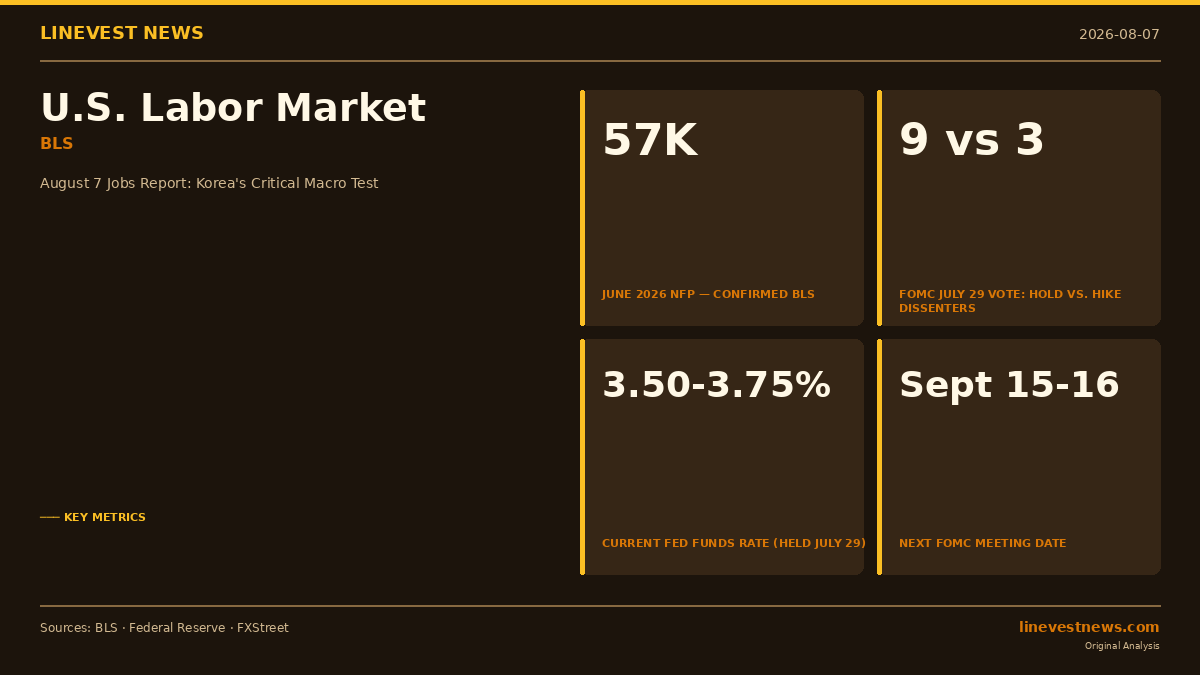
- June 2026 NFP: just 57,000 (BLS confirmed, released July 3), with April–May revised down a combined 74,000 jobs
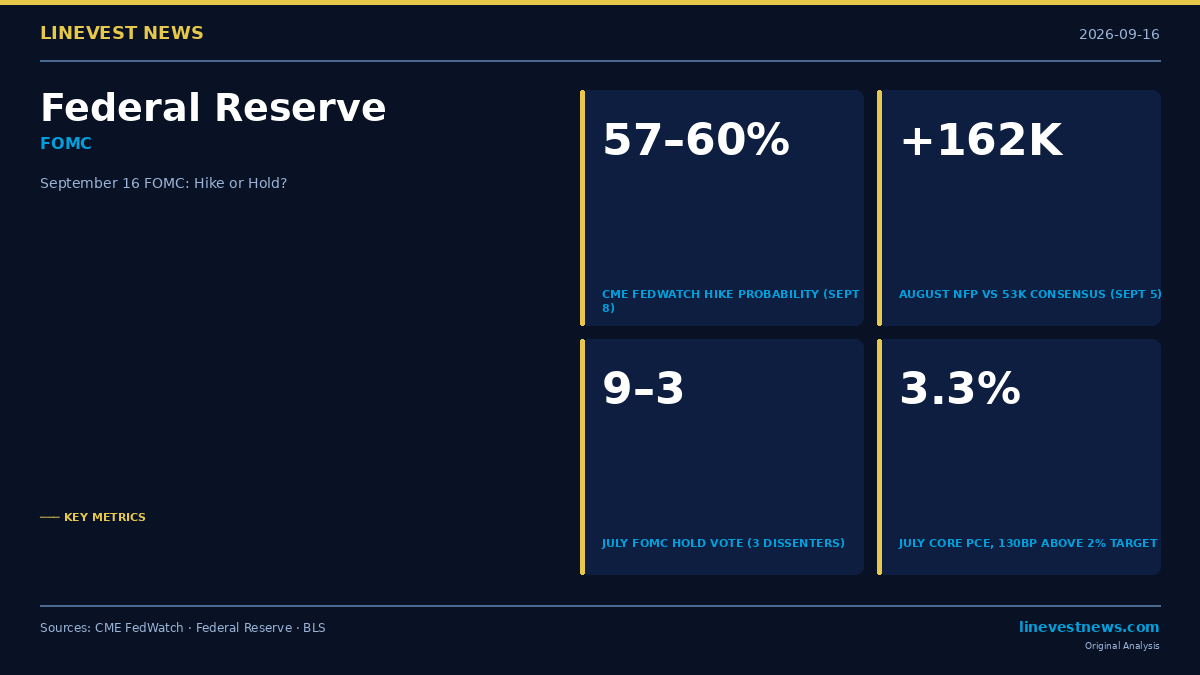
- The Fed held at 3.50%–3.75% on July 29 in a 9-3 vote — three regional presidents dissented in favor of a 25 bps hike
- Analyst consensus for Friday's July print: approximately 117,500 (FactSet), more than double June's weak result
- If July disappoints materially, the September 15–16 FOMC hike case weakens; a strong beat reinforces the hawks
Part A: Setting the Stage — A Weak June and a Split Fed
Friday's U.S. Employment Situation report arrives as the Federal Reserve is more internally divided than at any point in recent memory. On July 29, the FOMC voted 9-3 to hold rates at 3.50%–3.75% — but three regional presidents dissented, calling for an immediate 25 bps hike: Cleveland Fed President Beth Hammack, Minneapolis Fed President Neel Kashkari, and Dallas Fed President Lorie Logan.
That hawkish dissent came against a June labor market that was already showing material softening.
June 2026 Employment Situation (BLS, Released July 3)
| Indicator | June 2026 | Notes |
|---|---|---|
| Nonfarm Payrolls | +57,000 | Well below the 150K-200K monthly pace of 2023-2024 |
| Unemployment Rate | 4.2% | Little changed |
| Avg. Hourly Earnings (MoM) | +0.3% | USD 37.64 per hour |
| Avg. Hourly Earnings (YoY) | +3.5% | Above Fed's 2% inflation target |
| Labor Force Participation | 61.5% | Down from prior month |
| April revision | +148,000 | From +179,000 (-31K) |
| May revision | +129,000 | From +172,000 (-43K) |
Source: U.S. Bureau of Labor Statistics, Employment Situation Summary — June 2026
Combined April–May revisions totaled -74,000 jobs — suggesting the underlying trend is weaker than the initially reported headline figures implied. Despite this, three Fed members judged that inflation risks justify tightening further. The August 7 report will either vindicate their hawkish stance or undermine it.
The Wage Growth Wildcard
Average hourly earnings at +3.5% year-over-year remain the Fed's primary concern. Even with headline payroll weakness, sustained wage growth keeps services inflation elevated and gives the hawk camp a strong argument. The question Friday's data must answer: is a labor market adding just 57,000 jobs per month generating enough wage pressure to warrant a September hike?
Part B: Korean Market Implications — Four Angles
1. Three Scenarios and Their KOSPI Impact
| July NFP Outcome | Fed September Implication | USD/KRW Direction | KOSPI Likely Reaction |
|---|---|---|---|
| Below ~90K (clear miss) | September hike off table; hawks lose ground | USD weakens | Positive — rate risk unwinds, multiples expand |
| 90K–140K (below consensus but above June) | Status quo hold; September meeting stays live | Broadly neutral | Muted; August CPI becomes the next key test |
| Above ~150K (beats 117.5K consensus) | Hawks vindicated; September hike probability rises | USD strengthens | Negative — rate re-pricing pressure on KOSPI |
For Korean investors, the most important channel is the USD/KRW exchange rate (currently in the 1,453–1,525 range), which the Fed–BoK policy rate spread drives over the medium term.
2. Samsung and SK Hynix — At the Intersection of Rate Risk and AI Supercycle
Samsung Electronics (005930.KS) and SK Hynix (000660.KS) are the two largest components of the KOSPI by market capitalization. Both reported record Q2 2026 results:
- Samsung Q2 2026: Consolidated revenue ₩171.5T (+130% YoY), Operating Profit ₩89.5T (+1,817% YoY). The DS (semiconductor) division drove the surge; the MX (mobile) division reported an operating loss for the quarter.
- SK Hynix Q2 2026: Revenue ₩79.32T (+257% YoY), Operating Profit ₩60.54T (+557% YoY, 76% margin). HBM4 mass production commenced in Q2.
Despite exceptional fundamentals, both stocks carry valuation risk tied to global rate expectations. A Friday payroll miss would reduce the probability of a September Fed hike, generally supportive of technology stock multiples and therefore KOSPI's two largest weights.
Conversely, a strong jobs beat would reintroduce September hike risk — a headwind for the AI memory cycle narrative and for the KOSPI's semiconductor-heavy composition.
3. The Fed–BoK Policy Rate Spread
The Bank of Korea raised its base rate to 2.75% on July 16, 2026, its first hike since January 2023. The current Fed funds target of 3.50%–3.75% sits 75–100 bps above Korea's policy rate — a spread that has contributed to capital outflow pressure and won weakness in recent months.
If Friday's jobs report is weak enough to reduce the probability of a September Fed hike: - The prospective Fed–BoK spread narrows - Downward pressure on the won eases - Foreign portfolio inflows into Korean equities become more likely
If the data supports a September hike, the Fed could push to 3.75%–4.00%, widening the spread to 100–125 bps — increasing pressure on KRW and complicating the BoK's mid-August policy meeting.
The BoK faces a genuine dilemma: hike in tandem with the Fed to defend the won, or hold and risk further KRW depreciation.
4. August 7 — A Dual-Event Day for Korea
Friday is not only a major U.S. macro day — it is also when Naver (035420.KS) reports Q2 2026 earnings. The analyst consensus for Naver's Q2 operating profit is ₩572.7B (FnGuide), with three primary watch points:
| Naver Q2 Watch Point | Why It Matters |
|---|---|
| AI Briefing advertising revenue | First commercial quarter for the generative-AI ad product (launched July 21) |
| FIFA World Cup 2026 content cost | Q2 vs. Q3 cost allocation affects reported profitability |
| NVIDIA USD 1B investment terms | Expected ₩1.45T–₩1.53T (at current USD/KRW 1,453–1,525) data center capital commitment |
If the BLS payrolls miss (negative for the dollar, positive for KRW and KOSPI multiples) and Naver beats its ₩572.7B consensus, Friday, August 7 could become a meaningful positive inflection for Korean equities. If both disappoint, the reverse applies.
Also expected this week: SK Telecom (017670.KS / NYSE: SKM) is set to hold its earnings call for Q2 2026 results, with consensus operating profit near ₩527.9B (+56.1% year-over-year), reflecting recovery from the Q2 2025 USIM data breach base effect.
Key Risks: Why One Data Point Is Not a Policy Pivot
Three hawks remain committed: Hammack, Kashkari, and Logan voted for a hike even with June's 57K print. A single below-consensus result on Friday is unlikely to flip their stance.
Wages sticky at +3.5% YoY: The Fed's focus is not only on employment quantity — sustained wage growth keeps the inflation outlook uncertain, giving hawks continued cover.
Multiple inputs before September 15–16 FOMC: Friday's jobs report is an early data point, but the FOMC will also weigh July CPI (released August 12), July PPI, and August employment and inflation data before the September meeting. One weak payroll print does not determine September's outcome.
Structural labor market shift: Some economists argue the monthly payroll gains required to keep unemployment stable have declined to approximately 100,000–150,000 (from the 200,000+ level of 2021–2022), as demographic retirements and immigration policy changes reduce labor supply growth. Under this framing, 57,000 in June is clearly below neutral — but a July recovery toward 100K could be consistent with a still-decelerating labor market rather than a rebound.
Tariff overhang unchanged: U.S. tariffs on Korean automotive and select electronics exports remain in place, regardless of the Fed's rate path.
Bottom line: Friday's August 7 Employment Situation report is a live decision-driver for the September 15–16 FOMC. The 9-3 split in July's vote, combined with June's 57,000 payroll print and -74,000 in April–May revisions, means the hawks need Friday's data to support their case. For KOSPI investors, a below-consensus result would reduce September hike risk, ease pressure on the USD/KRW exchange rate, and provide a multiple-expansion backdrop for Samsung, SK Hynix, and Korean financials. Watch 8:30 AM ET on August 7.
This article is for informational purposes only and does not constitute investment advice. Past performance is not indicative of future results.
Sources - BLS Employment Situation Summary — June 2026 - THE EMPLOYMENT SITUATION — JUNE 2026 (BLS PDF) - Fox Business — June 2026 Jobs Report - FXStreet — Forecasting the Upcoming Week: US Labor Market Takes Center Stage After Hawkish Fed Split - CNBC — Bank of Korea Raises Rates to 2.75% - FXStreet — CME FedWatch Shows 24.1% Probability of July Hike