
Naver035420.KS
About Naver
Naver operates South Korea's dominant internet search engine and portal, the anchor for an ecosystem that spans online advertising, e-commerce, digital payments, cloud computing, and content. Search and display advertising remain the largest earnings source, while its shopping platform ties merchants, price comparison, and the Naver Pay wallet into a commerce loop. The company publishes webtoons and web novels globally through its storytelling arm and holds a stake in A Holdings, the joint venture with SoftBank that controls the Japanese messaging operator LINE. Unlike most large Korean issuers, Naver is founder-influenced but not part of a chaebol.
Foreign investors treat the stock as Korea's closest analogue to a global platform company, though most revenue is still generated domestically, tying results to Korean advertising and consumer-spending conditions. Its market position keeps it under standing scrutiny from Korean competition authorities over search neutrality and marketplace practices. The stake in the LINE joint venture adds a layer of cross-border governance complexity involving Japanese regulators and SoftBank. Competition from global platforms in search, advertising, and commerce is a structural pressure, and the company reinvests heavily in artificial intelligence and cloud, keeping dividends modest relative to earnings.
Naver traces to 1997, when engineer Lee Hae-jin led a search-engine project inside Samsung SDS that was spun out in 1999 as an independent startup. A 2000 combination with game company Hangame created NHN Corporation, which dominated Korean search and casual gaming for a decade before splitting in 2013; the search and portal business kept the Naver name. Its Japanese subsidiary built the LINE messenger, later merged with Yahoo Japan's parent under A Holdings, a fifty-fifty venture with SoftBank formed in 2021. Webtoon publishing, begun as a portal feature, grew into a global content arm whose U.S. entity listed on Nasdaq in 2024.
The commercial engine is a self-reinforcing marketplace: merchants list products in Naver's shopping service, buy search and display advertising to reach users, settle transactions through Naver Pay, and ship via affiliated logistics partners, with Naver collecting advertising fees, commissions, and payment income at each step. Advertisers pay through auction-based keyword pricing tied to Korea's dominant search traffic. Cloud services and webtoon content sales add enterprise and consumer revenue streams beyond the core. Its home-market position is entrenched against Google in search and Coupang in commerce, and nearly all profit is generated domestically, with content and cloud carrying the international growth ambition.
Company profile by LineVest editorial. Journalism, not investment advice.
Naver coverage
4 articles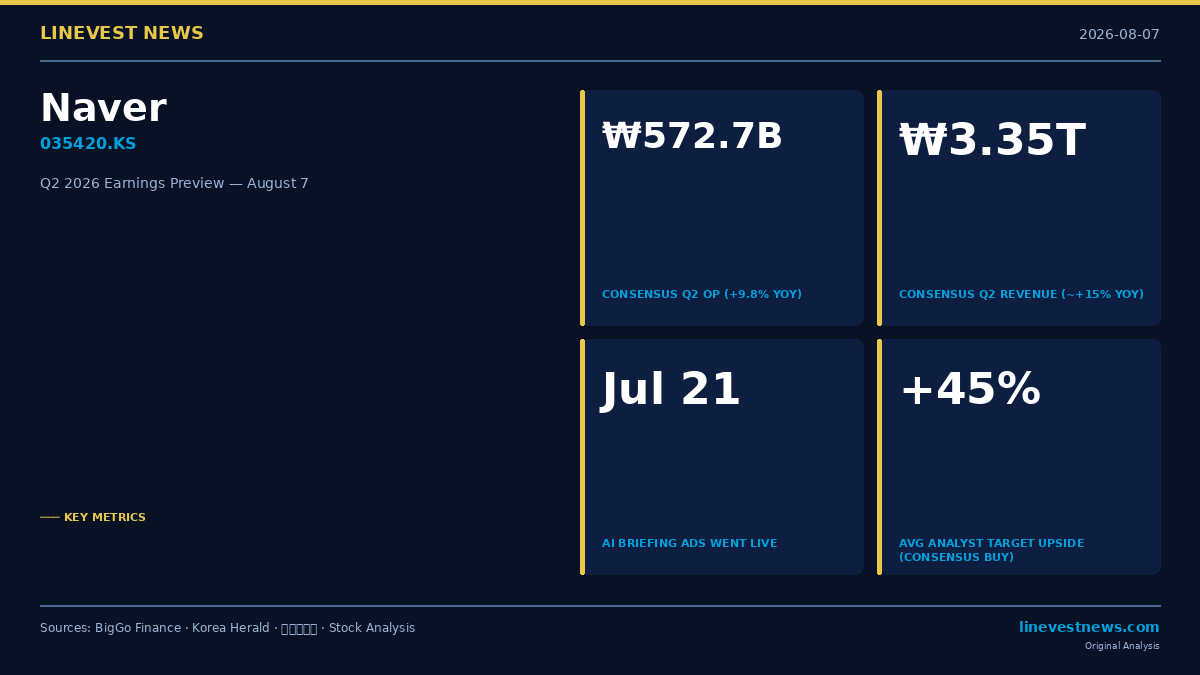
Naver (035420.KS) Q2 2026 Earnings Preview: Three Questions for August 7 as AI Ads Go Live
Naver Q2 2026 earnings due August 7. Consensus OP ₩572.7B (+9.8% YoY). Three watch points: FIFA cost drag, AI Briefing ads launched July 21, NVIDIA $1B deal dilution.
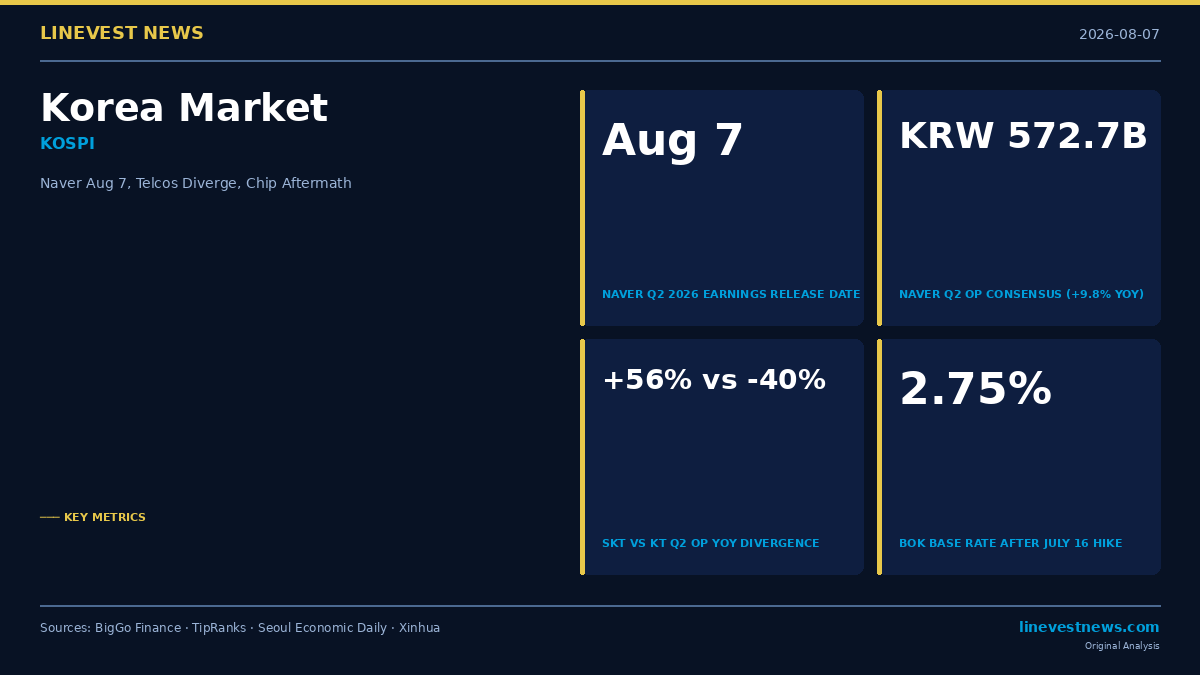
Korea Market Week Ahead: August 3–8, 2026 — Naver Earnings, Telco Divergence, and Chip Cycle Aftermath
Naver Q2 on Aug 7 (OP consensus KRW 572.7B, +9.8% YoY). SKT +56% vs KT -40% telco divergence. Apple DRAM warning after record Samsung/SK Hynix quarters. BoK meets mid-August.
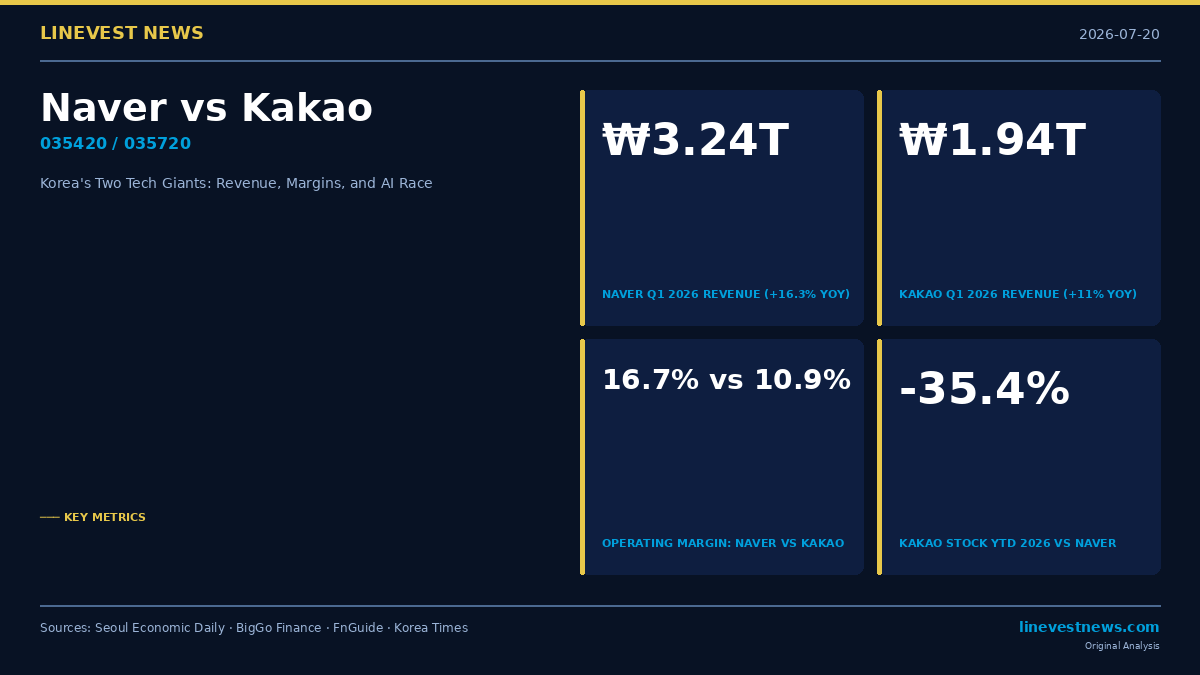
Naver vs Kakao: Business Comparison for Investors (2026)
Naver (035420) and Kakao (035720) dominate Korea's digital economy. Compare revenues, margins, user bases, and risks to decide which fits your Korea tech thesis.
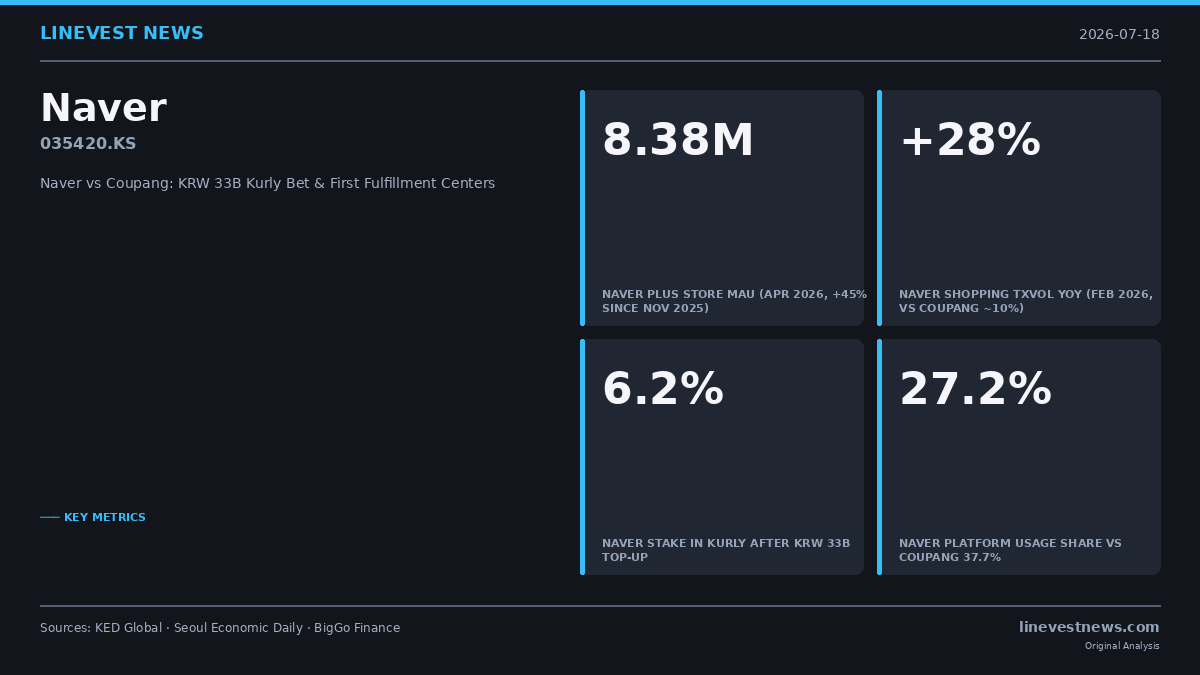
Naver vs Coupang 2026: KRW 33 Billion Kurly Bet and First Fulfillment Centers Reset Korea E-Commerce Race
Naver injected KRW 33B into Kurly (stake to 6.2%) and is scouting its first fulfillment centers as Coupang data breach handed Korea No. 2 a 45% MAU surge.
Frequently asked questions
What does Naver do?
Naver operates South Korea's dominant search engine and internet portal, monetized through advertising, and runs a large e-commerce marketplace with the Naver Pay payment service. It also provides cloud computing, publishes webtoons and web novels globally, and holds a stake in the venture controlling Japan's LINE messenger.
Who controls Naver?
Naver has no controlling shareholder. Founder Lee Hae-jin, who serves as a top executive, holds a meaningful but minority stake, while Korea's National Pension Service and foreign institutions own much of the register. Strategic direction is set by professional management under board oversight rather than by a family holding structure.
How can foreign investors get exposure to Naver?
Naver's shares trade on the Korea Exchange under ticker 035420. The company has no U.S.-listed depositary receipts, so foreign investors generally buy the Seoul listing through brokers with Korean market access or hold Korea-focused and Asian internet-sector ETFs that carry the stock as a major position.
Answers are editorial summaries for general information, not investment advice.
Go deeper than the headline
You just read what happened. Here's how to read what it means.
The day's reports, every morning — free
LineVest Daily lands in your inbox before the opening bell with the reports we published that day — what each company's latest 10-K or 10-Q actually says about the numbers, in plain English. Free, no card required.
This report, on any company you name
Apply this depth of research to a company you choose. We connect the selected filing’s financial detail with management choices, relevant industry evidence and the conditions that could change the business. English PDF by email within 3 hours.
Which company should we read?
$15 · one-time · PDF within 3 hours
Pick a company to continueIndependent journalism based on primary SEC filings — not investment advice. No brokerage affiliation.