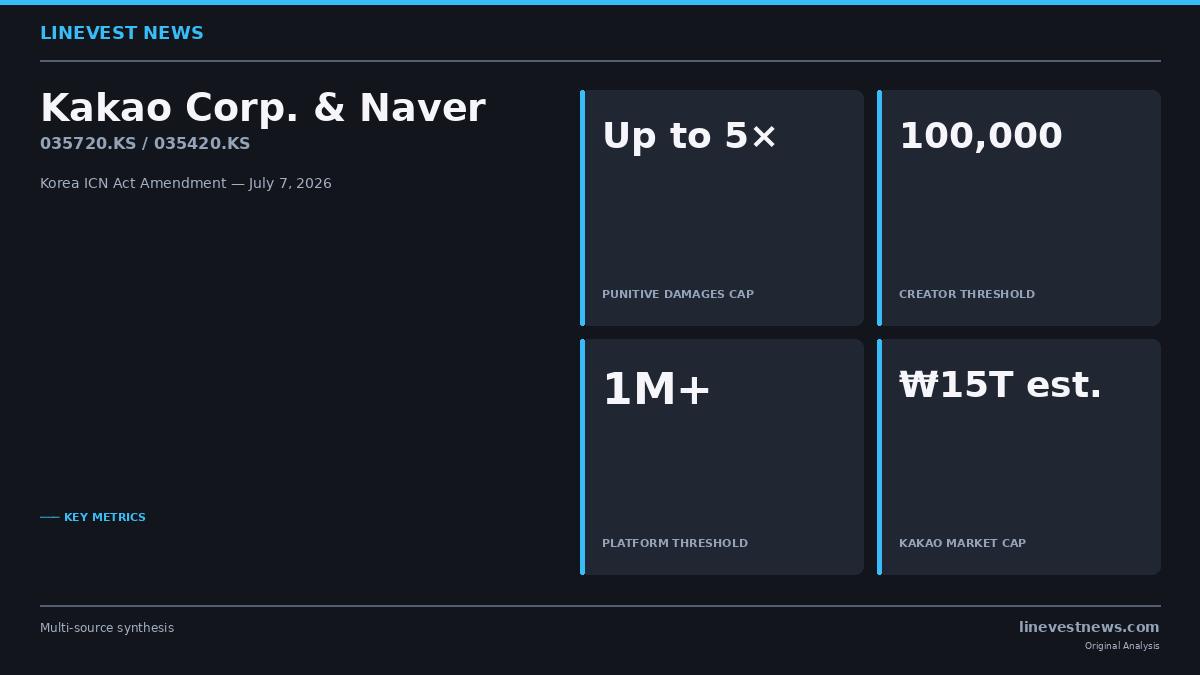
South Korea's revised Information and Communications Network Act — commonly called the "fake news law" — takes effect July 7, 2026, imposing punitive damages and mandatory content-monitoring duties on the country's largest digital platforms. For Kakao Corp. (035720.KS) and Naver Corp. (035420.KS), the law introduces the most significant platform liability regime in Korea's history, arriving as Kakao shares hover near a 52-week low.
Part A: What the Law Does
The amended ICN Act targets two distinct groups. Content creators who have posted at least three pieces of content in the past three months and who either hold 100,000 or more subscribers or average 100,000 or more monthly views are classified as "major online information producers." If such creators deliberately spread false or manipulated information to obtain an unfair advantage — whether economic or intangible, such as expanding political influence — courts may impose punitive damages of up to five times the proven loss.
Platform operators crossing 1 million daily active users must now build and maintain reporting and monitoring systems, route disputed content through the Korea Media and Communications Commission's transparency center, and act on verified complaints. Corporate administrative surcharges apply for failing to remove confirmed unlawful content. More pointedly, chief executives may face personal criminal prosecution if their companies refuse government corrective orders.
The law's reach extends beyond social media. Malicious product reviews on delivery apps, shopping platforms, and parenting communities all fall within scope — a broader sweep than comparable regimes elsewhere.
Part B: Investment Implications for Kakao and Naver
Compliance posture. Both Kakao and Naver have chosen to delegate borderline cases to the Korea Internet Self-Governance Organization (KISO) rather than adjudicate content in-house. A Naver representative told the Korea Times: "We are tightening our rules to match the new law. If a case feels ambiguous, we'll have to send it back to KISO again for review." Kakao made a similar commitment: "We plan to request reviews from KISO and actively comply with the organization's deliberation results, given the limits of our system for determining what is true and factual."
This posture caps immediate legal exposure but shifts processing costs to KISO's bandwidth — an institution that has never operated at the scale the new law demands. Analysts expect both companies to expand in-house trust-and-safety teams, adding to operating expenses in a year when advertising revenue recovery remains fragile.
Content-platform risk premium. Kakao (035720.KS) stock has already priced in significant headwinds — shares reached a 52-week low in late June amid a prolonged labor dispute — but the new law introduces an additional liability layer. A single high-profile enforcement action could force costly system overhauls or trigger regulatory escalation to CEO-level accountability, a scenario without precedent in Korean internet history.
Naver is relatively better insulated because its dominant news aggregation model gives it greater control over content provenance. Kakao's more open community features and the breadth of KakaoTalk's ecosystem — which spans mobile payments, ride-hailing, and digital content — expose more surface area to the new rules.
Scope creep and trade friction. The U.S. State Department previously expressed "serious concern" about the bill, warning it risked undermining freedom of expression. UNESCO issued a similar caution. The Seoul Economic Daily's editorial board warned that the law's vague provisions covering "hatred, animosity, and incitement" could chill legitimate policy criticism, calling for narrower application. Industry groups have flagged the potential for the law to become "a spark for trade disputes" with Washington, particularly as Korea-US digital trade talks remain ongoing.
For foreign investors, the key uncertainty is enforcement calibration. If regulators move aggressively against platforms over ambiguous content, the chilling effect on product development at Kakao and Naver could reduce user engagement metrics — a direct risk to ad revenue. Conversely, if regulators treat KISO self-referral as adequate compliance, incremental cost may be limited to staffing increases.
Sources: The Korea Times – Analysis, July 1, 2026 · South China Morning Post, July 2026 · Seoul Economic Daily – Editorial, July 2, 2026