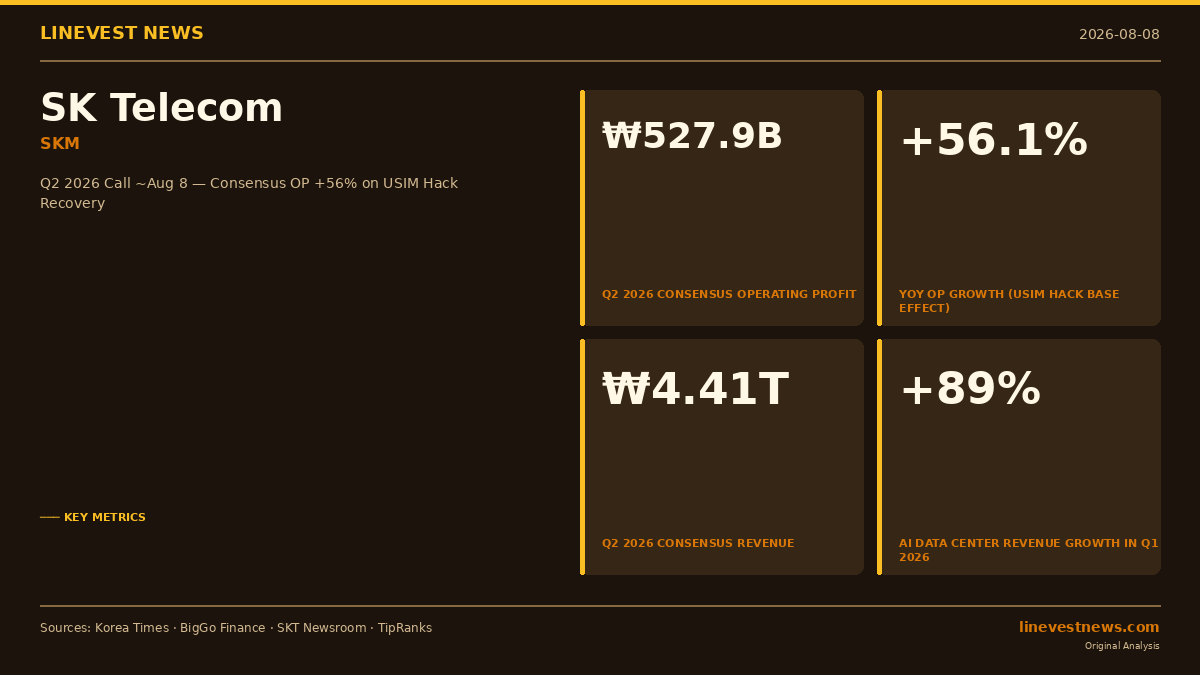
TL;DR - Q2 2026 results expected in early August, with an investor call around August 8 — verify the confirmed date at ir.sktelecom.com - Consensus OP ₩527.9B (+56.1% YoY) is largely a base effect: Q2 2025 was crushed by the USIM data breach - Q1 2026 already recovered to ₩537.6B, surpassing the pre-hack Q2 2024 benchmark of ₩537.5B. Q2's test is whether SKT sustains that level despite typical seasonal softness - Three watch points: AI data center revenue trajectory, sequential margin stability, and H2 guidance tone
Part A: Consensus Snapshot
| Metric | Q2 2024 (pre-hack) | Q2 2025 (hack-depressed) | Q2 2026 Consensus |
|---|---|---|---|
| Revenue | ₩4.42T | ~₩4.34T (est., -1.8% YoY) | ₩4.41T |
| Operating Profit | ₩537.5B | ~₩338B (est., -37.1% YoY) | ₩527.9B (+56.1% YoY) |
| OP Margin | ~12.2% | ~7.8% | ~12.0% |
Consensus: Korea Times, BigGo Finance. Q2 2025 columns are estimates derived from reported YoY decline rates; they carry no independent confirmation.
SK Telecom (017670.KS / NYSE: SKM) is expected to release Q2 2026 results in early August. TipRanks reports an investor call around August 8 — investors should confirm the exact date and time at ir.sktelecom.com before the event.
What Happened in Q2 2025?
On April 19, 2025, malicious code was discovered on a core USIM authentication server, exposing 26.96 million pieces of USIM data. This figure exceeds SK Telecom's approximately 23 million mobile subscribers because it encompasses USIM records tied to IoT devices and MVNO connections on the network. The breach was functionally comprehensive: nearly every subscriber's USIM metadata was compromised.
The business damage was immediate and severe:
- SKT suspended new mobile subscriptions for months, causing subscriber churn that partially benefited KT and LG Uplus.
- Approximately ₩500B in customer benefit packages (free USIM replacements, credits) hit the 2025 income statement.
- Korea's Personal Information Protection Commission assessed a ₩134B fine.
- The Korea Consumer Agency's dispute mediation committee recommended ₩100,000 compensation to claimants who filed. The mediation is non-binding, and the legal exposure across the broader subscriber base remains uncertain.
- Q2 2025 operating profit is estimated to have fallen approximately 37.1% YoY.
The Q2 2026 "+56%" headline is therefore not a growth surge. It is a recovery from a depressed base.
Q1 2026 Actual Results (for context)
| Metric | Q1 2026 Actual |
|---|---|
| Revenue | ₩4.392T |
| Operating Profit | ₩537.6B |
| Net Income | ₩316.4B |
| AI Data Center Revenue | ₩131.4B (+89.3% YoY) |
| SK Broadband OP | ₩116.6B (+21.4% YoY) |
Source: SK Telecom Newsroom
Note that Q1 2026 operating profit of ₩537.6B already surpassed the Q2 2024 pre-hack reference of ₩537.5B. The Q2 2026 consensus of ₩527.9B, however, implies a -1.8% sequential decline versus Q1. Seasonal softness in Q2 is normal for Korean telcos; the question is whether SKT sustains the recovery profile rather than slipping back toward the hack-year trough.
Part B: Three Questions for the Earnings Call
Question 1: Is the AI Data Center Business Scaling as Promised?
Q1 2026 revealed SK Telecom's most compelling new growth engine: the AI data center segment posted revenue of ₩131.4B (+89.3% YoY). SK Broadband, the wireline subsidiary that houses much of this infrastructure, grew operating profit 21.4% YoY in Q1.
At MWC 2026, SKT unveiled plans for 15GW total AI data center capacity by 2035, with an initial 5GW phase by 2029 and a near-term 1GW hub as the first milestone. The company has committed ₩140T in total capital through 2035. In partnership with NVIDIA, SKT is building a full-stack AI cloud (colocation + GPU compute) targeting domestic hyperscalers and global cloud tenants. In July 2026, SKT established a dedicated AI infrastructure subsidiary — the company positions itself as "Korea's only full-stack operator" across AI infrastructure, models, and enterprise services.
What to watch: Does AI data center revenue sustain the +80–90% YoY trajectory in Q2? Management commentary on enterprise B2B pipeline and NVIDIA DSX platform rollout will set H2 expectations.
Question 2: Can Margins Hold Steady Sequentially?
Consensus projects Q2 2026 OP at ₩527.9B — a -1.8% sequential decline from Q1's ₩537.6B, and slightly below the pre-hack Q2 2024 ₩537.5B benchmark. Some analysts estimate ₩542B, which would represent genuine above-2024-level performance.
The sequential softness is a normal seasonal pattern for Korean telcos; Q2 typically runs below Q1 on somewhat lower data usage and marketing dynamics. What would be concerning is a larger-than-seasonal miss:
- If OP comes in below ₩510B, it would suggest ongoing hack-related headwinds or new cost pressures.
- If OP beats ₩537.5B, it confirms that Q2 2026, not just Q1, has structurally recovered.
Factors that could push results toward the higher end:
- 5G ARPU lift: Penetration rate forecast near ~81.8% in Q2, supporting higher average revenue per user.
- SK Broadband data center contribution: High-growth segment with 21.4% YoY OP increase in Q1.
Factors that could weigh on margins:
- Continuing legal and regulatory costs from hack-related proceedings.
- Ramp costs for the ₩140T AI data center commitment.
Question 3: What Does Management Signal About H2 and Full-Year Guidance?
Analyst consensus places full-year 2026 operating profit at approximately ₩1.96T — well above 2025's depressed base, which absorbed the majority of hack-related charges in H2. With H1 consensus at approximately ₩1.07T (Q1 actual ₩537.6B + Q2 consensus ₩527.9B = ₩1,065.5B), H2 would need to deliver approximately ₩895B to reach the full-year consensus.
Key call topics that will move the stock:
- Whether the full-year OP guidance of ~₩1.96T is confirmed, raised, or revised
- The trajectory and timeline of hack-related legal and compensation proceedings — any definitive resolution reduces tail-risk uncertainty
- AI data center capex phasing and when this segment is expected to produce material consolidated profit contribution
Peer Comparison: Korea's Big 3 Telcos in Q2 2026
| SKT (017670.KS / SKM) | KT (030200.KS) | LG Uplus (032640.KS) | |
|---|---|---|---|
| Q2 2026 OP Consensus | ₩527.9B (+56.1% YoY) | ~₩609B (-40% YoY) | ₩312.2B (stable) |
| Q2 2026 Rev Consensus | ₩4.41T | ₩6.89T | ₩3.91T |
| Stock performance | ~+51% vs 2025 hack recovery low | ~-5% (12-month) | ~+0.6% (12-month) |
| Key Theme | Hack recovery + AI data center | 2025 property-gain base fades | Restructuring cost savings |
Note: SKT's stock gain is measured from the 2025 hack-year trough, not on a 12-month basis. Direct comparison with KT and LG Uplus 12-month figures is not meaningful.
KT's -40% YoY consensus decline diverges sharply from SKT's recovery: KT's Q2 2025 included substantial one-time gains from property development that are not repeated in Q2 2026. This is a base-effect distortion working in the opposite direction from SKT. KT's underlying business is not deteriorating — it gained mobile subscribers during SKT's suspension period. LG Uplus delivered steady results through voluntary retirement programs that reduced labor costs.
The combined big-3 Q2 2026 OP picture shows KT's property-gain drag outweighing SKT's recovery gain in aggregate terms.
SKT on the Korea Exchange and NYSE
017670.KS trades at approximately ₩87,400 on the Korea Exchange, up roughly 51% from the ₩57,900 level near the 2025 hack recovery low as investors priced in earnings normalization. The NYSE-listed ADS (SKM) tracks the KRX recovery. Korean analyst consensus leans buy-rated, with the full-year 2026 OP recovery thesis as the central bull case. Dividend recovery to pre-incident levels is an additional potential catalyst — FY2025 payouts were reduced alongside the profit collapse.
Key Risks
| Risk | Status |
|---|---|
| USIM breach legal exposure | Korea Consumer Agency mediation is non-binding; full compensation liability remains uncertain |
| PIPC fine | ₩134B assessed by Personal Information Protection Commission |
| AI capex commitment | ₩140T through 2035; FCF impact depends on phasing |
| KT and LGU+ competition | Both carriers gained subscribers during SKT's 2025 suspension; normalized competitive dynamics ahead |
| FX exposure | SKM/ADR holders face KRW/USD translation risk |
This article is journalistic analysis prepared before SK Telecom's Q2 2026 results are released. All consensus figures are broker estimates that may differ from actual results. Investor call timing should be confirmed on SKT's IR website. This is not investment advice. LineVest is not a registered investment adviser.
Sources - South Korea's Big 3 Telcos Face Divergent Q2 Earnings — BigGo Finance - Telecoms Set for Mixed Q2 as AI Investment Race Looms — Korea Times - SK Telecom Q1 2026 Results — SKT Newsroom - SK Telecom Sets August 8 Conference Call — TipRanks - SKT to Invest in Korean AI Data Centres — Telecoms.com - SK Telecom Hit with $97M Fine — TechRadar