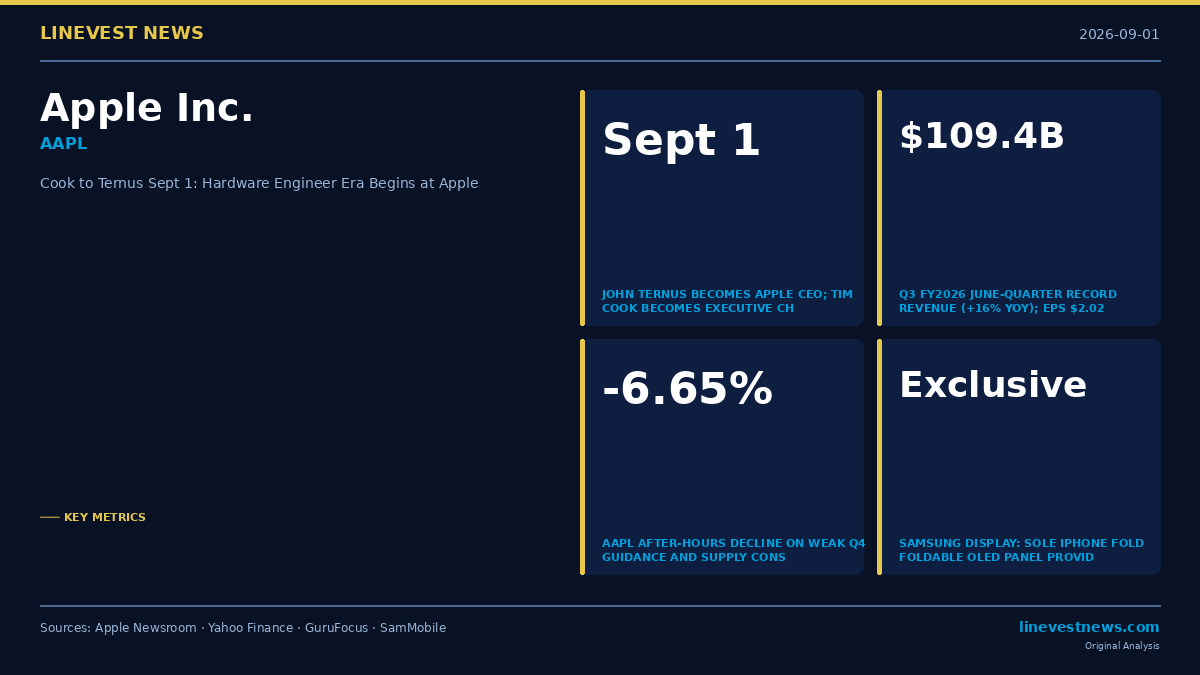
TL;DR - Tim Cook transitions to Executive Chairman on September 1, 2026; hardware engineer John Ternus becomes Apple CEO - Cook's final quarterly call (Q3 FY2026, July 30) posted a June-quarter record $109.4B revenue (+16% YoY), but missed on iPad, Services, China, and Q4 guidance — AAPL fell 6.65% after hours - Samsung Display is the exclusive OLED supplier for the iPhone Fold, Ternus's first major new-category product launch - Rising DRAM costs (three consecutive quarters, Q4 expected higher) benefit Samsung Electronics DS and SK Hynix while pressuring Apple's margin
Part A — The Transition and Tim Cook's Final Report Card
Leadership Change: What Apple Announced
Apple's board unanimously approved a leadership transition in April 2026: Tim Cook steps down as chief executive and becomes Executive Chairman of the Board, while John Ternus, 51, Apple's Senior Vice President of Hardware Engineering, assumes the CEO role effective September 1, 2026.
Tim Cook, who took over from the late Steve Jobs in August 2011, spent 15 years reshaping Apple from a company of ~$350B market cap into a nearly $5 trillion enterprise. His era was defined by supply chain mastery, Services monetization, and the Apple Silicon transition.
Cook described his successor this way: "John Ternus has the mind of an engineer, the soul of an innovator, and the heart to lead with integrity and with honor."
John Ternus profile: - Joined Apple in 2001 as a product design team member - VP of Hardware Engineering (2013); SVP (2021) - Mechanical engineering degree, University of Pennsylvania - Led Apple Silicon hardware engineering: VP through M1 launch (Nov 2020); SVP through M2, M3, and M4 - Oversaw iPhone, iPad, Mac, Apple Watch, AirPods, and Apple Vision Pro hardware design
Tim Cook's Last Quarter: Q3 FY2026 in Numbers
Apple reported its fiscal third quarter (April–June 2026) on July 30 — Tim Cook's final quarterly earnings call before the handover. Total revenue of $109.4B (+16% YoY) set a June-quarter record and beat the $108.9B consensus. Below the topline, however, iPad, Services, and Greater China each missed, and Q4 guidance came in below analyst expectations.
Q3 FY2026 Segment Results vs. Analyst Consensus:
| Segment | Actual | Consensus | Beat / Miss |
|---|---|---|---|
| Total Revenue | $109.4B | $108.9B | Beat |
| iPhone | $54.25B | $53.86B | Beat |
| Mac | $10.35B | $8.74B | Beat |
| iPad | $6.19B | $6.92B | Missed |
| Services | $30.74B | $31.22B | Missed |
Wearables, Home & Accessories: approximately $7.87B derived residual (total $109.4B less four segments above). Greater China geographic revenue was $18.80B vs. ~$19.5B consensus (also missed); already embedded in the product-segment totals — not additive.
Key P&L metrics (Q3 FY2026):
| Metric | Q3 FY2026 | vs. Prior Year / Consensus |
|---|---|---|
| Total Revenue | $109.4B | +16% YoY; beat $108.9B |
| iPhone Revenue | $54.25B | +22% YoY |
| Diluted EPS | $2.02 | +29% YoY; beat $1.89 consensus |
| Net Income | $29.79B | +27% YoY |
Q3 FY2026 EPS includes a one-time after-tax benefit of approximately $0.11/share from tariff refunds.
Q4 FY2026 Guidance: Apple guided for revenue growth of 9–11% year over year — below analyst consensus — citing worldwide scarcity of advanced memory chips and processors as a supply headwind. Cook disclosed that Apple has paid higher memory costs for three consecutive quarters, and expects Q4 costs to be higher still.
AAPL fell 6.65% in after-hours trading, from $333.43 to $311.25.
Part B — Investment Analysis: The Ternus Era and Korean Supplier Implications
Why an Engineer CEO Changes the Supply Chain Calculus
Tim Cook's defining skill was supply chain optimization — building the world's most efficient global manufacturing network. John Ternus's defining skill is hardware engineering — he was the architect of Apple's most consequential product decisions of the past decade.
An engineer at the helm typically signals: 1. Heavier investment in custom silicon and vertical integration — deepening reliance on specialized memory and display components 2. Faster pivots to new form factors — the iPhone Fold is Ternus's first major new-category product 3. More aggressive supply chain diversification — engineers tend to engineer around single points of failure 4. Tighter component specifications — suppliers must meet higher tolerances or risk losing share
For Korean companies at the intersection of Apple's display and memory supply chains, this transition carries both upside and risk.
Samsung Display: Sole iPhone Fold OLED Supplier — A Major Opportunity
Samsung Display is the sole and exclusive provider of foldable OLED panels for the iPhone Fold, Apple's first foldable smartphone and the most significant new product category of the post-Cook era. Samsung Display also provides LTPO+ panels for the iPhone 18 Pro and Pro Max; LG Display provides OLED panels for the standard iPhone 18.
BOE, China's largest panel maker, was excluded from iPhone 18 Pro supply following yield-certification failures, further reinforcing Samsung Display's position in the premium tier.
For Samsung Display (a subsidiary of Samsung Electronics, 005930.KS), the iPhone Fold relationship is strategically critical. Supply-chain analysts estimate the initial iPhone Fold production run at roughly 6–9 million units in the first year, at a significantly higher average selling price per panel than standard OLED. If Ternus's engineering-driven roadmap expands the Fold line in subsequent cycles, Samsung Display's exclusivity for the foldable tier becomes increasingly valuable.
Samsung Electronics DS: LPDRAM Share Growth Meets Pricing Power
Samsung Electronics' Device Solutions (DS) division is Apple's dominant supplier of low-power DRAM (LPDRAM) for the iPhone lineup. Industry analysis suggests Samsung's LPDRAM share for the iPhone is rising — with PhoneArena reporting that Apple will depend even more on Samsung's memory for the iPhone 18 family than it did for iPhone 17, potentially supplying 60–70% of LPDRAM requirements.
The timing matters: Cook's Q3 call confirmed that DRAM costs have risen for three consecutive quarters and will rise again in Q4. Goldman Sachs projects DRAM pricing up approximately 13% in Q3 2026 from Q2 levels. HBM4 pricing — which Samsung and SK Hynix are actively negotiating with AI data-center customers — reportedly carries a 50–60% premium over the prior HBM3E generation.
For investors, this creates an unusual dynamic: Samsung DS benefits from the very cost inflation that hurts Apple's gross margin. As long as iPhone demand remains robust — Q3 iPhone revenue of $54.25B (+22% YoY) suggests it does — Samsung's LPDRAM volumes stay high even as prices rise.
Risk: Ternus may push for broader supply chain diversification. Apple has been reported to be exploring additional component suppliers to reduce single-source dependencies — a structural initiative that, if extended to LPDRAM, would take multiple product cycles to execute but warrants monitoring.
SK Hynix: NAND Supplier and DRAM Pricing Environment Beneficiary
SK Hynix (000660.KS) supplies NAND flash storage and select DRAM components for Apple devices, competing with Samsung and Kioxia for Apple's storage business. Beyond the direct supply relationship, SK Hynix is a key beneficiary of the same memory price inflation that is pressuring Apple's cost structure.
SK Hynix's 2026 results have reflected an unprecedented AI-driven memory super-cycle, with revenue and operating margins at record levels on the back of HBM demand from data-center customers (see our SK Hynix Q2 2026 coverage). The same pricing environment that burdens Apple's procurement team directly improves SK Hynix's margin profile. DRAM ASP rose approximately 30% quarter over quarter in Q2 2026; NAND ASP rose mid-50% in the same period, per company guidance. As Apple continues sourcing iPhone and Mac memory through 2026 and into 2027, SK Hynix stands to benefit from the elevated ASP environment.
LG Display: Standard iPhone OLED, Limited Fold Exposure
LG Display (034220.KS) supplies OLED panels for iPhone 18 (standard models) and select iPad Pro models. Samsung Display holds the iPhone Fold exclusivity and the Pro tier; LGD's Apple panel business is structurally a standard-tier story.
LG Display's restructuring, expected to deliver operating-profit recovery in H2 2026 after a loss-generating Q2, depends on iPhone panel mix and OLED TV demand improving. If the Ternus-era Fold launch scales quickly and takes share from standard iPhone units, LGD faces a structural headwind on its Apple panel shipments that its current recovery plan may not fully anticipate.
The Supply Constraint Handover Risk
The most immediate risk for Apple under Ternus is inheriting a supply-constrained Q4 environment. TSMC advanced-node scarcity constrains SOC production for iPhone and Mac; independently, DRAM price inflation squeezes procurement costs. The iPhone 18 — Ternus's first traditional flagship as CEO — launches into both headwinds simultaneously, while the iPhone Fold launches as his first new product category.
Looking further ahead: Ternus oversaw Apple Silicon hardware engineering as VP through the M1 launch and as SVP through M4. As CEO, he will take full ownership of the M5 production ramp and the M6-generation roadmap — each expected to push memory bandwidth and capacity requirements higher, reinforcing Korean component suppliers' design-win momentum.
Key Investor Questions
| Question | Bear View | Bull View |
|---|---|---|
| Will Ternus deliver a breakout hardware product? | iPhone Fold ramp slow; Vision Pro still niche | Fold + M-chip cycle = multi-year upgrade wave |
| Can Samsung Display maintain Fold exclusivity? | Ternus diversifies supply | No credible foldable OLED alternative before 2028 |
| Does the Services miss signal structural weakness? | AI subscription fees cannibalize free tier | One-quarter consensus miss; double-digit growth rate intact |
| Is China risk manageable under new leadership? | Huawei presses in premium segment | Status premium persists; China missed estimate but still grew |
| Will DRAM costs stabilize under Ternus? | Ternus accelerates custom memory design | Memory pricing environment benefits 005930.KS and 000660.KS |
Sources
- Apple Newsroom — Tim Cook / John Ternus announcement (April 2026)
- Yahoo Finance — Apple Q3 2026 earnings beat, services miss
- Fortune — Meet John Ternus, the 51-year-old who will succeed Tim Cook as Apple CEO
- SamMobile — Samsung to support Apple's biggest 2026 product launches
- GuruFocus — Apple Q3 2026 earnings call highlights: supply constraints and rising memory costs
- PhoneArena — Your next iPhone will depend even more on Samsung's memory
- Yahoo Finance — Apple explores new chip suppliers as investors weigh supply chain risks
- Silicon Analysts — HBM pricing and market share 2026 (SK Hynix, Samsung, Micron)
This article is journalistic analysis and does not constitute investment advice. LineVest is not a registered investment adviser. All decisions to buy or sell securities should be made in consultation with a qualified financial professional.