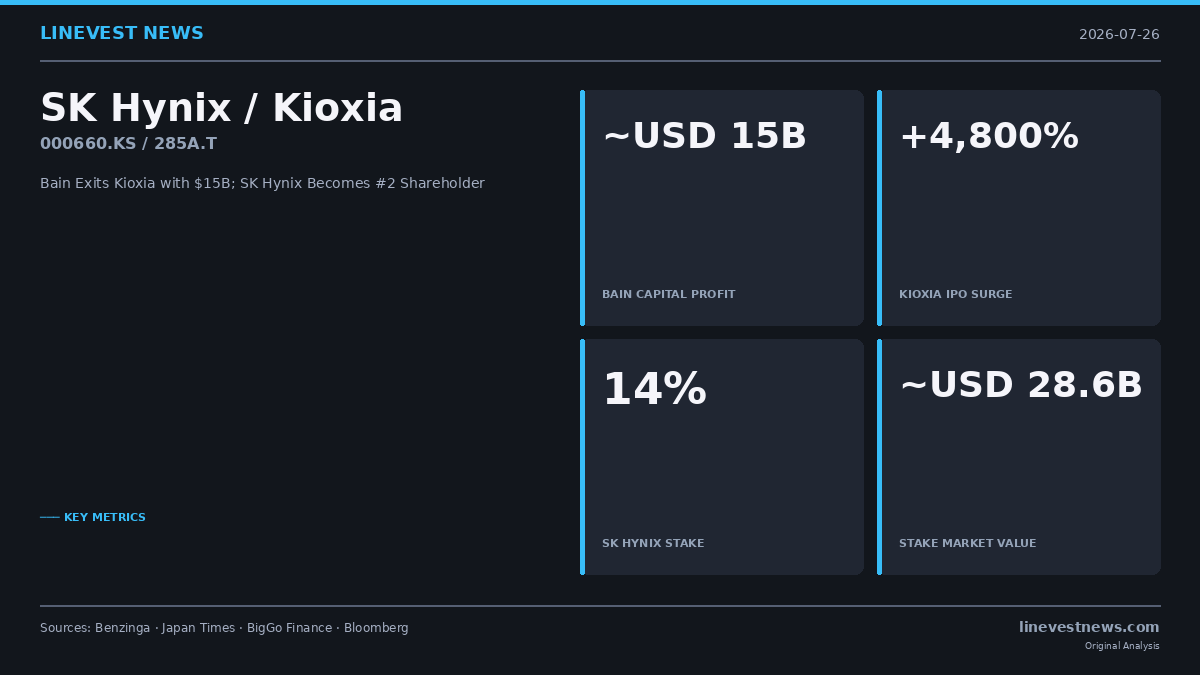
TL;DR - Bain Capital completed its full exit from Kioxia Holdings in early July 2026, booking approximately USD 15 billion in profit - Kioxia shares surged 4,800%+ since their December 2024 IPO; market cap ~USD 204 billion as of mid-July - SK Hynix retains a 14% stake via a special-purpose vehicle — now effectively Kioxia's second-largest shareholder after Toshiba (~21.9%) - Stake is now worth approximately USD 28.6 billion (KRW 42.4 trillion at KRW 1,484/USD) - Korean media reports Japan is watching the development closely as a Korean chipmaker rises to co-own Japan's NAND flagship - SK Hynix full Q2 2026 results are due July 29; sell-side consensus: KRW 64.1 trillion operating profit
Part A — What Happened
Bain Capital confirmed in early July 2026 that it had completed the full divestment of its stake in Kioxia Holdings Corporation (TYO: 285A), Japan's largest NAND flash memory maker formerly known as Toshiba Memory. The exit closes one of the most lucrative semiconductor investments in private equity history, generating approximately USD 15 billion in profit.
Bain led a consortium that acquired Toshiba's memory division for roughly USD 18 billion in 2018, taking on a stake that peaked at approximately 44% before Kioxia's December 2024 initial public offering. The company debuted at JPY 1,455 per share and subsequently surged more than 4,800%, reaching a peak market capitalization of approximately JPY 44.36 trillion (~USD 273 billion) in mid-June 2026. A roughly 30% pullback from that peak put Kioxia's market cap at approximately USD 204 billion as of mid-July 2026 — ranking it among Japan's ten most valuable listed companies.
Shareholder structure after Bain's exit (approximate)
| Shareholder | Estimated Stake | Notes |
|---|---|---|
| Toshiba Corporation | ~21.9% | Retained from original 2018 sale |
| SK Hynix (via SPV) | ~14% | Held through Bain-established special-purpose vehicle |
| Bain Capital | 0% | Fully exited, July 2026 |
| Public float / Other | ~64% | Post-IPO tradable shares |
With Bain's exit, SK Hynix — a financial co-investor that had been a quieter third-party participant in the consortium — effectively vaults to the position of second-largest identifiable shareholder in Kioxia, behind only Toshiba.
Part B — Korea Investor Analysis
A KRW 42 Trillion Holding in a Direct Rival
SK Hynix's 14% stake in Kioxia is now worth approximately USD 28.6 billion (KRW 42.4 trillion) based on Kioxia's mid-July 2026 market capitalization. For context, SK Hynix's original contribution to the 2018 consortium was made through convertible bonds — a financial instrument that limited its governance exposure while preserving equity upside. The current market value of its holding represents a dramatic appreciation relative to the initial outlay.
The strategic irony is significant. SK Hynix is Korea's — and the world's — leading producer of DRAM memory and high-bandwidth memory (HBM) chips. Kioxia is the world's second-largest NAND flash memory maker by shipment volume, specializing in a different memory architecture. While HBM (stacked DRAM) and 3D NAND are architecturally distinct, both companies compete for the same hyperscaler procurement budgets at Amazon Web Services, Microsoft Azure, and Google Cloud — and both have benefited from the AI-driven memory supercycle.
Japan's Geopolitical Lens
Korean financial media reported on July 26 that Japanese officials are watching the shareholder shift closely as a Korean semiconductor powerhouse ascends to a position of influence over Japan's foremost NAND manufacturer. Japan regards its memory chip sector — particularly Kioxia — as a strategic technology asset following the near-collapse of Toshiba Memory in 2017, which initially drew intense regulatory scrutiny over potential foreign control.
The Japan-Korea semiconductor dynamic has grown more complex over the past two years. While both nations' chip companies now cooperate in AI memory supply chains — Kioxia supplies server SSDs to the same hyperscaler platforms that rely on SK Hynix's HBM3E — cross-ownership at the 14% level raises potential questions about competitive intelligence, board alignment, and future corporate votes. SK Hynix currently has no board representation at Kioxia and has maintained a passive financial role since the 2018 transaction.
Three Scenarios for SK Hynix Investors
Hold and compound: Kioxia's improving profitability — driven by AI server SSD demand — generates passive income via dividends, with no immediate disclosure obligations unless SK Hynix's ownership crosses additional notification thresholds in Japan.
Monetize the stake: At current prices, a full disposal of the 14% position would yield a gain of approximately USD 24-25 billion after subtracting the original bond cost basis. Executed over multiple tranches, such a sale would rank as one of the largest share block trades in Asia's technology sector. Any such move would likely require public disclosure in Japan and Korea.
Deepen the relationship: Kioxia's 3D stacking and packaging expertise — relevant as AI accelerators push for tighter memory integration — could become a basis for a formal technology collaboration. No such arrangement has been publicly discussed, but the equity relationship creates a structural foundation that did not exist prior to Bain's exit.
Pre-Earnings Context: July 29 Full Results
SK Hynix reports its complete Q2 2026 financials on July 29, three trading sessions away. A consensus of 14 sell-side analysts points to KRW 64.1 trillion in operating profit (~USD 43.7 billion) on revenue of KRW 84.1 trillion — figures that would represent the highest single-quarter earnings in the history of Korean corporate reporting. The implied operating margin of approximately 76% would also lead the global semiconductor peer group.
Shares of SK Hynix (000660.KS) fell 8.3% on July 26 as investors assessed unrelated governance risk stemming from SK Group Chairman Chey Tae-won's court-ordered divorce settlement of KRW 944 billion — the largest in Korean legal history. If Chey were to liquidate SK Group holdings to fund the settlement, secondary pressure on SK Hynix's stock price could follow. Market participants are watching for any DART filings from the Chairman's family trust over the near term.
Whether SK Hynix's management addresses the Kioxia shareholding directly on the July 29 earnings call will be a secondary point of interest. The company has historically declined to characterize the Kioxia stake as a strategic position, but the post-Bain ownership landscape changes the optionality materially.
This article is for informational purposes only and does not constitute investment advice. LineVest News is an independent publication and is not affiliated with any brokerage.
Sources - Benzinga, "SK Hynix Still Owns a Piece of Japan's Hottest AI Stock After Bain's Exit" (July 2026) - CryptoBriefing, "Bain confirms 14% stake in Kioxia through SK Hynix vehicle as $15B exit winds down" (July 2026) - KuCoin, "Bain Exits Kioxia Stake, Realizing $15B Profit Amid AI-Driven NAND Demand Surge" (July 2026) - The Japan Times, "Bain Capital exits Kioxia after chip deal yields big returns" (July 9, 2026) - BigGo Finance, "Bain Capital Exits Kioxia Holdings Completely, Closing Chapter on $18B Investment" (July 2026) - Bloomberg, "Bain Capital Exits Kioxia After Chip Deal Yields Record Returns" (July 8, 2026)