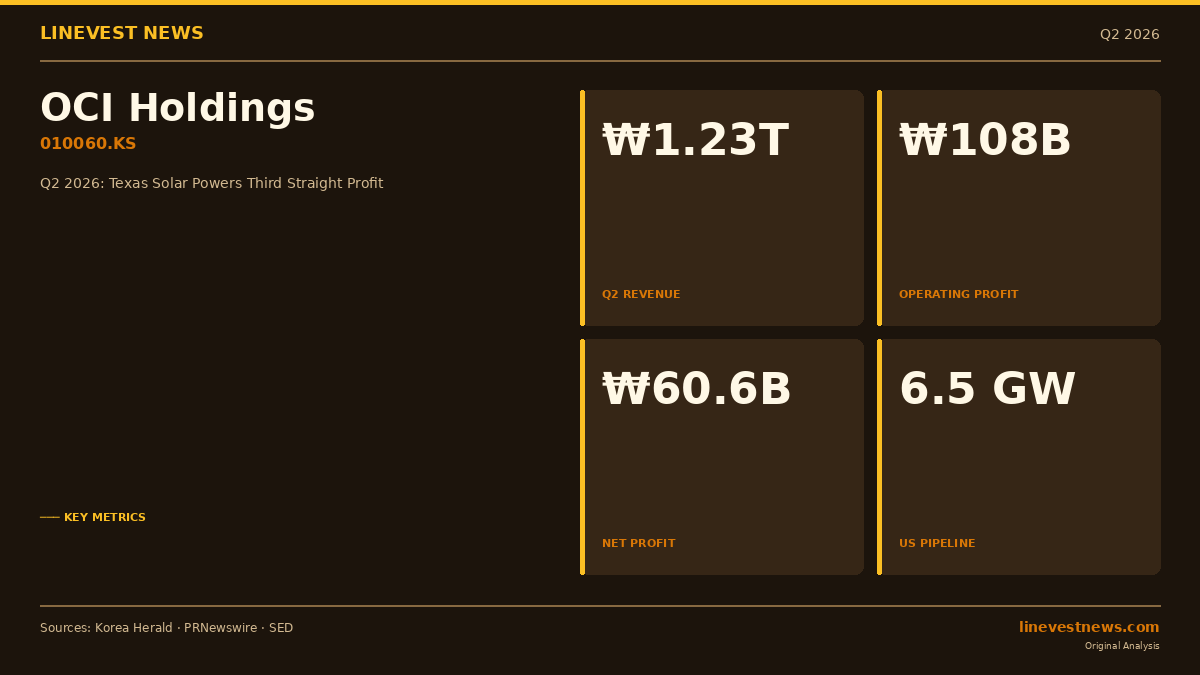
TL;DR - OCI Holdings posted Q2 2026 revenue of ₩1.23 trillion (+58% YoY), operating profit of ₩108 billion (vs. −₩80.3B loss in Q2 2025), and net profit of ₩60.6 billion—its third consecutive quarter in the black - The swing was driven by monetization of the 670 MW La Salle solar project in Texas, developed by US subsidiary OCI Energy - The company holds a 6.5 GW US solar development pipeline and is doubling polysilicon capacity to 70,000 MT by 2029, targeting AI data-center electricity demand
Part A — What Happened
OCI Holdings (010060.KS), Korea's largest integrated solar energy and specialty chemicals company, reported a sharp earnings turnaround for the April–June quarter of 2026.
| Metric | Q2 2026 | Q2 2025 | Change |
|---|---|---|---|
| Revenue | ₩1,230B ($838M) | ₩776.2B ($529M) | +58.5% YoY |
| Operating profit | ₩108B ($73.6M) | −₩80.3B | Swing |
| Net profit | ₩60.6B ($41.3M) | −₩82.4B | Swing |
The primary catalyst was OCI Energy's successful monetization of La Salle, a 500 MW solar power project in La Salle County, Texas. In May 2026, OCI Energy and Israel's Arava Power executed a Membership Interest Purchase Agreement (MIPA) under which Arava acquired a 50% stake in the expanded 670 MWdc project. The full project is expected to break ground by year-end 2026 and reach commercial operation in 2028, with capacity sufficient to power approximately 100,000 US homes.