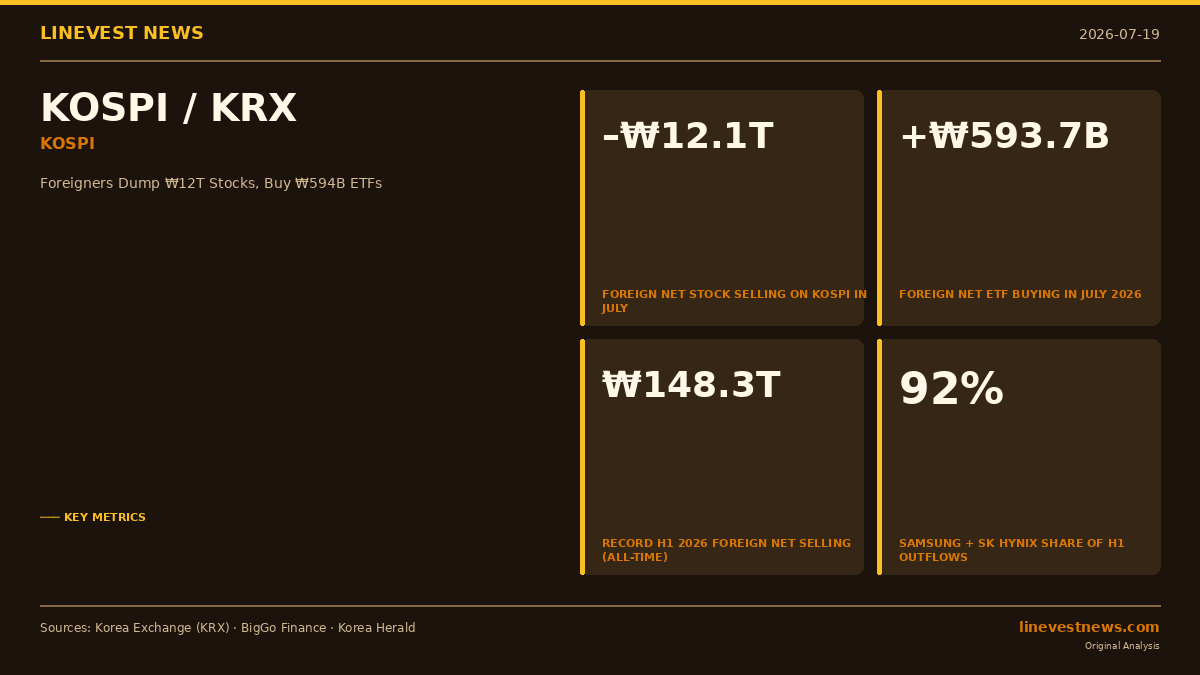
TL;DR - Foreign investors shed a net ₩12.44T in Korean equities in July (₩12.1T on the KOSPI + ₩338.1B on KOSDAQ), led by Samsung and SK Hynix - Yet they bought a net ₩593.7B in Korean ETFs — KODEX Leverage and KODEX 200 led with ₩375.6B in combined purchases - The "sell stocks, buy index" pattern reflects passive-fund rebalancing, FX drag from a weak won, and pre-earnings positioning — not a wholesale exit from Korea - With SK Hynix Q2 results due July 22 and the BoK at 2.75% following its July 16 rate hike, the divergence narrows one of two ways: a strong earnings beat flips single-stock flows positive, or FX uncertainty deepens the ETF-hedging preference
Part A — What the Data Shows
Through mid-July 2026, KRX data showed foreign investors posting (across 12 reported trading sessions):
| Market | Net Flow (July, 12 sessions) |
|---|---|
| KOSPI (main bourse) | –₩12.1T (–USD 8.12B at ~₩1,490/USD) ← KRX data |
| KOSDAQ | –₩338.1B |
| ETFs (all markets, net) | +₩593.7B |
Foreigners were net sellers in eight of those 12 KOSPI sessions — but net buyers of ETFs in 10 of 12 sessions. That split is the tell.
Which ETFs Are Foreigners Buying (and Selling)?
| ETF | Strategy | July Net Flow |
|---|---|---|
| KODEX Leverage | 2× daily KOSPI 200 | +₩195.0B |
| KODEX 200 | KOSPI 200 tracker | +₩180.6B |
| SK hynix leveraged (Samsung AM) | 2× daily SK Hynix | –₩79.0B (sold) |
| SK hynix leveraged (Mirae AM) | 2× daily SK Hynix | –₩46.4B (sold) |
Foreigners are selling individual semiconductor names and the single-stock leveraged products tied to them, while simultaneously buying broad-index exposure through KODEX Leverage and KODEX 200. The two broad-index ETFs account for ₩375.6B of the ₩593.7B net ETF figure; the SK Hynix leveraged products were net sold, partially offsetting other ETF gains.
Context: The Historic H1 2026 Sell-Off
July's selling comes against an extraordinary first-half backdrop. According to KRX data compiled by BigGo Finance, foreign investors recorded a net ₩148.32T (USD 96.7B at H1 average exchange rates) in outflows from Korean equities in H1 2026 — the largest half-yearly total on record. Samsung Electronics and SK Hynix together accounted for approximately 92% of that total. In June alone — the heaviest single month, at ₩57.5T — the two chipmakers accounted for ₩46.5T (about 81% of June's outflow). The gap between the half-year 92% and June's 81% reflects near-total chip concentration in earlier months, with June's sell-off drawing in slightly more non-semiconductor names.
The foreign ownership stakes reflect the cumulative pressure:
| Company | Foreign Ownership | Note |
|---|---|---|
| Samsung Electronics (005930.KS) | 46.88% | Below 2008–09 GFC low |
| SK Hynix (000660.KS) | 50.40% | Near multi-year low |
Part B — Decoding the Divergence
1. Passive Fund Rebalancing Is the Structural Driver
The KOSPI surged more than 100% in H1 2026, briefly breaching 8,000 points for the first time. A rally of that magnitude mechanically inflates Korea's weighting in global equity benchmarks, forcing passive funds to trim holdings to restore target weights. Wi Jae-hyun of Kyobo Securities characterized the pattern plainly: "The recent rise in the exchange rate appears to have been primarily driven by rebalancing sales from overseas passive funds."
Crucially, rebalancing does not imply conviction to exit Korea — it is arithmetic. A fund that ran Korea at benchmark-plus-one must sell to get back to neutral when Korea outperforms by 100%. The same logic explains why these funds simultaneously buy KODEX Leverage and KODEX 200: they want to retain broad Korea upside while reducing the oversized single-name weight in Samsung and SK Hynix.
2. The FX Factor: Won Weakness Hurt Dollar Returns
The won fell to as low as ₩1,550 per dollar at its H1 nadir — its weakest level since the 2008 financial crisis. Currency depreciation compounds against portfolio gains in a nonlinear way: a portfolio that returned 80% in won terms would have returned only approximately 68% in U.S. dollar terms at the peak won weakness — a reduction of roughly 12 percentage points after compounding a ~6–7% depreciation against an 80% gain. Foreign managers running dollar-denominated mandates face this math every quarter.
The BoK's July 16 rate hike raised the benchmark rate to 2.75%, and the currency has since firmed to around ₩1,490 per dollar in July 2026. Buying KOSPI index ETFs rather than individual stocks does not eliminate this FX drag, but it shifts the bet from stock-specific risk to systemic risk: if the won continues recovering, index ETF holders benefit automatically without having to rebuild individual positions.
3. Pre-Earnings Positioning in Semiconductor Names
SK Hynix releases its Q2 2026 preliminary results on July 22 — three trading days from today. Samsung Electronics follows on July 30. Ahead of binary events of this magnitude, institutional investors often reduce single-name exposure to limit downside variance, while maintaining broad-market ETF positions to stay invested if the prints are strong.
The combined ₩125.4B in foreign selling of SK Hynix-linked leveraged ETFs (₩79.0B + ₩46.4B) reinforces this read: leverage is coming off the most volatile name in the Korean market just before it reports what could be a record quarter. Sell-side consensus for SK Hynix Q2 operating profit sits at ₩60–65T — up 551%–606% year-on-year from ₩9.21T in Q2 2025 (range midpoint ~₩62.5T = +579% YoY), per multiple analyst estimates including KIS Securities and BofA. A miss would be punished; a beat would reward broad KOSPI exposure more symmetrically than levered single-stock bets.
4. Three Catalysts That Could Flip the Pattern
| Catalyst | Timeline | Likely Impact |
|---|---|---|
| SK Hynix Q2 OP beat (>₩65T) | July 22 | Relief rally in 000660.KS and SKHY; potential for foreign re-accumulation |
| Won appreciation (USD/KRW below ₩1,470) | Ongoing | Reduces dollar-return drag; may revive single-name buying |
| Post-MSCI rebalancing seasonal lull | July–August | Peak passive selling may be behind us as H1 rebalancing clears |
JPMorgan has cautioned that selling is "likely to persist for some time" as long as Korea remains a strong emerging-market outperformer. However, the most acute rebalancing pressure — triggered by the KOSPI's first-half surge — appears to have largely cleared the market by mid-July.
5. Investor Implications
Two actionable signals stand out:
Index ETFs as a lower-friction entry point. KODEX 200 and KODEX Leverage (which tracks 2× daily KOSPI 200 returns) are attracting foreign buyers even as individual stocks face headwinds. This suggests global investors still see value in Korea the market — they are just being more selective about how they express that view. For foreign retail investors unable to access KRX-listed ETFs directly, the nearest proxy is the iShares MSCI South Korea ETF (EWY) and similar products on overseas exchanges.
Semiconductor ownership at a potential floor. Samsung Electronics' 46.88% foreign ownership is below levels last seen during the 2008-09 global financial crisis. Historically, foreign ownership hitting multi-decade lows has preceded re-accumulation phases. With Q2 semiconductor earnings due in the next two weeks, any positive surprise could accelerate a repositioning that pushes ownership back toward the 50–52% range.
This article is for informational purposes only and does not constitute investment advice. LineVest News is not a registered investment adviser.
Sources - Korea Herald — Foreigners offload S. Korean stocks but net purchase ETFs this month - Korea JoongAng Daily — Foreigners remain net sellers of stocks but net purchase ETFs in July - Korea Times — Foreigners offload Korean stocks but net purchase ETFs this month: KRX - BigGo Finance — Kospi Surges Over 100%, Yet Foreigners Dump Record $96.7 Billion