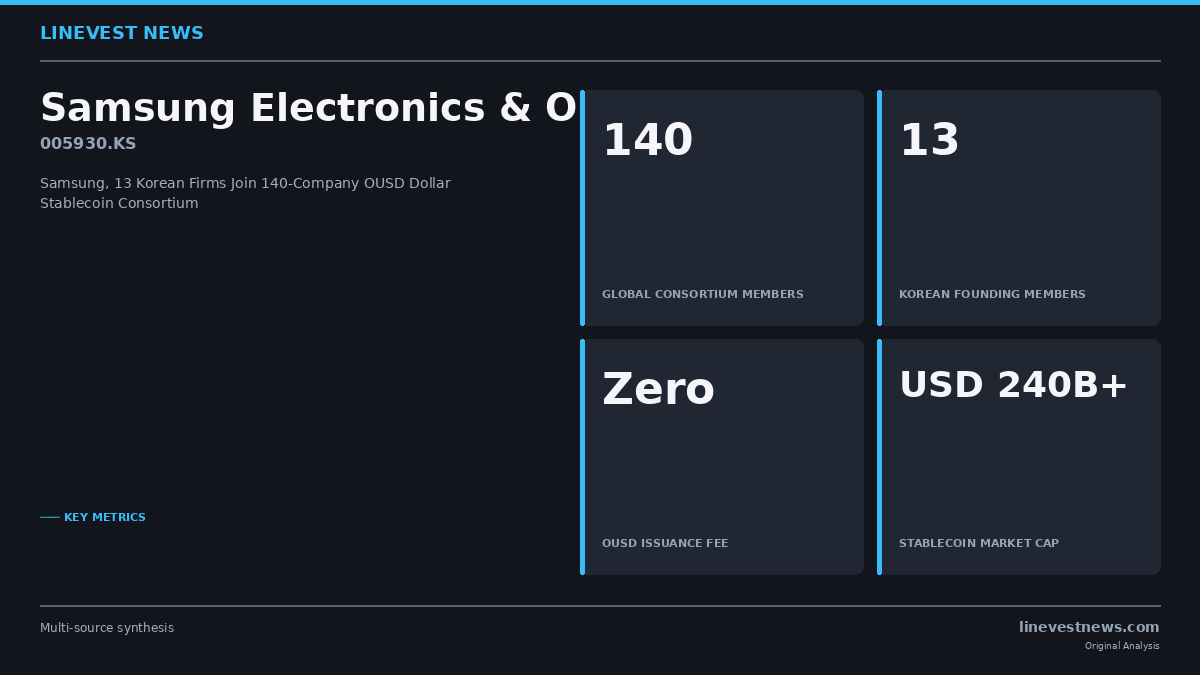
Samsung Electronics (005930.KS), Shinhan Financial Group (055550.KS), and eleven other Korean firms have joined the Open Standard consortium — a 140-member global alliance co-anchored by Visa, Mastercard, Stripe, Coinbase, BlackRock, Standard Chartered, and Google — to launch Open USD (OUSD), a dollar-pegged stablecoin engineered for large-scale enterprise payments.
The consortium announced its launch on June 30 (local time), marking what market observers describe as Korea's most sweeping institutional commitment to digital dollar infrastructure. Thirteen Korean entities signed on as founding members, spanning device ecosystems, financial groups, digital-asset platforms, and card networks.
Korea's 13 Founding Members
Samsung Electronics headlines the Korean contingent, alongside Hanwha Group, Shinhan Financial Group (신한지주), Kakao Dunamu (operator of Upbit, Korea's largest crypto exchange), Kakao Bank (323410.KS), KBank (279570.KS), KB Kookmin Card, Woori Card, Samsung Card (029780.KS), Hana Card, Hyundai Card, BC Card, and Nonghyup Card.
The breadth of participation — spanning Korea's largest conglomerate device-maker, its top crypto exchange, three internet-native banks, and eight card networks — signals a coordinated effort to build end-to-end OUSD infrastructure within the Korean financial ecosystem.
How OUSD Works
OUSD is designed as a low-cost, high-throughput B2B stablecoin. Member companies may issue and redeem OUSD at zero fee. Revenue generated from dollar reserves — after a small administrative charge — is distributed pro-rata among all participating members, inverting the economics of existing retail stablecoins where issuers such as Circle (USDC) or Tether (USDT) retain all reserve income.
Governance is handled by a board composed of partner companies, each holding a seat in collective decision-making. The open, shared-profit structure is designed to align member incentives around broad adoption rather than issuer monopoly rents.
Launch is planned before end-2026.
Strategic Implications for Korea
The timing is significant. The U.S. Senate passed the GENIUS Act in June 2025, establishing a federal framework for dollar stablecoins and clearing legal uncertainty for institutional participants. Korean regulators are expected to introduce a domestic stablecoin bill in late 2026, and an established international membership may accelerate approval.
For Samsung Electronics — whose Samsung Pay reaches consumers across dozens of markets — an OUSD membership creates potential for device-level stablecoin integration. For Kakao Dunamu and the three internet banks, it opens a path to offer compliant dollar settlement rails beyond Korea's won-denominated ecosystem.
Card network participation by BC Card, Hana Card, Hyundai Card, and others suggests OUSD could eventually run on existing payment terminals, bypassing the need for new crypto-native infrastructure.
Market Context
Stablecoins have evolved from speculative instruments into institutional-grade settlement infrastructure. The global stablecoin market surpassed USD 240 billion in circulation in 2025, with enterprise and cross-border volumes growing at a faster pace than retail use. OUSD's launch pits the Open Standard consortium directly against Circle's USDC — currently the largest institutional stablecoin — and positions Korea's financial incumbents as active co-builders rather than passive adopters.
Sources: Chosun Biz · ETNews