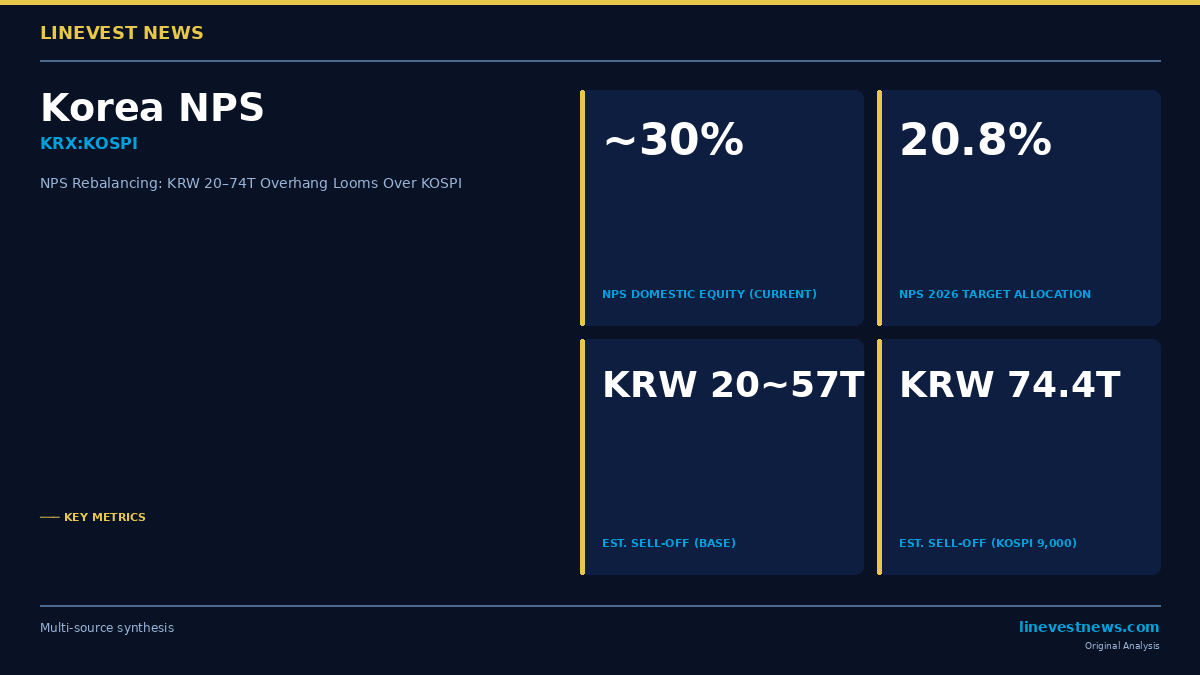
Korea's National Pension Service (NPS), the world's third-largest pension fund by assets, is poised to begin large-scale domestic equity rebalancing as the KOSPI's sharp 2026 rally has pushed its stock portfolio well above the 2026 target band. Market estimates now project sales of KRW 20 trillion to KRW 74.4 trillion — equivalent to USD 12.9 billion to USD 47.8 billion — beginning as early as Wednesday, July 1.
The Overhang
The NPS sets an annual domestic equity target of 20.8% of total assets for 2026, with a permissible deviation of ±8 percentage points — establishing an upper band of 28.8%. With the KOSPI closing Monday at 8,476 (+81.83 points), internal estimates now put the fund's actual domestic equity ratio at roughly 30%, roughly 1.2 percentage points above that ceiling.
Two major brokerage houses have sized the potential rebalancing:
| Scenario | Estimated Sales | Source |
|---|---|---|
| KOSPI ~8,500 | KRW 14.7–51.2T (USD 9.4–32.9B) | Shinyoung Securities |
| KOSPI at 9,000 | KRW 74.4T (USD 47.8B) | Shinyoung Securities |
| Restore target weighting | KRW 20–57T (USD 12.9–36.7B) | Daishin Securities |
The rebalancing is expected to begin on Wednesday, July 1 — the first trading day of the second half.
Measured Pace, But Real Pressure
NPS Chairman and CEO Kim Sung-joo has emphasised restraint. "As a public institution, we operate under the principle of minimising market disruption," he said. Shinyoung Securities analyst Cho Yong-gu echoes the cautious tone: "The NPS is likely to scale down its annual, monthly and daily rebalancing caps to minimise market impact."
That approach aligns with past episodes where the fund stretched disposals across weeks or months. The risk is that market participants may treat each NPS-linked overhang as a de facto ceiling, particularly given that foreign investors already posted a record KRW 7.7 trillion net-sell of Samsung Electronics (005930.KS) and SK Hynix (000660.KS) in a single week in late June.
Macro Backdrop: Strong but Concentrated
S&P Global Ratings separately noted that South Korea's 100 largest companies generated nearly KRW 140 trillion (USD 90 billion) in combined operating profit in Q1 2026 — but characterised growth as "heavily concentrated in a single sector." The agency raised its 2026 GDP growth forecast to 3%, while flagging that semiconductor firms are driving nearly all of the earnings expansion while most other sectors face modest growth or external headwinds.
"We believe the AI supercycle will continue at least until 2028," said S&P's Jeremy Kim, though chief economist Louis Kuijs urged companies to "maintain financial discipline as they expand capacity, given the cyclical nature of the industry."
The NPS situation crystallises a structural irony embedded in South Korea's bull run: the stronger the market performs — driven by AI-memory demand from Samsung and SK Hynix — the greater the mandatory selling pressure from the country's largest institutional shareholder. Whether that dynamic acts as a ceiling near KOSPI 9,000 or merely a speed bump will become clearer as July trading begins.
Sources: Korea Herald – NPS Rebalancing · Korea Herald – S&P Analysis