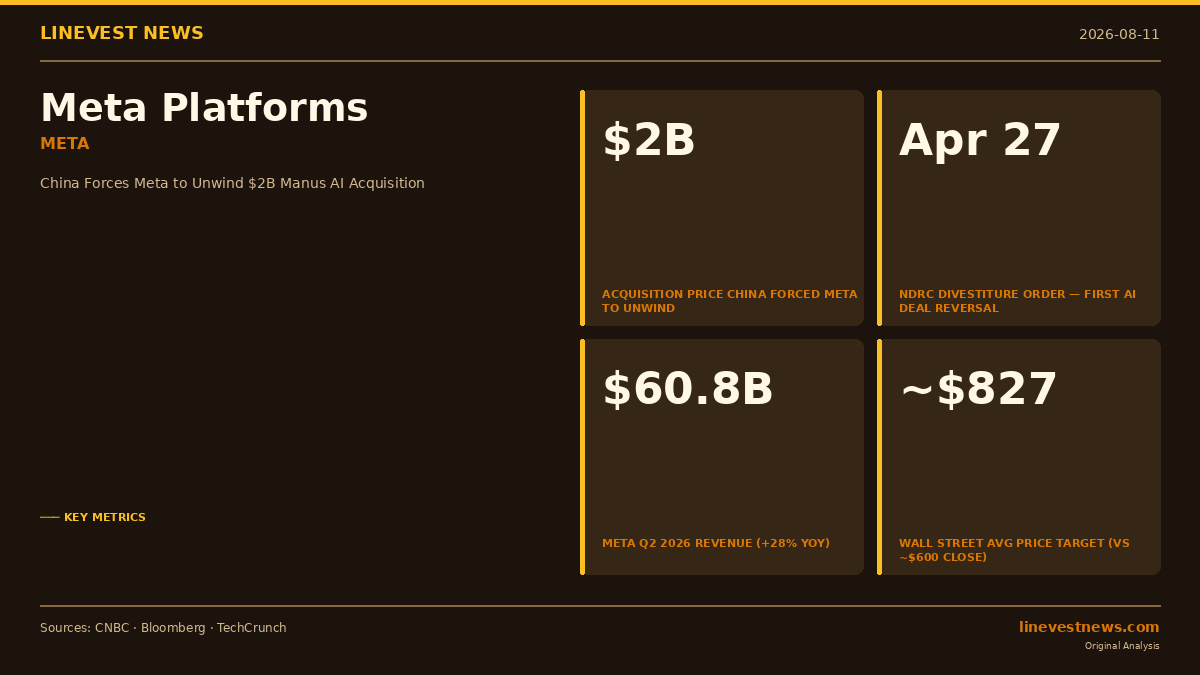
TL;DR - China's NDRC in April 2026 ordered Meta to unwind its $2 billion acquisition of AI agent startup Manus — the first time Beijing has applied its foreign investment security review rules (enacted December 2020, effective January 2021) to order the reversal of an AI transaction that had already begun operational integration. - Manus confirmed on August 11 it will "soon resume operating as an independent company"; user data generated from December 29, 2025 onward will be deleted August 23–24, with a backup window open through August 22. - The financial exposure from the forced reversal is capped at approximately $2B. Actual recovery depends on undisclosed settlement terms; Manus co-founders are in talks to raise ~$1B from external investors, which could partially compensate Meta if the raise includes a buyout of Meta's interest. - Meta's broader AI strategy is intact: $130–145B capex guidance for 2026, Llama open-source momentum, and alternative partnerships (Reliance Industries in India, AMD GPU scale-up) absorb the setback.
Background: The Deal That Beijing Blocked
Manus and the $2 Billion Bet
In late December 2025, Meta announced the acquisition of Manus, a Singapore-based AI agent startup launched in 2025 by Xiao Hong, whose parent company Beijing Butterfly Effect Technology was founded in 2022. Manus had built one of the most capable autonomous AI agents available commercially — able to browse the web, write and execute code, book travel, and complete complex multi-step tasks with minimal human input. The deal, valued at approximately $2 billion, ranked among Meta's more significant outright acquisitions. (Meta's $14.3B Scale AI transaction in mid-2025 was a minority non-controlling stake, not a full acquisition.)
At announcement, founders claimed Manus had no active Chinese investors and that its corporate relocation to Singapore reflected a genuine operational pivot westward — claims China's NDRC effectively rejected by asserting jurisdiction over the underlying IP and engineering team. Xiao Hong began transitioning into a Vice President role at Meta to integrate Manus's agent capabilities across Instagram, WhatsApp, and Facebook — a role that has since been reversed with the unwinding.
China's Intervention: A Historic First
Shortly after the late-December 2025 announcement, China's National Development and Reform Commission (NDRC) launched a probe that concluded approximately four months later, citing potential violations of the country's Foreign Investment Security Review rules enacted in December 2020 (effective January 18, 2021). On April 27, 2026, the NDRC issued a formal divestiture order requiring Meta to unwind the deal — the first use of that framework to reverse an AI transaction that had already begun operational integration between the parties.
The NDRC's rationale centered on national security: Manus's core technology, developed by Chinese engineers on Chinese soil, was deemed too sensitive to transfer to a U.S. company without regulatory clearance. Critically, China did not contest Singapore's corporate jurisdiction; it contested the underlying intellectual property and the engineers behind it. Legal analysts at O'Melveny noted the ruling carries sweeping implications: any AI startup with Chinese-origin research personnel or early-stage development in China could now be subject to Beijing's retroactive veto — even after corporate relocation.
From Block to Breakup: The Timeline
| Date | Event |
|---|---|
| December 29–30, 2025 | Meta announces ~$2B acquisition of Manus; Xiao Hong begins integration as VP-designate |
| April 27, 2026 | China's NDRC issues formal divestiture order — first AI deal reversal under 2020 rules |
| June 2026 | Meta severs Manus staff access to internal systems; data sharing halted |
| August 11, 2026 | Manus publicly announces it will resume as independent company |
| August 22, 2026 | User data backup window closes (data from Dec 29, 2025 onward) |
| August 23–24, 2026 | Data deletion executed per NDRC-required separation terms |
| August 25, 2026 | Users able to restore backed-up data; Manus formally independent |
Investor Analysis: What This Means for META
The Financial Math: Painful but Manageable
Meta's Q2 2026 results, reported July 29 via the company's earnings press release, give investors the clearest lens on the company's financial scale. Revenue reached $60.8 billion in the quarter (+28% year-over-year), beating the consensus of $60.29 billion.
| Metric | Q2 2026 Actual | Analyst Consensus |
|---|---|---|
| Revenue | $60.8B (+28% YoY) | $60.29B |
| EPS (GAAP) | $6.18 | $7.22 (miss, -14.4%) |
| Capital Expenditure | $31.1B | — |
| Free Cash Flow | $784M (−91% YoY) | — |
Full-year 2026 capex guidance: $130–145B (per Meta's Q2 earnings press release)
Even a full $2 billion write-down — final settlement terms remain undisclosed — would carry an after-tax impact of approximately $1.6 billion (at ~21% tax rate), or roughly 10% of Meta's reported Q2 2026 net income of $15.85 billion. A meaningful one-time charge, but manageable relative to the company's quarterly earnings power. The actual exposure may be lower: Manus co-founders are in talks to raise approximately $1 billion from external investors. Meta's recovery depends on whether that recapitalization includes a buyout of Meta's economic interest — terms that remain undisclosed. The GAAP EPS miss versus consensus ($6.18 actual vs. $7.22 estimated, a 14.4% gap) was significantly driven by a $2.4 billion pre-tax legal proceedings charge recognized in the quarter (per Meta's Q2 2026 earnings press release, as reported by multiple financial news outlets). At a ~21% corporate tax rate, the after-tax impact was approximately $1.9 billion — the majority of the $2.614B total net income shortfall ($1.04/share × 2.51B shares). Capital expenditure of $31.1B (83% higher than Q2 2025's $17.0B) flows through the balance sheet via capitalization, contributing to EPS pressure only through incremental depreciation in subsequent quarters.
Wall Street's average price target is approximately $827 per share. As of August 11, 2026, META shares traded in a range of $593.40–$612.43 (per CNN Markets). At that closing range, the $827 average target implies roughly 35–39% upside (approximately 39% from the lower end of the day's range, 35% from the upper end). Analyst notes published August 11, 2026 broadly described the Manus unwind as a manageable setback that does not alter Meta's AI leadership position.
The Bigger Risk: A Geopolitical Precedent
The financial loss matters less than the precedent. For the first time, China successfully used its Foreign Investment Security Review rules (effective January 2021) to order the full reversal of an AI acquisition that had already begun operational integration. Legal analysts at O'Melveny promptly warned that a new compliance reality had arrived: any deal involving a target company with Chinese-origin research, founders, or early infrastructure now carries the risk of a post-closing divestiture demand from Beijing.
This changes the calculus for AI M&A. The pool of acquirable AI companies is disproportionately populated by Chinese-diaspora founders who built early prototypes in China before relocating. U.S. acquirers accustomed to evaluating deals on technology and talent alone must now add a China-risk due-diligence layer.
Meta's AI Strategy After Manus
Manus's agentic AI capabilities were intended to accelerate Meta AI's consumer-facing products. Without Manus, Meta is building or buying those capabilities elsewhere:
- Internal build: Meta's Llama open-source model family continues to attract global developer adoption. Meta AI, embedded across Instagram, WhatsApp, Facebook, and Meta Ray-Ban glasses, gives the company massive distribution to deploy agents even without Manus's stack.
- Partnership pivot: Reports from mid-2026 indicated Meta is pursuing AI data center partnerships with Reliance Industries in India — a partnership structure that would sidestep China-adjacent regulatory risk. The company has also substantially scaled AMD GPU procurement as a parallel compute path.
- Scale AI anchor: Meta's $14.3 billion minority investment in Scale AI (announced June 2025, ~49% stake) — a larger transaction than Manus — remains intact and provides the data-labeling infrastructure underpinning model training.
Three Questions Investors Should Track
1. Will Meta recapture any of the technology? Reports indicate Manus co-founders are in discussions to raise approximately $1 billion from external investors to recapitalize the company post-separation. If Meta participates through a minority position, it could maintain partial access to Manus's roadmap — though Beijing's ruling creates ambiguity about whether such a structure would survive Chinese scrutiny.
2. Does the Manus loss accelerate Meta's India pivot? India represents the most obvious large-market alternative for AI talent and partnership sourcing unconstrained by Chinese regulatory jurisdiction. Watch for additional Reliance-Meta announcements in H2 2026 as a signal that Zuckerberg is redirecting Manus-style ambitions toward the subcontinent.
3. What happens to Meta's AI agent roadmap? Manus was supposed to compress the timeline to autonomous task completion across Meta platforms. Investors should listen for Q3 2026 earnings commentary (expected late October) on whether the Manus gap has created a measurable delay in the agent product pipeline.
The Bottom Line
The forced unwinding of Meta's Manus acquisition is the clearest demonstration yet that Chinese regulatory power extends beyond China's borders into global AI M&A. For META shareholders, the financial exposure — up to $2 billion, though actual recovery terms remain undisclosed — is manageable relative to the company's ~$1.5 trillion market cap and $60.8 billion quarterly revenue. For the broader AI investment landscape, however, the precedent is significant: geopolitical risk must now be priced into any acquisition of a company with Chinese-origin founders, technology, or early-stage infrastructure — regardless of where it is incorporated today.
Meta's core competitive position in AI — built on Llama, vast consumer distribution, and $130–145B in annual capex — remains intact. The Manus episode is a reminder that the global race for AI talent is simultaneously a geopolitical contest, and China has now demonstrated it will intervene directly when it believes the rules are being circumvented.
This article is for informational purposes only and does not constitute investment advice.
Sources: - Meta Q2 2026 Earnings Press Release (July 29, 2026) - CNBC: Manus to return as independent company after China forced Meta to unwind $2 billion deal (August 11, 2026) - TechCrunch: Meta reportedly moves to unwind $2B Manus deal after Beijing's demand (June 2026) - CNBC: Meta acquires intelligent agent firm Manus (December 2025) - TechCrunch: China vetoes Meta's $2B Manus deal after months-long probe (April 2026) - O'Melveny: China Unwinds Meta's Acquisition of Manus — Implications for Cross-Border AI Transactions - Variety: Meta Q2 2026 Earnings — Revenue Up 28% to Over $60B (July 2026) - Bloomberg: Manus to Resume Independent Operations in Unwind of Meta Deal (August 11, 2026)