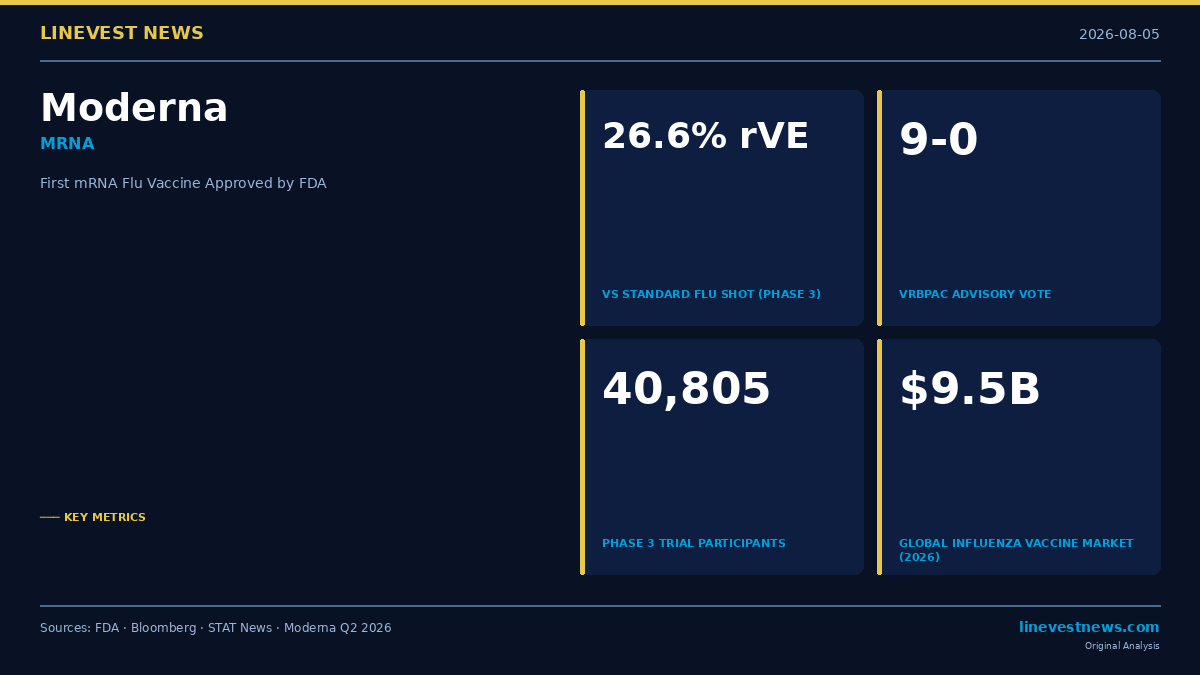
TL;DR - The FDA approved Moderna's mFlusiva (mRNA-1010) on August 5, 2026, making it the first influenza vaccine built on messenger RNA technology to receive U.S. clearance. - Phase 3 trial (40,805 adults 50+): mFlusiva showed 26.6% relative vaccine efficacy (rVE) versus a standard-dose flu shot, meaning 26.6% fewer influenza cases in the mFlusiva arm; the FDA advisory panel voted 9-0 in favor. - A February 2026 "refusal-to-file" from then-CBER Director Vinay Prasad temporarily blocked review; FDA Commissioner Makary reversed the RTF within one week, and Prasad departed the FDA in April — six months before the August 5 approval. - Revenue impact is back-loaded: ACIP is frozen by a March 2026 court injunction (no automatic insurance coverage), and Moderna missed the 2026 contracting cycle — Wall Street does not expect meaningful mFlusiva revenue before H2 2027.
Part A — What the FDA Actually Approved
On August 5, 2026, the FDA granted approval for mFlusiva (mRNA-1010), Moderna's seasonal influenza vaccine candidate, for adults aged 50 years and older. The authorization represents the first regulatory clearance in U.S. history for an mRNA-based influenza vaccine.
The FDA used an age-stratified approval structure:
| Age Group | Approval Type | Key Condition |
|---|---|---|
| 50–64 | Traditional approval | rVE vs. standard-dose met approval threshold |
| 65+ | Accelerated approval | Postmarketing confirmatory trial vs. high-dose comparator (Fluzone HD) required |
For the 65+ cohort, the Phase 3 trial compared mFlusiva against a standard-dose flu vaccine — the same comparator used for the 50-64 group — and showed 27.4% rVE. However, the FDA's position is that Fluzone HD (a high-dose product) represents the "best available standard of care" specifically for adults 65 and older. The accelerated approval for this subgroup acknowledges the rVE data vs. standard-dose while deferring the question of performance vs. high-dose to a required postmarketing trial. The traditional approval for 50-64 reflects that a standard-dose comparator is appropriate for that age band.
The pivotal data comes from a Phase 3 double-blinded, active-controlled trial enrolling 40,805 adults aged 50 and older. Against a licensed standard-dose quadrivalent inactivated influenza vaccine, mFlusiva showed:
- 26.6% rVE against influenza-like illness overall (26.6% fewer influenza cases vs. comparator arm)
- 27.4% rVE in adults aged 65 and older
- No new or serious safety concerns identified by FDA reviewers
On July 30, 2026, the FDA's Vaccines and Related Biological Products Advisory Committee (VRBPAC) voted 9-0 in favor of the vaccine — an unusually strong consensus signal for a novel technology platform.
The Regulatory Drama: From Refusal to Approval in Six Months
The backstory matters for anyone analyzing FDA policy risk in biotech.
February 3, 2026: Vinay Prasad, then Director of the Center for Biologics Evaluation and Research (CBER), issued a rare refusal-to-file (RTF) letter — the FDA's mechanism for declining to review an application — for mFlusiva. Prasad overruled the agency's own career scientific staff, arguing Moderna had used an inadequate comparator: a standard-dose rather than high-dose flu vaccine, which he considered the "best available standard of care" for adults 65+. Neither federal regulation nor existing FDA guidance explicitly required a high-dose comparator.
Within one week: FDA Commissioner Marty Makary reversed the RTF decision. A Type A meeting — the FDA's highest-urgency dispute resolution process — concluded with Moderna proposing the age-stratified pathway (traditional for 50-64, accelerated for 65+), which the agency accepted. The reversal was described internally as "part of a conversation that occurs with all drug makers."
April 2026: Prasad departed the FDA. A subsequent wave of senior leadership exits followed, including Makary himself, acting CBER Director Katherine Szarama, and the agency's chief of staff and chief AI officer.
August 5, 2026: Full FDA approval issued, six months after the February RTF.
Part B — What This Means for MRNA Investors
1. The Market Entry Is Real — But Revenue Is Back-Loaded
The global influenza vaccine market is valued at approximately $9.5 billion (2026) and is projected to reach $14.8 billion by 2033 at a 6.5% CAGR, driven by adoption of higher-efficacy products and aging demographics. The U.S. portion represents roughly $3–5 billion of that total. Moderna is entering a market dominated by established players:
| Company | Key Product | Technology | FDA-Approved Age |
|---|---|---|---|
| Sanofi | Fluzone HD | High-dose quadrivalent | 65+ |
| GSK | Fluarix Quadrivalent | Egg-based quadrivalent | 6 months+ |
| CSL Seqirus | Flucelvax Quadrivalent | Cell-based | 6 months+ |
| AstraZeneca | Flumist | Live attenuated nasal | 2–49 |
| Moderna | mFlusiva | mRNA | 50+ |
However, two structural constraints delay Moderna's revenue ramp:
Constraint 1: ACIP is frozen. The Advisory Committee on Immunization Practices (ACIP) — the CDC body whose recommendations trigger Medicare Part B reimbursement and commercial insurer zero-cost-sharing mandates — is operating under a federal court injunction issued in March 2026. ACIP cannot convene or issue new vaccine recommendations. Without an ACIP recommendation, mFlusiva lacks the coverage backbone that drives mass adoption in the U.S. Patients can still receive mFlusiva, but may face out-of-pocket costs unless covered through an alternative mechanism.
Constraint 2: Missed 2026 contracting. Most health systems, pharmacy chains, and HMO purchasing offices finalized flu vaccine orders for the 2026–2027 season before August 5. Moderna cannot meaningfully displace existing orders on short notice. Analysts do not expect material mFlusiva revenue until H2 2027, when Moderna can enter full contracting cycles with potential ACIP status (if the injunction is lifted).
2. Moderna's Current Financials: Still Burning, But Stabilizing
Moderna reported Q2 2026 results on August 7, 2026:
| Metric | Q2 2026 | Q2 2025 | Change |
|---|---|---|---|
| Total Revenue | $145M | $142M | +2% |
| Net Loss | ($782M) | ($822M) | Improved by 5% |
| Loss per Share | ($1.97) | ($2.13) | Better by $0.16 |
For full-year 2026, Moderna guided:
| Guidance Item | 2026 Target |
|---|---|
| Revenue growth | Up to +10% YoY |
| Cost of Sales | ~$1.7B |
| R&D Expense | ~$2.9B |
| SG&A Expense | ~$1.0B |
| Year-End Cash & Investments | $4.7–5.2B |
Cash was $6.9 billion as of June 30, 2026, but the company paid a $950 million litigation settlement in July 2026. The revised $4.7–5.2B year-end cash guidance reflects this outflow. At roughly $4.7B minimum, Moderna has sufficient runway to reach the 2027 mFlusiva commercialization window without an equity raise — a key de-risk signal for investors worried about dilution.
Moderna's stock traded near $59.17 as of August 7 (market cap ~$23.6B). Wall Street consensus sits at Hold, with mean analyst price targets implying roughly 2% downside — acknowledging the historic approval while remaining cautious on near-term revenue and the competitive landscape.
3. The Platform Thesis: What mFlusiva Unlocks Beyond Flu
The commercial near-term story is limited. The platform story is not.
Combo vaccine resubmission. mFlusiva's approval establishes the regulatory precedent Moderna needs to advance its mRNA-1083 (combined COVID + flu) program. A single-shot annual combination targeting adults 65+ could command a substantial U.S. market if approved — potentially larger than mFlusiva alone.
Pandemic preparedness. Moderna's biodefense pipeline — including candidates for H5N1 avian influenza and mpox — benefits from regulators having now formally accepted mRNA flu efficacy data. In a pandemic scenario, established mFlusiva safety and manufacturing infrastructure enables faster regulatory pathways for novel strain-specific emergency use authorizations.
Broader mRNA platform validation. The mFlusiva clearance signals that mRNA can function as a preventive immunology platform, not merely a pandemic response tool — a narrative shift with long-run valuation implications for Moderna's pipeline.
4. Key Risks Investors Should Monitor
- ACIP injunction timeline: No clear resolution date. If the injunction persists through the 2027 contracting season, the mFlusiva revenue delay extends to 2028.
- High-dose competitive response: Sanofi's Fluzone HD holds deep distribution relationships with 65+ providers. Winning formulary slots will require years of commercial effort.
- Pfizer/BioNTech mRNA flu programs: Pfizer and BioNTech have mRNA-based flu programs in earlier development stages. A commercial entrant in this space would compress pricing power in the mRNA flu segment.
- MRNA balance sheet: Even at $4.7B cash, Moderna spends approximately $3B in R&D annually. The runway to profitability depends on the mRNA combo vaccine timeline and COVID product maintenance revenue.
Sources
- FDA Approves Moderna's mRNA Flu Vaccine — STAT News (Aug. 5, 2026)
- Moderna's mRNA Flu Shot Wins US Approval in FDA Turnaround — Bloomberg (Aug. 6, 2026)
- FDA Approves mFlusiva, the First mRNA-Based Influenza Vaccine — Pharmacy Times
- Moderna's mRNA Flu Shot Wins Unanimous Support at FDA Adcomm — BioSpace
- FDA Advisory Panel Votes 9-0 in Favor of Moderna's mRNA Flu Vaccine — BioPharm International
- Moderna Q2 2026 Financial Results and Business Updates
- mFlusiva mRNA Flu Vaccine Meets Frozen ACIP — PharmaDossier
- Moderna Gets FDA Approval for mRNA Flu Vaccine, But CDC Input Still Uncertain — MedCity News
- mFLUSIVA Approved: FDA Clears mRNA Flu Shot — TechTimes
- MRNA Stock Gets a Shot in the Arm as FDA Approves Flu Vaccine — Yahoo Finance
- FDA Approves mRNA Flu Vaccine After Phase 3 Success — AJMC
This article is for informational and journalistic purposes only and does not constitute investment advice or a solicitation to buy or sell any security. LineVest News is an independent publication and is not registered as an investment adviser. Always conduct independent due diligence before making investment decisions.