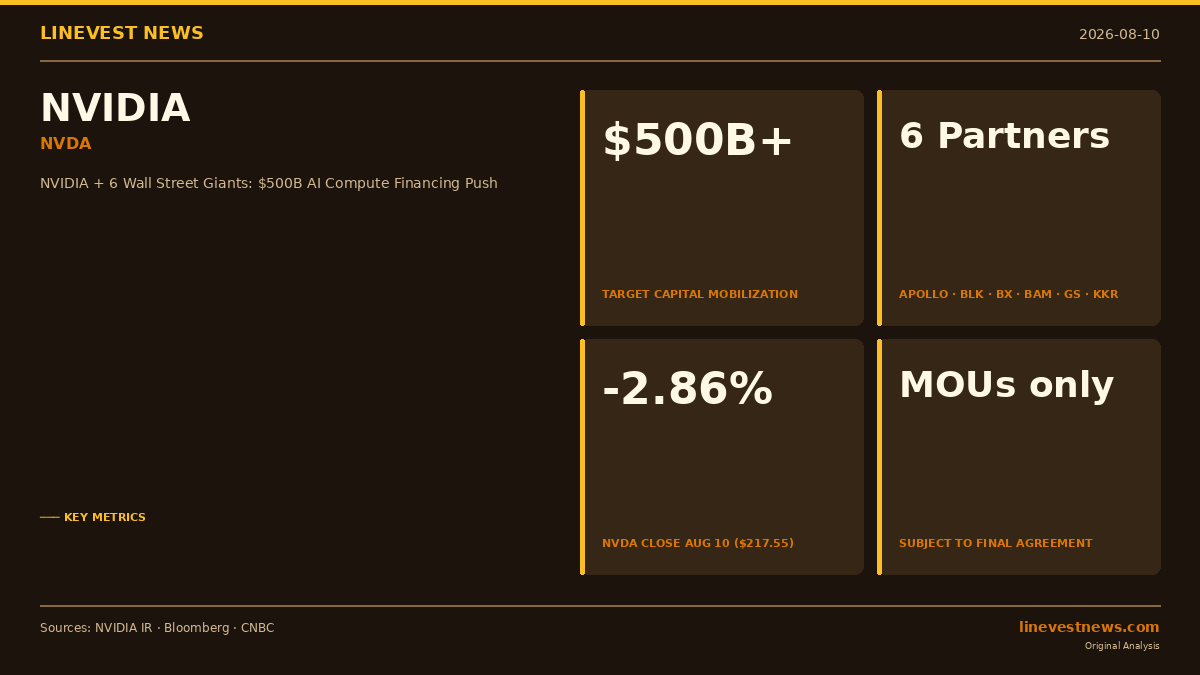
TL;DR - NVIDIA signed memorandums of understanding with six major Wall Street asset managers — Apollo, BlackRock, Blackstone, Brookfield, Goldman Sachs, and KKR — to establish independent compute financing platforms targeting more than $500 billion in third-party capital - The structure treats NVIDIA's GPU compute as infrastructure-like collateral, with financing routed through special-purpose entities issuing private offerings and bonds - NVDA stock fell 2.86% to $217.55 on August 10 despite the announcement, as investors weighed technology obsolescence risks against the bullish framing - Partnerships remain at the MOU stage, subject to final agreement execution; no individual firm commitments or deployment timelines were disclosed - NVIDIA's Q2 FY2027 earnings are scheduled for August 26, 2026
Part A: What Was Announced
On August 10, 2026, NVIDIA announced strategic partnerships with Apollo Global Management, BlackRock, Blackstone, Brookfield Asset Management, Goldman Sachs, and KKR to establish what the company described as independent compute financing platforms. The goal: mobilize over $500 billion in third-party capital for the buildout of AI data centers over time.
The announcement formalized a structure in which NVIDIA's accelerated computing hardware — primarily its GPU clusters — serves as the underlying investable asset. Special-purpose entities would issue private offerings and bonds secured against AI compute capacity, directing financing to frontier AI labs, enterprise customers, and cloud AI providers at "attractive rates."
All six arrangements were signed as memorandums of understanding. The partnerships remain subject to final agreement execution, and NVIDIA disclosed no individual commitments per firm, no financing terms, and no timeline for capital deployment.
Jensen Huang, NVIDIA's chief executive, framed the initiative in infrastructure terms: "In AI, compute is revenue. NVIDIA compute is uniquely suited for this role. It is broadly adopted, flexible across models and workloads, fungible and transferable across customers and operators, and continuously improved through CUDA software — extending its useful life and improving its economics over time."
Huang told CNBC he personally approached each of the six firms and that none declined to participate.
Partner Firm Statements
Apollo President Jim Zelter: "Modern compute has emerged as a scarce, mission-critical asset class with compelling investment characteristics that is positioned to drive significant long-term economic growth and productivity gains."
BlackRock Chairman and CEO Larry Fink: "This partnership deepens our relationship with NVIDIA, including through the AI Infrastructure Partnership, and brings together NVIDIA's leadership in accelerated computing with BlackRock's ability to connect long-term capital to essential infrastructure."
Blackstone President and COO Jon Gray: "We continue to be enormous investors globally across the NVIDIA ecosystem, and this announcement further underscores our confidence in their platform and the future of AI infrastructure."
Brookfield CEO Bruce Flatt: "With demand for large-scale AI compute growing significantly as adoption scales across industries, compute is fast becoming the essential layer of infrastructure and a core pillar of the Brookfield AI infrastructure strategy."
Goldman Sachs Chairman and CEO David Solomon: "NVIDIA's full-stack platform is in high demand and uniquely positioned at the center of that global buildout."
KKR Co-CEOs Joe Bae and Scott Nuttall: "That's why we're excited to build on our strategic partnership with NVIDIA, a founding investor in Helix Digital Infrastructure, to bring together NVIDIA's accelerated computing platform with KKR's long-duration capital, infrastructure expertise and capital markets capabilities to turn growing demand into real capacity at extraordinary scale."
Part B: What It Means for Investors
The Strategic Logic: Compute as an Asset Class
The central thesis of NVIDIA's financing initiative is that GPU clusters share enough characteristics with conventional infrastructure assets — airports, toll roads, commercial real estate — to serve as collateral for long-duration debt. NVIDIA's press release argued that its compute offers "the lowest token cost, highest revenue and longest life" among AI hardware alternatives, with CUDA software extending useful life and economic returns over time.
If the asset class framing holds, it could meaningfully expand the universe of buyers for NVIDIA hardware. Instead of requiring hyperscalers, governments, and startups to pay for GPU clusters upfront, the financing platforms would allow customers to borrow against projected compute revenue — reducing the capital threshold and potentially accelerating data center buildout at scale.
The six partners collectively represent a significant share of the global private credit, infrastructure, and alternatives market. Apollo manages approximately $670 billion in assets; Blackstone manages roughly $1 trillion; BlackRock manages more than $10 trillion. Their institutional endorsement of compute-as-collateral, even at the MOU stage, signals meaningful confidence that AI infrastructure demand is durable enough to underwrite long-duration loans.
Why the Stock Fell on Announcement Day
NVDA closed at $217.55 on August 10, down 2.86% for the session, against a 52-week range of $164.07 to $236.54. The decline, despite a headline that many viewed as bullish for demand, reflects two concerns that market participants surfaced.
First, technology obsolescence. The core vulnerability of GPU-backed financing is timing: if NVIDIA releases a new chip generation before loans mature, lenders face potential losses on aging collateral. Amazon has already moved in this direction, shortening GPU server depreciation from six years to five years effective 2025, adding roughly $1.4 billion in annual depreciation costs company-wide. That adjustment reflects the accelerating pace of AI hardware refresh cycles — the same dynamic that poses the central risk to compute-backed bonds.
Second, residual value uncertainty. Current H100 GPU rental rates of approximately $1.70 to $2.35 per hour do not guarantee strong secondhand prices when leases expire. Forbes reported that NVIDIA is prepared to provide residual-value support of up to 25% on some deals to address lender concerns, but the terms and scope of that support were not included in the official announcement.
These risks are not necessarily fatal to the financing structure. But they explain why investors priced the announcement with some skepticism rather than as straightforwardly positive.
Investor Implications
For NVIDIA shareholders, the initiative carries two distinct upside scenarios. If the financing platforms succeed in unlocking capital that would not otherwise have flowed into AI infrastructure, they expand the addressable market for NVIDIA hardware. Customer financing programs have historically served as demand multipliers in capital-intensive industries — semiconductor equipment, commercial aircraft, and data center construction all benefited from similar structures.
For investors in the participating asset managers — Apollo (NYSE: APO), BlackRock (NYSE: BLK), Blackstone (NYSE: BX), Brookfield (NYSE: BAM), Goldman Sachs (NYSE: GS), and KKR (NYSE: KKR) — the announcement signals a new revenue line in private credit and infrastructure. AI compute-backed loans and bonds would command a premium yield over conventional infrastructure debt, given the higher obsolescence risk, and could become a meaningful contributor to fee-earning assets under management as the market matures.
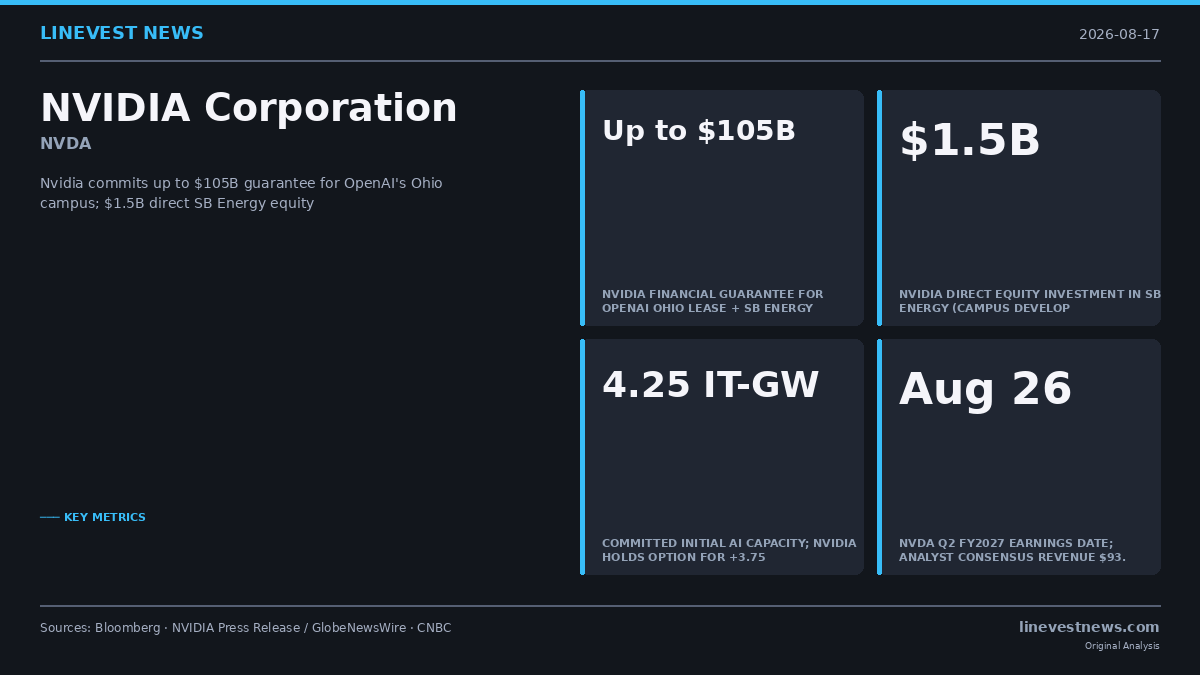
For NVIDIA, the initiative arrives about two weeks before its Q2 FY2027 earnings report, scheduled for August 26. With 61 analysts covering the stock and a Strong Buy consensus, the average 12-month price target of $302.83 implies 39.2% upside from NVDA's August 10 close. Whether the financing platform clears the MOU stage and generates measurable demand impact is likely to feature in analyst questions on that call.
The Broader Context
The $500 billion target sits within a global AI infrastructure investment environment that independent analysts widely expect to breach $1 trillion in 2026. NVIDIA has moved in recent months to extend its influence beyond chip sales: it invested up to $3 billion in Lancium, a Texas data center developer and power provider, and has established equity stakes in various AI cloud providers.
The Wall Street financing initiative represents a different lever — not direct equity investment, but the creation of a capital market infrastructure that positions NVIDIA's chips as the underlying asset in a new class of institutional debt products. If successful, it would reduce NVIDIA's dependence on any individual customer's capital spending cycle and distribute financing risk across a broad pool of institutional investors.
KKR's reference to its Helix Digital Infrastructure investment — in which NVIDIA is a founding investor — illustrates how these relationships are already layered across equity, infrastructure, and now debt markets. The announcement names six partners, but the architecture is designed to be extensible: each platform is independent, meaning additional asset managers could theoretically join as the market develops.
The primary question investors and lenders will be focused on is whether the underlying compute cash flows can be structured with sufficient certainty, term, and credit enhancement to attract the institutional capital needed to make the $500 billion target a reality — rather than a ceiling that reflects maximum theoretical ambition.
Sources: - NVIDIA IR Press Release, August 10, 2026 - NVIDIA Newsroom - Bloomberg, August 10, 2026 - CNBC, August 10, 2026 - Axios, August 10, 2026 - Forbes, August 10, 2026 - StockAnalysis.com – NVDA
This article is for informational purposes only and does not constitute investment advice. LineVest News is an independent financial news publication and is not affiliated with any brokerage.