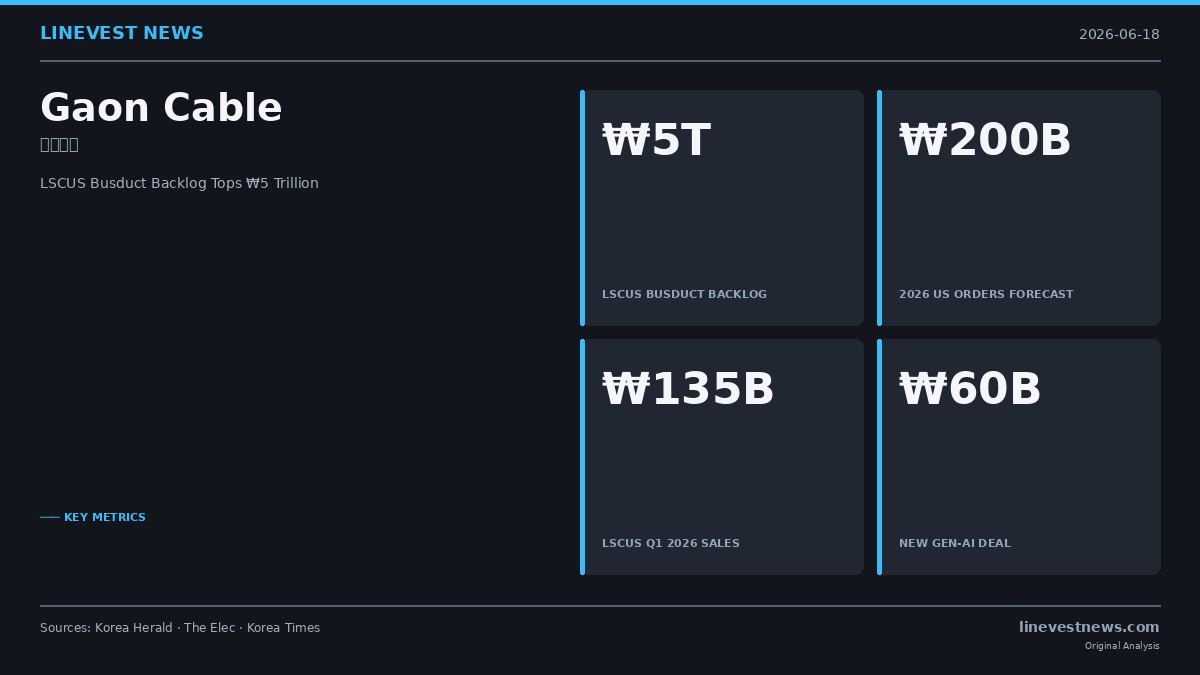
Gaon Cable (가온전선), the power-cabling arm of South Korea's LS Cable & System, has built a combined ₩5 trillion (approximately USD 3.6 billion) backlog of long-term busduct supply agreements with U.S. big-tech companies through its American subsidiary LSCUS, according to The Elec, as an unprecedented surge in AI data center construction transforms the company's North American business.
In the most recent additions to that backlog, LSCUS secured a ₩60 billion busduct supply contract with a generative AI firm operating a U.S. data center — its first order from an AI-native customer — alongside a separate ₩35 billion medium-voltage cable deal for AI data center power infrastructure, The Elec and Seoul Economic Daily reported. The two new contracts bring LSCUS's first-quarter 2026 sales to ₩135 billion, up more than 20 percent year-on-year.
For full-year 2026, Gaon Cable expects U.S.-related orders to reach ₩200 billion (approximately USD 131 million) — double the ₩100 billion recorded in 2025, the Korea Herald reported on Wednesday. The company is already supplying about ₩100 billion worth of cables annually for U.S. solar power grid projects, with AI data center hardware added as a second major revenue stream.
What busducts are and why they matter
Busducts are enclosed, modular power-distribution systems — copper or aluminum conductors sealed inside insulated metallic casings — designed to route large-scale electricity inside hyperscale facilities. A single high-density AI server cluster can demand several megawatts of power, making busducts a critical chokepoint in the AI infrastructure supply chain. Unlike commodity cables, busducts carry high switching costs and typically require long-term supply relationships, explaining the multi-year contract tenors in LSCUS's backlog.
CEO signals further portfolio shift toward high-margin products
Gaon Cable CEO Jung Hyun said "high-value products for AI data centers and renewable energy projects are increasingly contributing to our profitability," adding that the company would "continue to strengthen its portfolio with products that offer greater added value." The remark signals a deliberate move away from lower-margin commodity wire into power-distribution gear, where Korean manufacturers have built a credible niche against U.S. incumbents.
LS Group's broader AI power bet
Gaon Cable's wins fit within a wider LS Group push into U.S. AI infrastructure. Seoul Economic Daily reported in May 2026 that LS Group as a whole had secured a record ₩4 trillion in AI power-equipment orders in the United States. LSCUS's busduct business is the largest single contributor. The ₩5 trillion combined backlog represents roughly a decade's worth of Gaon Cable's historical annual revenue, providing extended earnings visibility that is rare among Korean mid-cap industrials.
Key risks
The data-center supply business is highly concentrated: Google, Meta and Amazon are understood to account for the bulk of LSCUS's busduct order book. Any slowdown in U.S. AI capital expenditure — whether from policy headwinds, macroeconomic pressures or a shift to in-house power hardware — could compress revenues. Gaon Cable has not disclosed contract-level margins on its data-center business.
Sources: Korea Herald · The Elec · Korea Times · Seoul Economic Daily