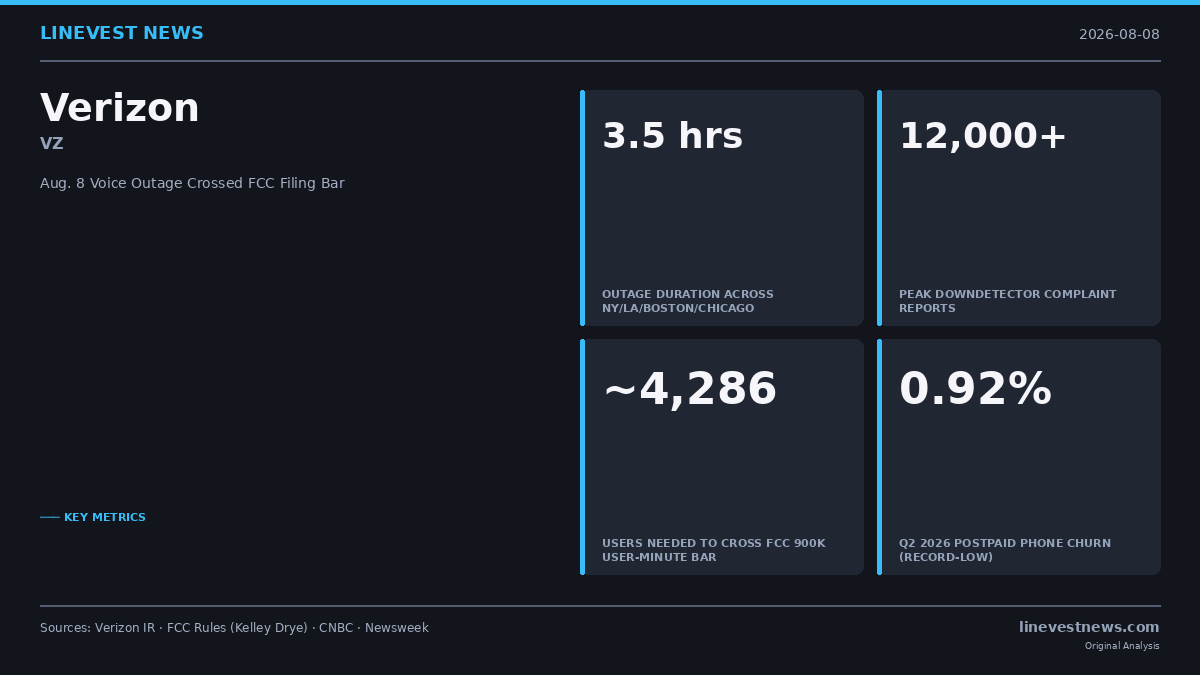
TL;DR - Verizon voice service failed across New York, Los Angeles, Boston, and Chicago for roughly 4 hours on Saturday, August 8, drawing 12,000+ Downdetector reports - At the FCC's 900,000 user-minute reporting threshold, even 30 minutes of disruption to ~30,000 users triggers a filing obligation — Saturday's event almost certainly crossed that bar - Verizon has not disclosed a root cause; no credit has been offered, unlike January's larger outage that prompted a formal FCC investigation - Third-quarter churn (reported ~late October) is the first place a retention effect from the outage could surface - Verizon Q2 2026 adjusted EBITDA was a record USD 13.7 billion; Q2 2026 postpaid phone churn 0.92%, postpaid phone net additions 184,000
Verizon (NYSE: VZ) restored voice service to wireless customers on Saturday evening after an afternoon disruption that drew more than 12,000 reports on Downdetector, the outage-tracking site that logs user-submitted complaints. The outage ran roughly 4 hours — reports were rising by 3 p.m. ET and service was confirmed restored around 7:19 p.m. ET, reaching across New York, Los Angeles, Boston, and Chicago, with effects spreading to other U.S. markets.
That scale is a fraction of the company's January failure — small enough to disappear inside a base of 147.0 million wireless retail connections, and yet still large enough that the federal outage-reporting threshold was likely crossed. Those two facts sat awkwardly together, and the weekend coverage carried only the first of them.
What actually broke
Reports began climbing during the 3 p.m. ET hour on Saturday and passed 12,000 by 4:25 p.m. ET. Verizon's statement was deliberately narrow: "We are aware of an issue impacting voice services for wireless customers in some parts of the U.S. Our engineers are engaged, and we are working quickly to identify and resolve the issue." A later update said engineers were "making progress on an issue impacting voice services." Service was confirmed restored at approximately 7:19 p.m. ET.
Two things Verizon did not say are more informative than what it did. It never named a cause. And the company advised customers still affected to restart their devices — an instruction that points at the handset, not the network, issued after engineers said the underlying problem was fixed. Verizon has not explained the gap between those two positions.
The disruption also did not stay inside Verizon's own brand. Straight Talk and Xfinity Mobile subscribers logged outages in the same window. Straight Talk is a prepaid brand of TracFone, which Verizon owns; Xfinity Mobile is Comcast's wireless service, which rides Verizon's network rather than its own towers. When Verizon's voice path stumbles, the public complaint tally therefore understates how many retail brands felt it — and understates how many wholesale partners had to answer their own customers for something they do not operate.
Why January is the only comparison that counts
On January 14, 2026, Verizon suffered a failure of an entirely different order. Downdetector reports topped 180,000 at the peak, in an outage that began in the early afternoon and ran approximately ten hours. The FCC's Public Safety and Homeland Security Bureau formally investigated, soliciting detailed accounts of service disruptions, 911 access failures, and business impacts from affected customers. Verizon attributed the event to "a software issue" and offered a USD 20 account credit to affected customers.
Saturday's event ran a fraction of that on both axes: far fewer reports, and roughly 4 hours rather than ten. The gap in Verizon's response is wider than the gap in scale, and it is the more useful signal. In January the company apologized in unusually plain language and committed to account credits. This weekend brought no apology in that register and no credit commitment. A carrier that has already demonstrated what it does after a bad outage has, by its own conduct, graded this one as something smaller.
There is an older marker too. On September 30, 2024, a Verizon outage drew more than 100,000 Downdetector reports, and the FCC said publicly that it was "working to determine the cause and extent of these service disruptions." Verizon called that failure "a technical issue" and offered no further specifics. Both of Verizon's large modern outages before Saturday ended in the same place: a regulator asking questions, and a carrier saying very little.
Why It Matters: The Threshold Nobody Quoted
The significance of Saturday is not the inconvenience of a lost afternoon. It is that the line separating a routine service blip from a federally reportable event sits far lower than the weekend's framing implied.
Under the FCC's network outage reporting rules, a wireless provider must notify the commission within 120 minutes of discovering an outage that lasts at least 30 minutes and affects at least 900,000 "user minutes" — the outage's duration multiplied by the number of potentially affected end users — as described in a client advisory from the law firm Kelley Drye & Warren summarizing the FCC requirement. Formal written reports follow on a fixed schedule after that first notification.
Run that bar against Saturday. The 900,000 user-minute figure sounds large, but because it is a product of time and people, it is cleared by modest populations once an outage runs for a while:
| Impairment Duration | Users Required to Cross 900K User-Minutes |
|---|---|
| 4 hours (240 min) | ~3,750 |
| 2 hours | ~7,500 |
| 1 hour | ~15,000 |
| 30 minutes (floor) | ~30,000 |
LineVest calculations from the FCC threshold as described by Kelley Drye & Warren.
Set those figures against a public complaint count already in five figures — and complaint counts capture only the sliver of affected users who bother to file one — and the arithmetic points one way. At roughly 4 hours of disruption across four major metro areas, Verizon would need at least approximately 3,475 potentially affected end users for Saturday's event to cross the federal filing bar — a number that becomes trivial once set against a network serving 147 million retail connections. The company's network serves 147 million retail connections.
That does not make Saturday a scandal. It makes it paperwork with a date attached. The reporting regime exists precisely so a regulator sees the failures that never generate a news cycle, and the overwhelming majority of such filings lead nowhere at all. But it does mean the accurate description of the weekend is not that some customers were inconvenienced. It is that a national carrier had a voice failure large enough to owe Washington a written explanation, and has not yet offered the public one.
Churn is the only line where this could show up
Verizon reported second-quarter results in late July. Wireless retail postpaid phone churn came in at 0.92%, postpaid phone net additions at 184,000, and adjusted EBITDA at USD 13.7 billion — the highest the company has ever reported. Management raised full-year guidance.
Churn is the transmission mechanism between a network failure and the income statement, and the metric tolerates very little movement. Monthly postpaid phone churn of 0.92% means Verizon parts with roughly one in every 109 of those customers each month. The quarter's positive net additions rested on that retention line holding. A network event of this size does not arrive as a lost quarter; it arrives as a few hundredths of a percentage point — a few basis points — of extra departures spread across the following months, in a measure where a few hundredths is the entire story.
One line from the July release is worth holding against the weekend. "We're putting customers at the center of every decision we make," CEO Dan Schulman said. Fifteen days later, Verizon customers spent a Saturday afternoon unable to place calls, were told to restart their phones, and were given no reason. Both statements belong to Verizon. Only the order is ours.
What to watch
Three specific things will settle the picture, each with a date attached:
The regulator. A final FCC written report is due within 30 days of discovery under the rules Kelley Drye describes — putting early September as the deadline by which Verizon must have characterized this failure to Washington. Whether the FCC speaks publicly, as it did after the 2024 outage, is the first tell.
A credit. January brought a USD 20 account credit for affected residential customers, redeemable through the myVerizon app. If Verizon issues credits for Saturday's event, it is grading the failure as larger than its statement implied.
Third-quarter churn. Verizon has reported third-quarter results in late October in each of the past two years. That disclosure is the first place a genuine retention effect from Saturday could surface in the numbers.
This reading can be wrong. If the FCC never comments, no credit is issued, and third-quarter churn prints at or below the second quarter's 0.92%, then Saturday was an isolated maintenance slip — not a third data point in a pattern. That outcome remains entirely available on the evidence so far. What is not available is the assumption running through most of the weekend's coverage: that an outage measured in five-figure complaint counts is too small to carry regulatory consequence. The threshold says otherwise.
Sources: - Verizon Q2 2026 Earnings Release: verizon.com - IndexBox / FOX Business (outage reports): indexbox.io - WRAL.com (service restoration time): wral.com - Newsweek (January 2026 outage / credit): newsweek.com - Kelley Drye & Warren (FCC network outage reporting rules): kelleydrye.com - Stockpil (outage details): stockpil.com - Verizon Fact Sheet (subscriber count): verizon.com - CNBC (outage coverage / restore): cnbc.com
Disclaimer: This article is journalism, not investment advice. LineVest is not a registered investment adviser. Figures are sourced to the filings, company disclosures, and reporting cited above; readers should verify against primary sources before acting on anything here.